Appreciating Others
What this chapter covers
- I can say the right thing to someone who is celebrating, sitting an examination, ill or grieving (2.1)
- I can give and explain ways to show appreciation, such as gifts, flowers, offering help and saying thank you (2.2)
- I can read an article about appreciation, find key details and work out word meanings from the text (2.3)
- I can write a short, polite thank-you message for a card or an e-card (2.4)
- I can tell abstract nouns (ideas and feelings) from concrete nouns (things I can see, hear, smell, taste or touch) and use both in sentences (2.5)
- I can recite a poem with rhyme and actions and find rhyming words (2.6)
Unit 2 is about appreciating others: saying the right words when something happens in someone's life, showing thanks in kind ways, reading about being grateful, writing thank-you messages, and learning the difference between abstract and concrete nouns.
2.1Saying the right thing (pp. 12-13)
We choose our words to match the situation. The unit gives four situations:
| Situation | What we can say |
|---|---|
| Someone is sitting for an examination | Good luck. Work hard and believe in yourself. All the best! |
| Someone is celebrating a birthday | Hope you have a wonderful birthday filled with love and fun. Happy birthday! |
| Someone is sick | Sorry to hear that you are not feeling well. Get well soon. We hope you have a speedy recovery. |
| A family member has passed away | We are sad to hear of your loss. Please accept our sincere condolences. |
English Year 6 SK, p. 12 (summary in my own words).
Practise in the book: what would you say to someone who has passed an examination with flying colours, has just had an operation, is in a storytelling competition, or has lost a beloved pet? Match the tone: cheerful for good news, gentle for sad news.
"I was absent because my brother fell and broke his arm."
"I hope he will recover soon."
Show answerHide answer
2.2Ways to show appreciation (p. 13)
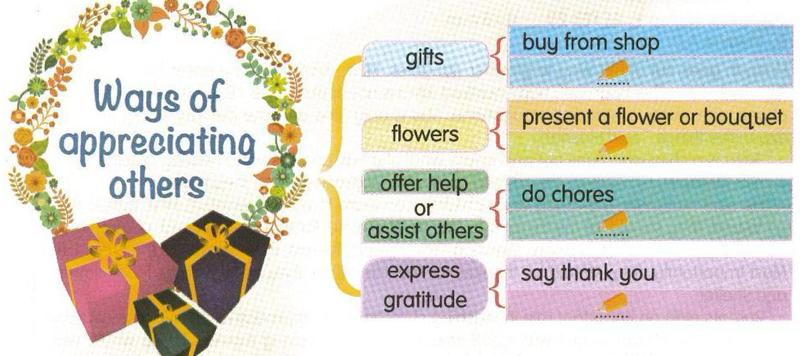
English Year 6 SK, p. 13.
- Gifts: buy something from a shop.
- Flowers: present a flower or a bouquet.
- Offer help: do chores, or assist others (for example, carry exercise books to the classroom for the teacher).
- Express gratitude: say thank you.
Show answerHide answer
2.3Reading: Be Appreciative (pp. 14-15)
The online article is about Mira, a nine-year-old who is not grateful. Her mother, Hasnah, gives her everything she never had as a child, but this has backfired (gone wrong): Mira wants a branded smartphone and only the most expensive things.
A child therapist, Dr Azwan, gives advice:
- Before bed, list the things you are most grateful for that day.
- Learn to be thankful: thank parents, friends, the postman or the bus driver.
- Be thankful for little things: food, clothes and shelter (the basic necessities).
Parents help by encouraging children to read stories with good values and watch inspiring movies.
| Word | Meaning |
|---|---|
| backfired | gone wrong (the opposite of what was hoped) |
| shelter | a roof over your head, a place to live |
| thoughtful | considerate, caring about others |
| indulge | to satisfy a particular interest, such as a hobby |
| confidence | belief in your own ability |
| attributes | qualities |
| pride | a feeling of satisfaction when you have done something well |
English Year 6 SK, pp. 14-15.
Show answerHide answer
2.4Writing: cards and e-cards (pp. 16-17)
A personalised card carries your own message, for example for Father's Day or Friendship Day. An e-card is a digital greeting card sent through email: it is quick to send, easy to create and kind to the environment.
A good thank-you message has these parts:
| Part | Example |
|---|---|
| Greeting | Dear Uncles and Aunts, |
| Say thank you and why | We would like to thank you for having us at the home yesterday. |
| Say what you enjoyed | We had a lot of fun playing games and singing songs. |
| Closing hope | We cannot wait to meet all of you again. |
English Year 6 SK, p. 17 (outline only).
Show answerHide answer
2.5Grammar: abstract and concrete nouns (pp. 18-19)
| Abstract noun | Concrete noun |
|---|---|
| pride, confidence, friendship, charity, childhood | school, music, perfume, sweets, table |
| honesty, courage, jealousy, danger, patriotism | apple, mirror, cottage, coffin |
English Year 6 SK, p. 18 (first row); second row added as extra examples.
This table is made of wood. (concrete)
Show answerHide answer
2.6Language Arts: the poem "Swinging" (p. 20)
The poem has three verses about a child on a swing, going "low and high". Lines end with rhyming words such as high / sky and go / low. Recite it with actions to feel the rhythm.