Family Ties
What this chapter covers
- I can name family members and describe a nuclear family and an extended family (3.1)
- I can read an article and a short text about family gatherings and find specific information (3.2)
- I can use a family tree to write a short description of each family member, and write simple sentences in neat handwriting (3.3)
- I can use reflexive pronouns (myself, yourself, himself, herself, itself, yourselves, ourselves, themselves) correctly, with and without by (3.4)
- I can recite a poem and talk about its meaning, and write my own poem about my family (3.5)
Welcome to Family Ties (Unit 3)! You will talk about nuclear and extended families, read about family gatherings, describe the people in a family tree, use reflexive pronouns and enjoy a poem about a messy baby sister.
3.1Listening and speaking: Types of family
Extended family: the nuclear family plus grandparents, uncles, aunts, cousins, nephews and nieces.
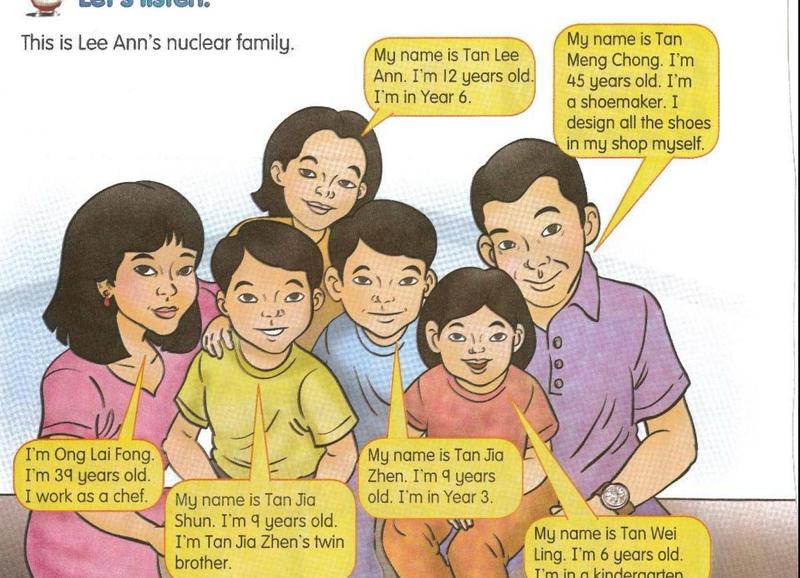
English Year 6 SK, p. 22.
| Person | Relationship |
|---|---|
| Tan Meng Chong | father of the four children, husband of Ong Lai Fong |
| Ong Lai Fong | mother, wife of Meng Chong |
| Tan Jia Shun and Tan Jia Zhen | twin brothers (both 9); Lee Ann's younger brothers |
| Tan Wei Ling | youngest child; Lee Ann's little sister |
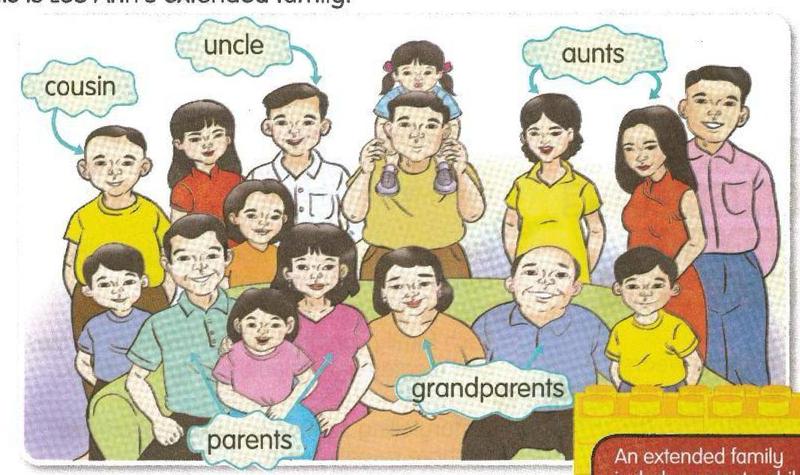
English Year 6 SK, p. 23.
Show answerHide answer
3.2Reading: Family gatherings
Magazine article: ideas for a family reunion (p. 24)
| Activity | What it is for |
|---|---|
| Family scavenger hunt | Different generations talk to each other while they answer family questions. |
| Family tree chart | A big chart where everyone writes in their own details. |
| Heritage cookbook | Every family gives a favourite recipe, making one family cookbook. |
| Memory T-shirts | Each family wears one colour with its name, so people can tell the families apart. |
| Story time | Sharing sweet memories by telling stories. |
| Photo swap | Everyone brings photos and labels them with details, then shares the stories. |
| Tour into the past | A trip to places near the family's birthplace, to share memories. |
Idith's family (p. 25)
Idith and her relatives say why an extended family is a blessing. Grandparents, aunts, uncles and cousins join the children's lives. They gather at weddings, birthday parties and funerals, and these meetings bring them closer. Cousins become best friends and share interests, hobbies and problems. A relative who lives far away is a real treat when he or she visits. Idith studies in London and keeps in touch through social media.
Show answerHide answer
3.3Writing: Family tree and sentences
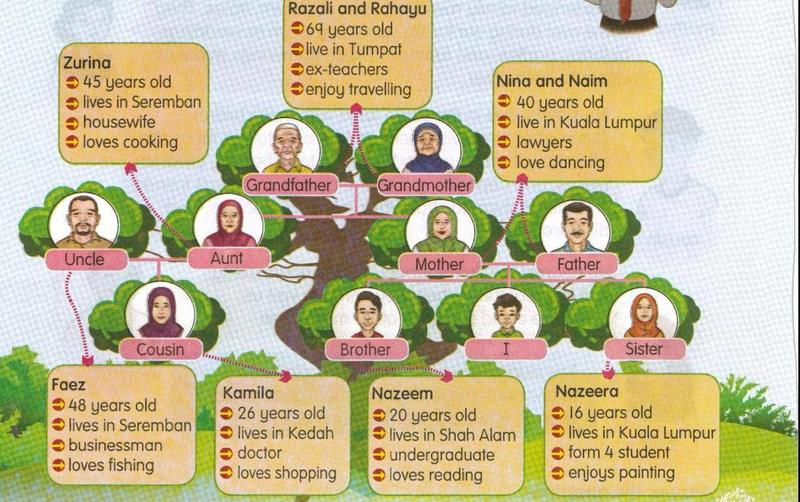
English Year 6 SK, p. 26.
| Person | Details from the tree |
|---|---|
| Razali and Rahayu (grandparents) | 69 years old, live in Tumpat, ex-teachers, enjoy travelling |
| Nina and Naim (mother and father) | 40 years old, live in Kuala Lumpur, lawyers, love dancing |
| Zurina (aunt) | 45, Seremban, housewife, loves cooking |
| Faez (uncle) | 48, Seremban, businessman, loves fishing |
| Kamila (cousin) | 26, Kedah, doctor, loves shopping |
| Nazeem (brother) | 20, Shah Alam, undergraduate, loves reading |
| Nazeera (sister) | 16, Kuala Lumpur, Form 4 student, enjoys painting |
Basic sentence patterns (p. 27)
| Pattern | Example |
|---|---|
| There is / are / was / were ... | There is a television in the room. |
| This is / was ... | This is a flower. |
| These are / were ... | These are my friends. |
| Subject + verb with -ing + object | Kamini is eating an apple. |
| Subject + verb with -ing + adverb or complement | The nephews are sleeping soundly. |
Show answerHide answer
3.4Grammar: Reflexive pronouns
| Number | Personal pronoun | Reflexive pronoun | Example |
|---|---|---|---|
| Singular | I | myself | I made the blouse myself. |
| you | yourself | Why do you blame yourself? | |
| he / she | himself / herself | He bought himself a pair of jeans. | |
| it | itself | The door closed by itself. | |
| Plural | you | yourselves | You must wash the clothes yourselves. |
| we | ourselves | We baked the cakes ourselves. | |
| they | themselves | They washed their clothes themselves. |
English Year 6 SK, p. 28.
- You can be one person or many. One person: "You painted the wall yourself." Many people: "Did you cook the food yourselves?"
- Put by before a reflexive pronoun to show you did it without help: "I cooked the curry all by myself." (p. 29)
Show answerHide answer
3.5Language arts: A poem about a baby
The poem "My sister's eating porridge" (John Coldwell, p. 30) is about a baby sister who makes a mess while she eats.
| Stanza | What it describes |
|---|---|
| 1 | Porridge goes everywhere: up her nose, down her front and in her hair. |
| 2 | She misses her mouth, and the porridge drips from the spoon like lumpy rain. |
| 3 | Most of the porridge lands on the floor, so she is still hungry and cries for more. |
Show answerHide answer
Summary
| Topic | Remember |
|---|---|
| Families | Nuclear: parents and children. Extended: also grandparents, uncles, aunts, cousins, nephews, nieces. |
| Reunion ideas | Scavenger hunt, family tree chart, heritage cookbook, memory T-shirts, story time, photo swap, tour into the past. |
| Describing people | Name, relationship, age, home, job, hobby. Use is / are and the -ing verb pattern. |
| Reflexive pronouns | myself, yourself, himself, herself, itself; yourselves, ourselves, themselves. "By + reflexive" means without help. |
| Poem | A baby sister's messy meal; simile "like lumpy porridge rain". |