Go Green
What this chapter covers
- I can say what the 3R campaign means and which recycling bin is for paper, which is for glass, and which is for aluminium and plastic (1.1.3)
- I can explain why households should separate their waste and say how my family manages rubbish (1.2.4)
- I can read a speech and a fact sheet, and answer questions on the main idea, details and meaning of words (2.2.2)
- I can write a concluding sentence that restates the topic sentence without new ideas (3.1.1, 3.2.2)
- I can write a short paragraph with a main idea, supporting details and a concluding sentence (3.1.1, 3.2.2)
- I can use the present continuous tense, positive and negative, for actions now, habits and the near future (5.1.3)
Unit 6 is about caring for Mother Earth. You will learn about recycling bins, how long rubbish takes to rot, how to end a paragraph, and the present continuous tense.
6.1Listening and speaking: the 3R campaign
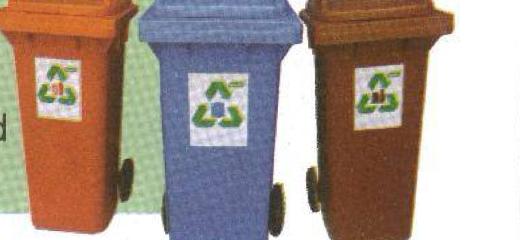
English Year 6 SK, p. 52.
| Bin | What goes in | Examples |
|---|---|---|
| Blue | paper | newspapers, magazines, cardboard boxes |
| Brown | glass | bottled drinks, perfume bottles, glasses |
| Orange | aluminium and plastic | soft drink cans, food product tins |
Where can you find recycling bins? They can be found at housing estates, schools and public places.
How many coloured recycling bins are introduced? They are three.
Separating waste (p. 53)
The news says that Malaysian households must separate their waste into categories such as plastic, paper, cardboard, glass, metal, food waste and farm waste. The reason is to reduce the amount of waste sent to landfills. A landfill is a place where rubbish is buried.
Show answerHide answer
6.2Reading: a speech to save Mother Earth
Mr Tan, adviser to the Junior Environment Club, gives a speech. His four tips (p. 54) each have a reason:
| Tip | Reason |
|---|---|
| Switch off and unplug gadgets not in use | They still use electricity if left plugged in |
| Switch to energy efficient lights (fluorescent or LED) | They last longer and use less electricity than conventional bulbs |
| Collect rain water | Use it for plants, drains and porches; it saves water and water bills |
| Avoid disposable items (plastic cups, bags, containers) | They take at least 20 years to decompose; less waste goes to landfills |
His closing words are a rhyme: "Keep the future bright, turn off the light."
Show answerHide answer
6.3Reading: decomposition fact sheet
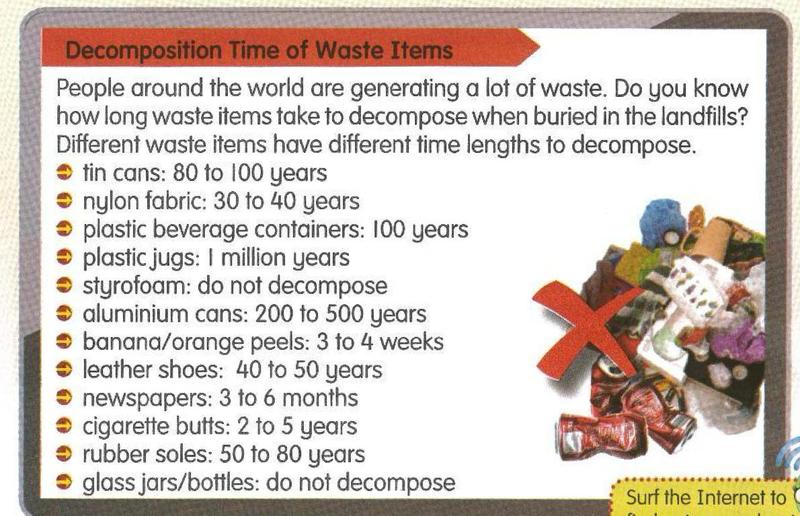
English Year 6 SK, p. 55.
| Quickest | Slow | Never |
|---|---|---|
| banana/orange peels: 3 to 4 weeks newspapers: 3 to 6 months | cigarette butts: 2 to 5 years leather shoes: 40 to 50 years plastic beverage containers: 100 years plastic jugs: 1 million years | styrofoam glass jars and bottles |
Show answerHide answer
6.4Writing: the concluding sentence
- It restates the topic sentence using different words.
- It must not bring in a new idea.
- It can start with a linking word: so, thus, therefore, hence.
Order of a paragraph: main idea, supporting details, concluding sentence. On p. 57 you also plan a paragraph from notes, for example "Ways to save trees": use scrap paper, use both sides of paper, avoid printing.
Show answerHide answer
6.5Grammar: present continuous tense
| Use | Example |
|---|---|
| Happening now | I am reading a book on the environment. |
| A habit or something over a period of time | They are studying in the university. |
| Near future | Najmee is coming home on Thursday. |
Use am with I, is with one person or thing, are with you, we, they and more than one.
Show answerHide answer
Summary
| Topic | Remember |
|---|---|
| 3R | reduce, reuse, recycle |
| Bins | blue: paper; brown: glass; orange: aluminium and plastic |
| Speech tips | unplug gadgets, energy efficient lights, collect rain water, avoid disposable items |
| Concluding sentence | last sentence, restates the main idea, no new idea; so, thus, therefore, hence |
| Present continuous | is / am / are + verb + ing; negative with not |