Bahasa Inggeris questions, unit 6
Nama / NameKelas / ClassTarikh / Date
Go Green
36 marks. Use Practice to check each answer as you go, or Exam to answer everything first. Ask a grown-up to help you mark the written answers.
Section A: objective questions
8 marksChoose the best answer for each question.
1
Question 1
What does 3R stand for?
Show answerHide answer
A
3R means reduce, reuse and recycle.
2
Question 2
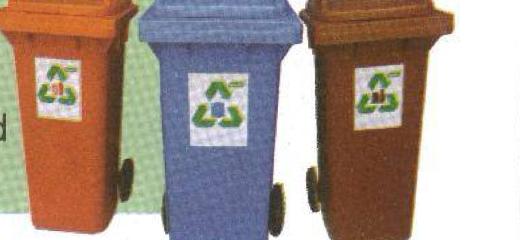
Which bin is used for newspapers and cardboard boxes?
Show answerHide answer
B
The blue bin is for paper.
3
Question 3
Where does a soft drink can go?
Show answerHide answer
D
Aluminium and plastic go into the orange bin.
4
Question 4
Why must households separate their waste?
Show answerHide answer
B
The ministry wants to reduce the amount of waste sent to landfills.
5
Question 5
According to Mr Tan, why should we unplug gadgets we are not using?
Show answerHide answer
C
Gadgets left plugged in still consume electricity.
6
Question 6
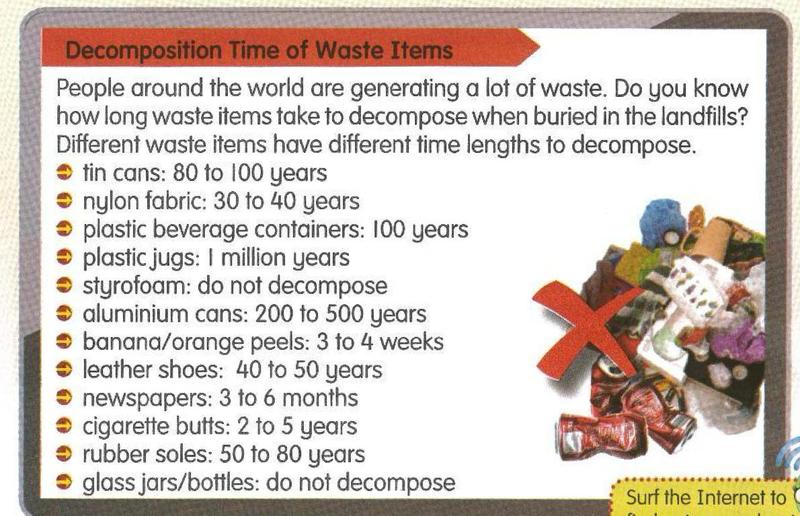
Which item takes the shortest time to decompose?
Show answerHide answer
A
A banana peel takes 3 to 4 weeks. A newspaper takes 3 to 6 months.
7
Question 7
The pupils ______ the drain now.
Show answerHide answer
C
The subject "pupils" is plural, so use are + verb-ing.
8
Question 8
Which is the best concluding sentence for a paragraph about saving water?
Show answerHide answer
B
A concluding sentence restates the main idea and brings in no new idea. Therefore signals a conclusion.
Section B: structured questions
28 marksAnswer all questions.
9
Question 9
Choose the correct bin.
[1 mark]
(a)A glass perfume bottle goes in the ______ bin.
Show answerHide answer
brown
[1 mark]
(b)A cardboard box goes in the ______ bin.
Show answerHide answer
blue
[1 mark]
(c)A food tin goes in the ______ bin.
Show answerHide answer
orange
10
Question 10
Read the extract. Then choose True or False.
Save Mother Earth
Energy efficient bulbs, such as LED lights, last for a long time and need less electricity than ordinary bulbs. Rain water that is collected can be used for watering plants and washing drains. Items such as plastic cups and bags need at least 20 years to rot in a landfill.
[1 mark]
(a)LED bulbs use more electricity than conventional bulbs.
Show answerHide answer
False
LED bulbs use less electricity.
[1 mark]
(b)Rain water can be used to water plants.
Show answerHide answer
True
[1 mark]
(c)A plastic bag decomposes in one year.
Show answerHide answer
False
It takes at least 20 years.
11
Question 11
Answer from Mr Tan's speech.
[1 mark]
(a)Who is Mr Tan?
Show answerHide answer
Tick each point you got.
[2 marks]
(b)State two ways to save our environment.
Show answerHide answer
Tick each point you got.
[1 mark]
(c)How can we reduce the waste going into landfills?
Show answerHide answer
Tick each point you got.
12
Question 12
Look at the fact sheet.
[1 mark]
(a)How long does a plastic jug take to decompose?
Show answerHide answer
Tick each point you got.
[1 mark]
(b)Name one item that does not decompose.
Show answerHide answer
Tick each point you got.
[1 mark]
(c)Which takes longer to decompose, a cigarette butt or a banana peel?
Show answerHide answer
Tick each point you got.
13
Question 13
Complete the sentences with the present continuous tense of the word in brackets.
[1 mark]
(a)Najmee ______ (sort) out the rubbish.
Show answerHide answer
Tick each point you got.
[1 mark]
(b)They ______ (work) together to clean up.
Show answerHide answer
Tick each point you got.
[1 mark]
(c)I ______ (drive) home now.
Show answerHide answer
Tick each point you got.
14
Question 14
Write the sentences in the negative using the present continuous tense, then say what is happening instead.
Example: He (wash) his car. / He (water) the plants. Answer: He is not washing his car. He is watering the plants.
Example: He (wash) his car. / He (water) the plants. Answer: He is not washing his car. He is watering the plants.
[2 marks]
(a)She (walk) to school. / She (ride) a bicycle.
Show answerHide answer
Tick each point you got.
[2 marks]
(b)They (listen) to music. / They (sing) a song.
Show answerHide answer
Tick each point you got.
15
Question 15
Rearrange the sentences into a paragraph in the correct order: main idea, supporting details, concluding sentence. Write the letters.
A. Thus, it saves our water bills and helps to conserve water.
B. It is important to collect water for reuse.
C. We can collect rain water by leaving empty buckets outside our homes.
A. Thus, it saves our water bills and helps to conserve water.
B. It is important to collect water for reuse.
C. We can collect rain water by leaving empty buckets outside our homes.
[3 marks]
(a)Order of letters:
Show answerHide answer
B, C, A
Tick each point you got.
16
Question 16
Write a paragraph about "Ways to save trees" using the notes: use scrap paper for drawing and sketching; use both sides of paper; avoid printing and read e-books instead.
[5 marks]
Show answerHide answer
We can save trees by using less paper. We can use scrap paper for drawing and sketching. We can also use both sides of paper for homework. Therefore, we should use less paper to save trees.
Tick each point you got.