Be Aware, Take Care!
What this chapter covers
- I can talk about safety measures at different places and explain why they matter (1.1.3)
- I can describe road safety features such as a speed hump, zebra crossing and traffic lights, and say what each one does (1.2.4)
- I can read a magazine article about a road safety campaign and pick out the goal, the time and the things that prevent accidents (3.2.2)
- I can read safety rules for a workshop and say whether statements are true or false (2.2.2, 2.2.3)
- I can write a short speech with a greeting, main points that are each elaborated in a paragraph, and a closing (4.2.3)
- I can plan a five-paragraph composition with an introduction, three body paragraphs and a conclusion (4.2.3)
- I can use the prepositions at, on and in correctly for time and place (5.1.5)
Unit 10 is about safety: on the road, in a workshop and when you meet strangers. You will describe safety features, read an article and a set of rules, write a speech and a composition, and use the prepositions at, on and in.
10.1Listening and speaking: road safety
In the listening text (p. 94) Encik Hakimi explains how people stay safe on the road.
- A jaywalker is a person who walks along or crosses a road illegally.
- Jaywalking often causes serious injury, and sometimes death.
- Pedestrian bridges and sky bridges let pedestrians cross a busy road safely from one side to the other. They have lights, walls and roofs that protect people.
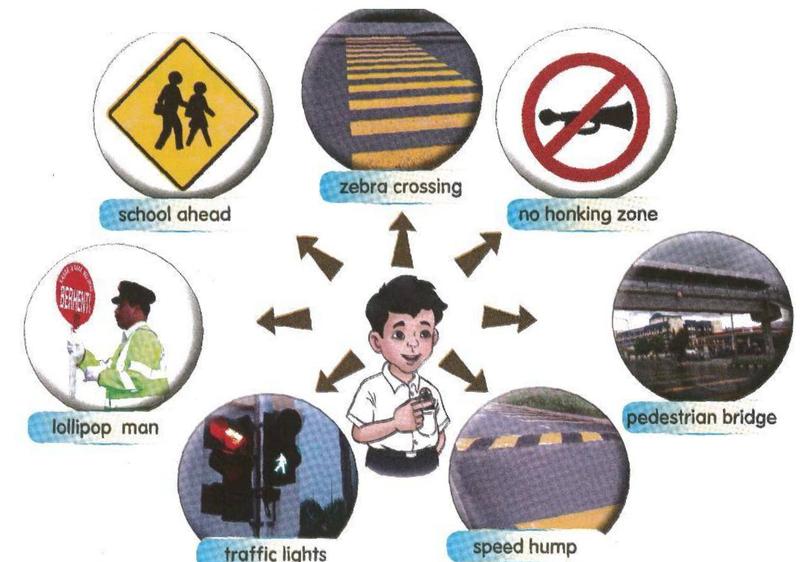
English Year 6 SK, p. 95.
| Safety feature | What it does |
|---|---|
| speed hump | found outside school areas; stops drivers going over the speed limit of 30 km per hour |
| lollipop man | holds the 'stop' sign to stop traffic so school children cross safely |
| zebra crossing | near schools; motorists give way and pedestrians cross |
| pedestrian bridge | in busy areas; people cross safely to the other side |
| traffic light | at road intersections; when the light turns red, motorists stop and pedestrians cross safely |
Show answerHide answer
10.2Reading: a road safety campaign
The magazine article on p. 96 tells about a campaign by the Safe Malaysia Team.
| Question | Answer from the article |
|---|---|
| Goal | to raise awareness among motorists to drive and ride safely |
| When | a week-long campaign, nationwide, in school holidays and festive seasons |
| What is given out | flyers with safety tips, mini hampers (with a safety kit), a free vehicle check at designated petrol stations |
| Road Safety Department | demonstrations on seat belts, helmets, speed limits and cyclists' hand signals; free reflective clothing for the first 100 attendees |
English Year 6 SK, p. 96.
Show answerHide answer
10.3Reading: workshop safety rules
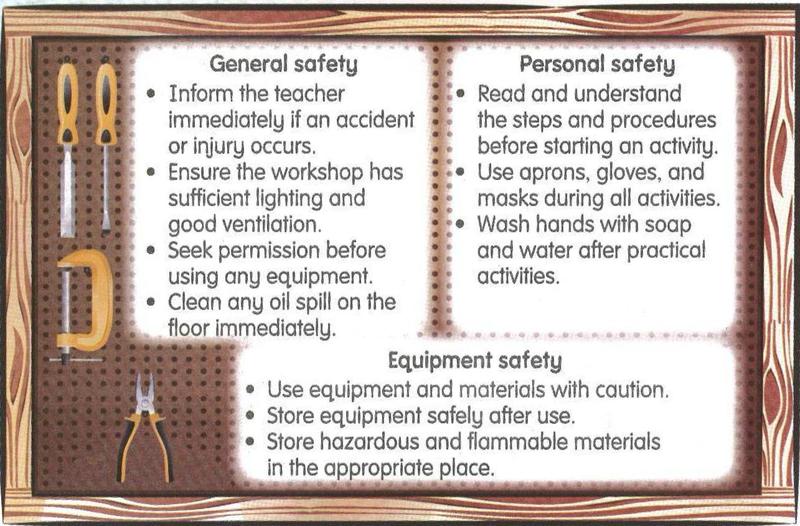
English Year 6 SK, p. 97.
| Kind of safety | Examples |
|---|---|
| General | tell the teacher at once about an accident; good light and ventilation; ask permission before using equipment; clean oil spills immediately |
| Personal | read the steps first; wear aprons, gloves and masks; wash hands with soap and water afterwards |
| Equipment | use with caution; store safely after use; keep hazardous and flammable materials in the right place |
Show answerHide answer
10.4Writing: a speech and a composition
A speech is a formal talk to an audience, for example at assembly. Najmee's model (p. 98) has these parts:
- Greeting: "Good morning to the headmaster, teachers and fellow friends."
- Introduction: your name, class and the topic.
- Main points, each elaborated in its own paragraph.
- Closing: "Thank you for listening."
A composition (p. 99) usually has five paragraphs: introduction, three body paragraphs and a conclusion. Each body paragraph has a main idea, supporting details and a concluding sentence. Write it in neat cursive.
Show answerHide answer
10.5Grammar: prepositions at, on, in
| Time | Place | |
|---|---|---|
| at | a specific time: at one o'clock, at lunch | exact location: at the bus stop, at No. 30 |
| on | a day or date: on Friday, on 10th May | a street or surface: on Jalan Tembusu, on Penang Island |
| in | a time frame or part of the day: in ten minutes, in the morning | an enclosed area: in the room, in the cupboard |
English Year 6 SK, p. 100.
One sentence may use more than one: "The train will arrive at one o'clock in the afternoon." (p. 101)
Show answerHide answer
10.6Language arts: Hansel and Gretel
On p. 102 the witch tells Gretel to start the fire so she can cook Hansel. Gretel pretends she cannot, the witch moves close to the oven, and Gretel pushes her in. She frees Hansel, and they find a room full of treasure. Think about what happens next and give a reason for each guess.
Summary
| Topic | Remember |
|---|---|
| Road safety | jaywalkers, pedestrian bridge, zebra crossing, speed hump, traffic light, lollipop man |
| Describing a feature | what it is, where it is found, what it does |
| Campaign article | goal, time, giveaways, tips: seat belt, helmet, speed limit, reflective clothing |
| Workshop rules | general, personal and equipment safety |
| Speech | greeting, introduction, elaborated points, thank you |
| Composition | 5 paragraphs: introduction, 3 body, conclusion |
| Prepositions | at (exact time, place), on (day, date, street), in (part of day, enclosed area) |