Land of Glory
What this chapter covers
- I can listen to a talk about the National Monument (Tugu Negara) and note facts such as its height, material, sculptor and what the figures stand for (1.1.2)
- I can talk about the national flag and other ways to show love for our country (1.1.3, 1.3.1)
- I can read a true story about Datuk Siti Rahmah Kassim and answer questions on who, why and my own opinion (2.2.3, 2.2.4)
- I can read the poem "Land of Glory" and give its theme, find words from meanings and add lines of my own (2.3.1, 2.2.2)
- I can write a cinquain, a five-line poem, using one noun, two adjectives, three gerunds, a short phrase and one noun (3.1.2, 3.2.2)
- I can use the articles a, an and the, and know when to use no article (5.1.7)
- I can read a story scene aloud and change my voice for each character (4.2.1, 4.3.1)
Unit 12 is about loving our country. You will learn about the National Monument, a hero who gave her gold bangle for independence, a poem about unity, how to write a cinquain, and how to use a, an, the.
12.1Listening and speaking: the National Monument
The listening text on p. 114 gives these facts about the National Monument, also called Tugu Negara.
| Fact | Answer |
|---|---|
| Name of the structure | The National Monument (Tugu Negara) |
| Height | 15 metres |
| Made of | bronze |
| Idea by | Tunku Abdul Rahman Putra Al-Haj, the first Prime Minister |
| Sculptor | Felix de Weldon |
| Number of figures | seven |
| Attended the ceremony | the Yang Di-Pertuan Agong, the Prime Minister and the head of the Armed Forces |
English Year 6 SK, p. 114.
- Why it was built: to honour the brave men who fought for the country's peace and freedom.
- The seven figures stand for leadership, suffering, unity, vigilance, strength, courage and sacrifice.
- The ceremony: held every year on Warriors' Day, 31st July, to show respect for the fallen heroes.
Show answerHide answer
12.2Showing love for our country
We can show our love and appreciation for our country by celebrating National Day every year and by flying the national flag (p. 115). The flag is called Jalur Gemilang. It has 14 stripes (equal red and white) and the colours stand for royalty (yellow), courage (red), unity (blue) and purity (white).
Show answerHide answer
12.3Reading: the unsung hero
The passage on p. 116 is a true story. In 1957, Siti Rahmah Kassim asked people at a hall in Bandar Hilir, Melaka, to give money so that Tunku Abdul Rahman could go to London.
- Purpose of the trip: to ask the British for the country's independence.
- What she did: she gave her gold bangle (a gift from her father) first, then went round the hall with it in a red shawl.
- Others: men gave rings and gold watches; women gave brooches and dress pins.
- The feeling: Tunku cried and so did the crowd, because the moment was so touching.
- Her message: young people should be taught determination and enthusiasm to serve the country.
English Year 6 SK, p. 116.
Show answerHide answer
12.4Reading: the poem "Land of Glory"
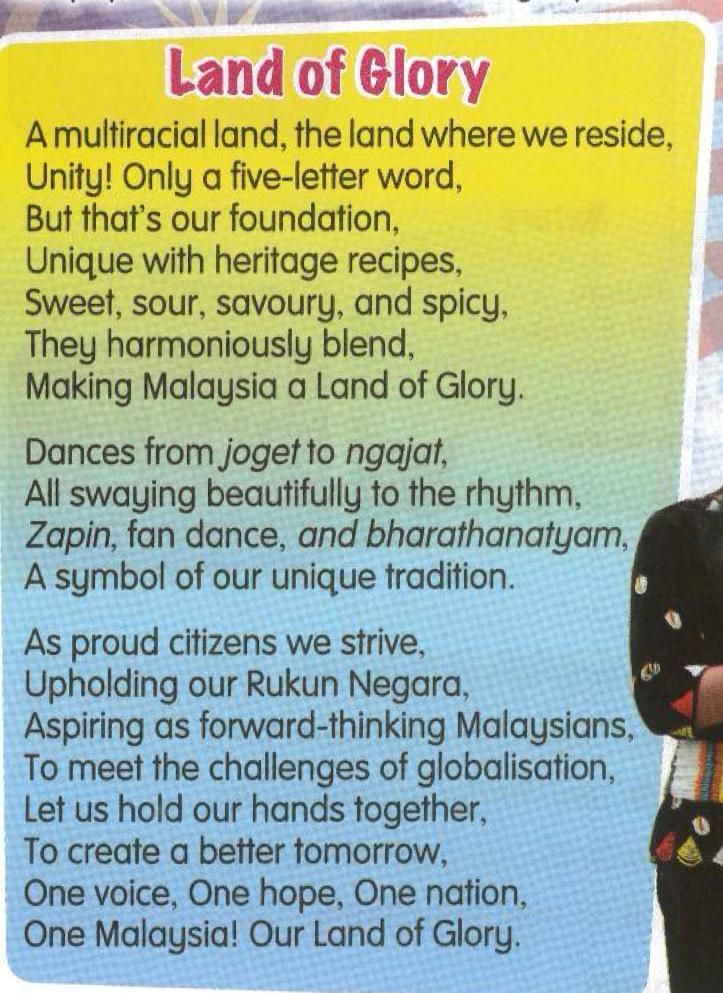
English Year 6 SK, p. 117.
| Verse | What it is about |
|---|---|
| 1 | Unity is the foundation. Food is sweet, sour, savoury and spicy, and the flavours blend well. |
| 2 | Dances: joget, ngajat, zapin, fan dance, bharathanatyam. They are a symbol of our unique tradition. |
| 3 | Proud citizens uphold the Rukun Negara, face globalisation and join hands for a better tomorrow. |
Main theme: unity among the different races in Malaysia. Word meanings: blend = mix; beautifully = elegantly; challenges = difficulties.
Show answerHide answer
12.5Writing: a cinquain
A cinquain is a five-line poem (say "sin-cane"; cinq is French for five).
| Line | Part | What to write |
|---|---|---|
| 1 | Title | one noun: the topic |
| 2 | Description | two adjectives |
| 3 | Action | three gerunds (verb + ing) |
| 4 | Feeling | four to five words |
| 5 | One noun | a word related to line 1 |
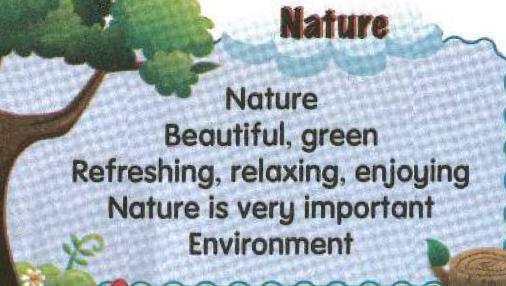
English Year 6 SK, p. 118.
Peaceful, colourful
Sharing, celebrating, smiling
We are one big family
Home
Show answerHide answer
12.6Grammar: articles a, an, the
| Article | Use | Example |
|---|---|---|
| a | singular noun starting with a consonant sound | a lawyer, a uniform (sound "yoo") |
| an | singular noun starting with a vowel sound or silent h | an aquarium, an hour |
| the | a particular thing, singular or plural | The sun is round. The boys are playing. |
| no article (zero) | things in general, countries, languages, some forms of transport | I hate cheese. She speaks Tamil. He goes by bus. |
English Year 6 SK, pp. 119-121.
Show answerHide answer
12.7Language arts: role-play
On p. 122 you read a scene from a story and role-play it by changing your voice for each character: the strange little man (nasal), Lisa (wobbly) and the King (hoarse). In the scene Lisa finds gold instead of straw, but the King wants even more.
Summary
| Topic | Remember |
|---|---|
| National Monument | 15 m, bronze, Tunku's idea, Felix de Weldon, seven figures, Warriors' Day 31st July. |
| Unsung hero | Siti Rahmah Kassim gave her gold bangle first so Tunku could go to London for independence. |
| Poem | Theme: unity. Food, dances and proud citizens building a better tomorrow. |
| Cinquain | 1 noun, 2 adjectives, 3 gerunds, 4-5 words, 1 noun. |
| Articles | a (consonant sound), an (vowel sound), the (particular), none (general, countries, languages). |