Tailor Made
What this chapter covers
- I can describe traditional and everyday attire, saying what it consists of, what it is made of and how it is worn (1.1.3, 1.3.1)
- I can read an information text about the Gawai Dayak festival and match accessories to their names (2.3.1, 2.2.2)
- I can read a story, answer questions on the details and explain what happened and why (2.3.1, 2.2.2)
- I can write an introduction with a thesis statement and a conclusion for a composition (3.2.2)
- I can spell the plural of nouns and the third person singular of verbs that end with -y (3.2.4)
- I can use adjectives, and put several adjectives in the correct order (5.1.6)
- I can give my opinion on a story and write my feelings in a diary (4.2.1)
Unit 11 is about what people wear. You will describe traditional attire, read about the Gawai Dayak festival and a story about a clever tailor, write an introduction and conclusion, learn the -y spelling rule and put adjectives in order.
11.1Listening and speaking: describing attire
Attire means clothes. The opener (p. 103) asks what we should wear to a wedding, a birthday party, a cultural show, a Hari Raya open house, a Mooncake festival and a Gawai festival. Dressing appropriately (in a way that suits the occasion) shows respect.
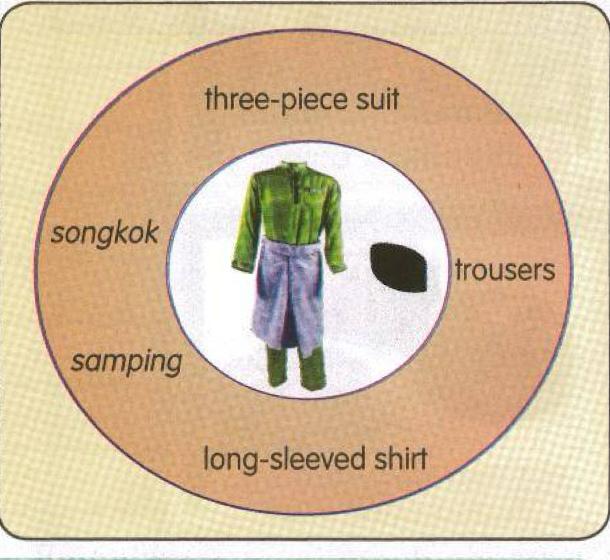
English Year 6 SK, p. 104.
| Attire | It consists of |
|---|---|
| baju melayu | a long-sleeved shirt, trousers and a samping that drapes around the waist; a songkok is worn on the head |
| lengha | a long skirt with a thick border at the bottom, a blouse with short sleeves and a dupatta (a shawl over the shoulder) |
| cheongsam | a long dress with short slits on the sides, a high collar and short sleeves |
Describing a model (p. 105)
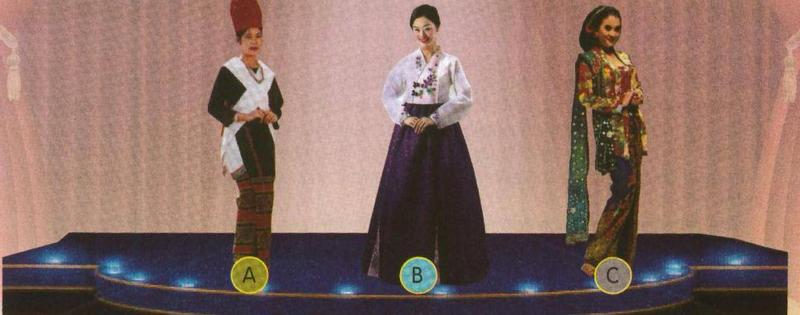
English Year 6 SK, p. 105.
| Model | Attire | Made of | Worn with |
|---|---|---|---|
| A, Myanmar | longyi | cotton or silk | fitted blouse, shawl |
| B, Korea | hanbok | silk or satin | fitted blouse, loose wrap-around skirt; an ornament, hair pin, pouch bag |
| C, Indonesia | baju kebaya | batik | sarong, embroidered blouse, selendang |
Show answerHide answer
11.2Reading: the Gawai Dayak festival
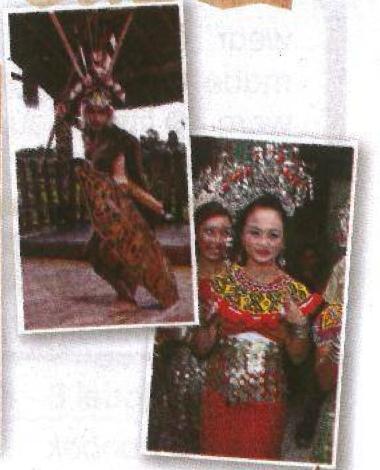
English Year 6 SK, p. 106.
Gawai Dayak is celebrated by the Dayaks in Sarawak on 1 and 2 June every year. A dance called the Ngajat is performed.
| Description | Name |
|---|---|
| male dancer's headgear (cloth with golden lace) | burang sumba |
| long loin-cloth wrapped around the body | tahup |
| female dancer's elaborate headdress | sipiah |
| knee length dress with intricate weaving | jomuh |
| copper bangles worn on the legs from the knee downward | sarim |
| copper belt | porik |
Show answerHide answer
11.3Reading: the brave tailor
Story (p. 107): A tailor sews a robe. Flies trouble him, so he kills seven with one swat and shouts, "I have killed seven in a single blow!" Two ladies overhear and think he has killed seven giants. They tell the king, who orders the tailor to kill the fearsome giant. The tailor has no choice but to obey. At the giant's cave, he is afraid, but he has a brilliant idea. While the giant sleeps, he sews the giant's lips together, so the giant cannot eat. The giant begs him to undo the stitches. The tailor agrees if the giant promises to stop killing people and leave the kingdom. The giant leaves and the king gives the tailor a handsome reward.
English Year 6 SK, p. 107.
| Question | Answer |
|---|---|
| What bothered the tailor? | flies |
| How many flies did he kill? | seven |
| What did the ladies hear? | that the tailor had killed seven giants in one blow |
| Why did the king call for him? | to make him kill the giant |
| What happened to the giant? | he left the kingdom |
Show answerHide answer
11.4Writing: introduction and conclusion
- An introduction is the first paragraph. It has a thesis statement that shows what the composition is about.
- A conclusion is the last paragraph. It may begin with in conclusion, to sum up or to conclude. It sums up the main idea or gives an opinion.
Conclusion: In conclusion, if you have never seen a ngajat dance, visit Sarawak during Gawai Dayak festival to experience its uniqueness.
The practice composition "Indian attire" has three body paragraphs: the sari, the salwar kameez and the veshti. Its introduction gives the main idea (three popular kinds of Indian attire) and its conclusion says Indian attire is unique, stylish and comfortable.
Show answerHide answer
11.5Spelling words ending with -y
| Letter before -y | Rule | Example |
|---|---|---|
| vowel (a, e, i, o, u) | just add -s | boy, boys; toy, toys; he plays |
| consonant | remove -y, add -ies | candy, candies; baby, babies; he cries |
The rule works for plural nouns and for the third person singular of verbs (he / she / it).
Show answerHide answer
11.6Grammar: adjectives and their order
An adjective describes a noun (a person, place, thing or opinion): an old man, a big cat, an honest boy. A noun can have more than one adjective, and they follow a fixed order.

English Year 6 SK, p. 110.
an expensive black leather belt (opinion, colour, material)
a big round building (size, shape)
Show answerHide answer
11.7Language arts: the miller's daughter
A poor miller says his daughter Lisa can spin straw into gold. The King takes her to his castle. If she can, she will be rewarded, and if she can't, she will be punished. The miller probably said it to boast. It is not possible to spin straw into gold, so Lisa is in trouble. For "Let's do" (p. 112), write a diary entry that begins "Dear diary, Today I ..." and say how you feel (frightened, worried, greedy).
Show answerHide answer
Summary
| Topic | Remember |
|---|---|
| Describing attire | It consists of ... ; made of ... ; worn with ... ; from (country). |
| Ngajat accessories | burang sumba (male headgear), tahup (loin-cloth), sipiah (headdress), jomuh (dress), sarim (bangles), porik (belt). |
| Introduction | First paragraph with a thesis statement. |
| Conclusion | In conclusion / To sum up / To conclude; sum up or give an opinion. |
| -y spelling | vowel + y: add -s. consonant + y: -ies. |
| Adjectives | opinion, size, quality, age, shape, colour, origin, material, noun. |