Overcoming the Odds
What this chapter covers
- I can listen to information about the Paralympic centre and give directions from a map (1.2, 2.1)
- I can read about successful people with disabilities and complete a table of facts (3.2)
- I can read a pamphlet about NGOs and say which organisation helps with which need (3.2)
- I can arrange sentences into a paragraph and write a short biography with a topic sentence and a conclusion (4.2)
- I can plan a five-paragraph composition on facilities for the disabled (4.2)
- I can use adverbs of manner (carefully, well, fast) with verbs and adjectives (5.1)
- I can discuss why a character made a promise and what might happen next (3.2, 5.1)
Unit 13 is about people who overcome the odds: disabled athletes, famous people with disabilities and the organisations that help them. You will give directions, read facts, write a short biography and a composition, and learn adverbs of manner.
13.1Listening and speaking: the Paralympic centre and directions
The Centre of Excellence for the Paralympic Games Malaysia is in Kampung Pandan, Kuala Lumpur. It trains disabled national and state athletes to reach excellence in sports internationally.
| Item | Detail |
|---|---|
| Location | Kampung Pandan, Kuala Lumpur |
| Sports facilities | swimming pool, archery range, basketball court, multipurpose court, goalball and badminton courts |
| Other facilities | administrative block, hostel for 300 athletes, underground car park |
| Open to | the public, Special Education school children and amateur paralympic athletes |
English Year 6 SK, p. 124.
Giving directions
Show answerHide answer
13.2Reading: successful people with disabilities
| Person | Nationality | Facts |
|---|---|---|
| Stevie Wonder | American | blind singer, musician and songwriter; performing since age 11; more than 30 top ten hits |
| Helen Keller | American | blind and deaf author and lecturer; first deaf and blind person to earn a college degree; wrote 12 books |
| Stephen Hawking | British | scientist, lecturer and author; has motor neuron disease; many books and scientific papers |
| Mark Inglis | New Zealander | mountaineer with two artificial legs; climbed Mount Everest in 47 days; also speaker, cyclist and author |
English Year 6 SK, p. 126.
Show answerHide answer
13.3Reading: a pamphlet on NGOs
An NGO is a non-government organisation. The pamphlet on p. 127 lists four.
| Organisation | Who it helps |
|---|---|
| National Autistic Society of Malaysia (NASOM) | people with autism: education, help, care and protection |
| Kiwanis Down Syndrome Foundation (KDSF) | young children with Down Syndrome; counselling for families; public awareness |
| Malaysian Association for the Blind (MAB) | visually impaired people: rehabilitation, courses and vocational training |
| Persatuan Dyslexia Malaysia (PDM) | dyslexic children: specialised diagnosis and treatment |
English Year 6 SK, p. 127.
Show answerHide answer
13.4Writing: a biography and a composition
Paragraph about a person (pp. 128-129)
Start with a topic sentence that says who the person is, add facts in time order, and end with a concluding sentence. Example plan for Terry Fox:
| Part | Notes |
|---|---|
| Topic sentence | Terry Fox was a Canadian who lost one leg to cancer |
| Details | 1977 lost leg; fitted with a prosthetic leg; 1980 ran across Canada to raise money for cancer research |
| Concluding sentence | He passed away in 1981 and was later voted Canada's Greatest Hero |
English Year 6 SK, pp. 128-129.
Five-paragraph composition (p. 129)
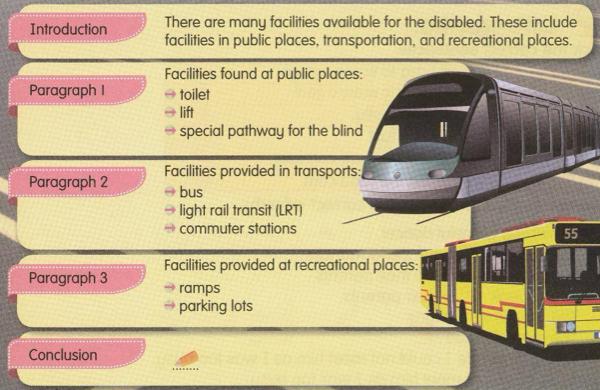
English Year 6 SK, p. 129.
Show answerHide answer
13.5Grammar: adverbs of manner
An adverb of manner tells us how an action is done. It describes a verb, or makes an adjective stronger.
| Use | Example |
|---|---|
| adverb + verb | She listens carefully. Kamini walks slowly into the room. |
| adverb + adjective | The house is very big. The weather is extremely hot. |
| no -ly ending | Come straight home. He spoke well. The boys ran fast. |
English Year 6 SK, p. 130.
Most adverbs are made by adding -ly to the adjective: graceful, gracefully; polite, politely; angry, angrily.
Show answerHide answer
The textbook also revises other kinds of adverb (p. 131).
| Type | Tells us | Examples |
|---|---|---|
| time | when | yesterday, tonight, tomorrow, now |
| place | where | outside, nearby, everywhere, back |
| frequency | how often | often, usually, sometimes, seldom, never |
| degree | how much | enough, too, very |
English Year 6 SK, p. 131.
13.6Language arts: Lisa and the strange little man
In the story on pp. 122 and 132, the King wants Lisa to spin straw into gold. A strange little man helps her, and she must promise him something in return each time. When Lisa has nothing left to give, he asks for her first born child if she becomes queen. Think about why she agreed (she was afraid and wanted to be queen) and what might happen if she broke her promise. You also design a wedding invitation card for the King and Lisa.
Summary
| Topic | Remember |
|---|---|
| Paralympic centre | Kampung Pandan; trains disabled athletes; open to the public. |
| Directions | go straight on, take the turning, next to, on your right. |
| Successful people | Stevie Wonder, Helen Keller, Stephen Hawking, Mark Inglis. |
| NGOs | NASOM, KDSF, MAB, PDM. |
| Writing | topic sentence, facts in order, concluding sentence. |
| Adverb of manner | tells how: carefully, well, fast; very and extremely modify adjectives. |