The Obedient Son
What this chapter covers
- I can listen to a folk tale dialogue, put the events in order and retell the story in my own words (1.1.3)
- I can read a story with a beginning, a middle and an ending and answer questions about its characters and events (2.2.3)
- I can guess and use phrasal verbs such as passed on, broke out, set off, look for, came across, ran into and turned down (2.3.1, 2.2.4)
- I can show causes and effects in a multiflow map (2.2.3)
- I can name the five elements of a plot (exposition, rising action, climax, falling action, resolution) and write a story in three paragraphs (3.2.2, 3.3.1)
- I can write complex sentences with who, which, whose and whom (5.2.1)
- I can write complex sentences with since, before, when, although, if, unless, because and while, and use a comma when the dependent clause comes first (5.2.1)
- I can read a scene from a story, explain how a character found out a secret name and say if I like the ending (4.2.1, 4.3.2)
Unit 15 is a folk tale about Chakri, a kind and hardworking boy who looks after his old mother. You will read the story, learn phrasal verbs, the plot structure of a story and two kinds of complex sentence.
15.1Listening and speaking: Chakri's promise
The pupils of 6 Robotics listen to part of an ASEAN folk tale. Chakri and his mother talk in four short scenes.
These events, in the correct order, are:
- Chakri's father had died.
- A war took place.
- They left the village.
- They had no money and no place to go.
- They stayed in the jungle.
- Chakri went into the jungle to find food.
Show answerHide answer
15.2Reading: The Obedient Son
A story has a beginning, a middle and an ending. Here is the story in my own words.
English Year 6 SK, pp. 146-147.
Characters and values
| Character | What he or she is like | Evidence |
|---|---|---|
| Chakri | kind, hardworking, obedient, honest, polite | He keeps his promise to his late father and refuses money he did not earn. |
| Chakri's mother | loving, unselfish | She asks him to save himself and leave her behind. |
| The gang leader | rough at first, then remorseful and admiring | He orders his men to return the loot. |
Show answerHide answer
Causes and effects (multiflow map)
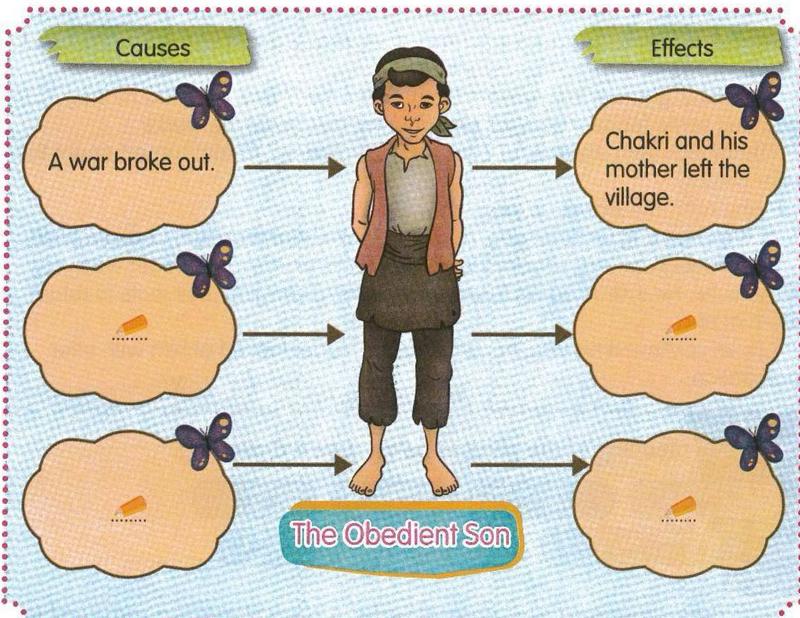
English Year 6 SK, p. 148.
| Cause | Effect |
|---|---|
| A war broke out. | Chakri and his mother left the village. |
| They had no money and nowhere to go. | They built a hut at the edge of the jungle. |
| They were hungry at lunch time. | Chakri went deep into the jungle to look for food. |
| The robbers saw how Chakri loved his mother. | They repented and gave back the loot. |
Show answerHide answer
15.3Phrasal verbs
| Phrasal verb | Meaning | Example |
|---|---|---|
| passed on | died | Chakri's father passed on many years ago. |
| broke out | started suddenly | A war broke out. |
| set off | began a journey | Chakri set off to the jungle. |
| look for | try to find | He went to look for food. |
| came across | found by chance | He came across a large tree. |
| ran into | met by chance | He ran into some robbers. |
| turned down | refused | He turned down the offer politely. |
English Year 6 SK, pp. 146-147 (the book asks you to guess the meanings; the meanings above are my own).
The book also gives carry on ("We will carry on the meeting until lunch time") and set off ("They set off for their journey last night"). More to practise: get in, turn off, jot down, dress up, stand up.
Show answerHide answer
15.4Writing: plot structure
A plot is the sequence of events in a story. It has five elements.
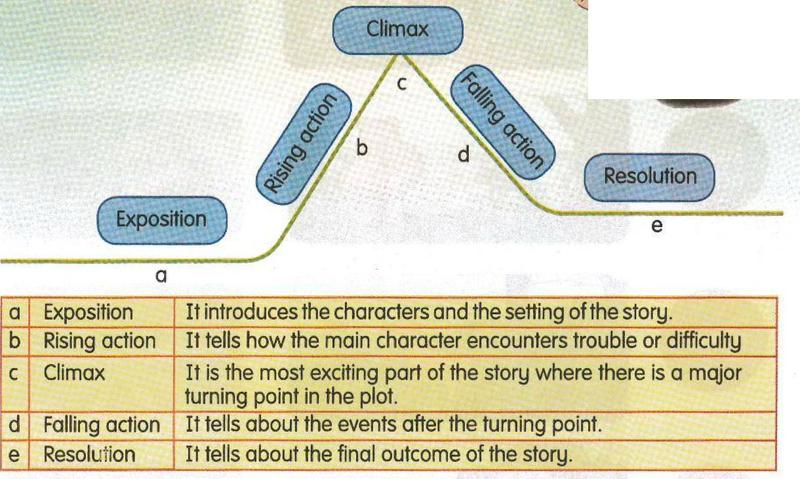
English Year 6 SK, p. 149.
| Element | What it does | In The Obedient Son |
|---|---|---|
| Exposition | introduces the characters and the setting | In a village lived the obedient Chakri and his mother. |
| Rising action | the main character meets trouble | A war broke out and they fled from the village. |
| Climax | the most exciting part, a turning point | Chakri was confronted by a group of robbers. |
| Falling action | events after the turning point | Chakri taught the robbers a lesson and they repented. |
| Resolution | the final outcome | They repented and looked up to Chakri. |
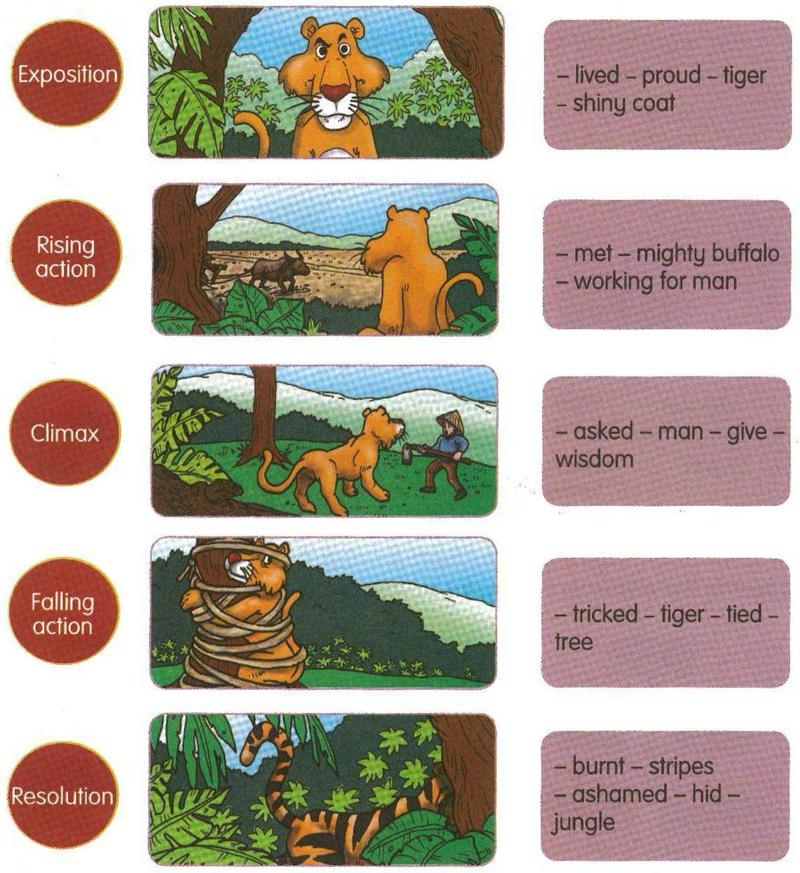
English Year 6 SK, p. 150.
Writing the story in three paragraphs: beginning (exposition and the start of the trouble), middle (rising action and climax), ending (falling action and resolution).
Show answerHide answer
15.5Grammar: complex sentences with who, which, whose, whom
| Word | Used for | Independent clause | Dependent clause |
|---|---|---|---|
| who | people (the doer) | He looked at his parents | who were dirty and dressed in rags. |
| whom | people (receiver of the action) | They hired the man | whom they interviewed last week. |
| which | things and animals | She likes the skirt | which is worn by the mannequin. |
| whose | belonging to someone | That is the boy | whose father is a famous artist. |
English Year 6 SK, p. 151 (the examples are from the book).
Show answerHide answer
15.6Grammar: subordinating conjunctions
Complex sentences are also made with since, before, when, although, if, unless, because and while.
| Order | Sentence | Comma? |
|---|---|---|
| Independent first | Asin's father took him to the cinema since it was a holiday. | no comma |
| Dependent first | Since it was a holiday, Asin's father took him to the cinema. | comma after the dependent clause |
English Year 6 SK, p. 152.
| Conjunction | Meaning | Example |
|---|---|---|
| since, because | reason | Since we had no money, we built a hut. |
| before, when, while | time | Before leaving for his hometown, Encik Hakimi checked his car. |
| although | contrast | I am going out although it is raining. |
| if, unless | condition | You should have a rest if you are tired. |
Show answerHide answer
15.7Language arts: Rumplestiltskin
In the story, a strange little man has made a promise with Queen Lisa and says that her child will be his. Her parents follow him into the woods and see him dance round a small fire, chanting his secret name. The next morning at the castle the queen guesses names. She tries Christoph and Nicholas, then says Rumplestiltskin. He cries out in rage, stamps his foot and never returns.
English Year 6 SK, p. 154. Pronunciation: Rum-ple-stil-skin.
| Question (p. 154) | Answer in short |
|---|---|
| How did Queen Lisa discover the man's name? | Her parents followed him into the woods, saw him dancing round a fire and heard his chant. She then used the name from the chant. |
| Do you like the ending? Why? | Give your opinion and a reason, for example: Yes, because the queen keeps her child. |
Show answerHide answer
Summary
| Topic | Remember |
|---|---|
| Story | Chakri keeps his promise, cares for his mother and is honest. The robbers repent. |
| Value | Be obedient, diligent and honest. |
| Phrasal verbs | passed on = died, broke out = started, set off, look for, came across, ran into, turned down = refused. |
| Plot | exposition, rising action, climax, falling action, resolution. |
| who / whom / which / whose | person doer / person receiver / thing / belonging. |
| Conjunctions | since, before, when, although, if, unless, because, while. Comma after a dependent clause at the start. |