Whole Numbers and Operations
What this chapter covers
- You can read, write and partition numbers up to 10 000 000 in numerals and in words (1.1.1)
- You can identify, complete and state number patterns that add, subtract, multiply or divide (1.1.2)
- You can say and write fractions and decimals of a million (1.1.3, 1.1.4)
- You can convert between whole numbers and fractions or decimals of a million (1.1.5)
- You can add, subtract, multiply and divide numbers up to 10 000 000, including fractions and decimals of a million (1.2.1)
- You can solve mixed operations with brackets and find an unknown number (1.2.1)
- You can identify prime numbers and composite numbers (1.3.1)
- You can solve problems with whole numbers and with fractions and decimals of a million (1.4.1)
1.1Reading and writing numbers up to 10 000 000
In Year 6 the numbers grow to millions. The population of a state, the attendance at a stadium or the number of internet users in a country can all be a million or more.
Put the digits into the place value chart, then read from the left. Say the millions, then the thousands, then the hundreds, tens and ones.
| Digit | 6 | 3 | 4 | 0 | 2 | 1 | 5 |
|---|---|---|---|---|---|---|---|
| Place value | millions | hundred thousands | ten thousands | thousands | hundreds | tens | ones |
| Digit value | 6 000 000 | 300 000 | 40 000 | 0 | 200 | 10 | 5 |
So 6 340 215 is six million three hundred and forty thousand two hundred and fifteen.
| Numeral | In words |
|---|---|
| 3 080 506 | three million eighty thousand five hundred and six |
| 7 205 040 | seven million two hundred and five thousand and forty |
| 8 000 080 | eight million and eighty |
| 10 000 000 | ten million |
Partitioning
Partition a number by digit value: 6 340 215 = 6 000 000 + 300 000 + 40 000 + 200 + 10 + 5. The 0 in the thousands place is left out.
Show answerHide answer
1.2Number patterns
A number pattern follows a rule. To find the rule, calculate the difference between two numbers that sit next to each other. Say the rule in words: "in ascending order by eight hundreds".

Step 1. Find the difference: 2 195 600 − 2 140 600 = 55 000.
Step 2. Check another pair: 2 250 600 − 2 195 600 = 55 000. The rule is + 55 000.
Step 3. x = 2 250 600 + 55 000 = 2 305 600.
Step 4. Check: 2 305 600 + 55 000 = 2 360 600. Correct.
Patterns do not always add or subtract. They can also multiply or divide.
- 5, 15, 45, 135, ... multiply by 3 each time. The next number is 135 × 3 = 405.
- 128, 64, 32, 16, ... divide by 2 each time. The next number is 16 ÷ 2 = 8.
- 1 × 1 = 1, 2 × 2 = 4, 3 × 3 = 9 ... Figure number 7 gives 7 × 7 = 49.
Show answerHide answer
1.3Fraction and decimal of a million
News reports say "2.5 million visitors" or "3¾ million tickets". These are decimals of a million and fractions of a million. To read or say them, say the number and then the word "million": 0.75 million is "zero point seven five million".

| Fraction | Decimal of a million | Whole number |
|---|---|---|
| ½ million | 0.5 million | 500 000 |
| ¼ million | 0.25 million | 250 000 |
| ¾ million | 0.75 million | 750 000 |
| ⅕ million | 0.2 million | 200 000 |
| ⅛ million | 0.125 million | 125 000 |
| 1⁄10 million | 0.1 million | 100 000 |
(b) 0.674 million = 0.674 × 1 000 000 = 674 000.
(c) 3⅗ million: ⅗ = 0.6, so it is 3.6 million = 3 600 000.
(d) 4 800 000 = 4 800 000 ÷ 1 000 000 = 4.8 million.
(e) 800 000 = 0.8 million = 8⁄10 million = ⅘ million (simplest form).
Show answerHide answer
1.4Basic operations
Add, subtract, multiply and divide in the usual way. Line up the digits by place value for adding and subtracting. When the question mixes whole numbers, decimals and fractions of a million, change everything to the same form first: all whole numbers, or all decimals of a million.
Step 1. 1⅗ million = 1.6 million. 85 000 = 0.085 million.
Step 2. 2.350 + 1.600 + 0.085 = 4.035 million = 4 035 000.
Subtract. 7.2 million − 4⅜ million
Step 1. 4⅜ = 4.375, so 4⅜ million = 4.375 million.
Step 2. 7.200 − 4.375 = 2.825 million = 2 825 000.
Multiply. 6 × 0.35 million = 2.10 million = 2 100 000.
Divide. 5½ million ÷ 4
Step 1. 5½ million = 5.5 million.
Step 2. 5.5 ÷ 4 = 1.375, so the answer is 1.375 million = 1 375 000.
Show answerHide answer
1.5Mixed operations
(b) 0.2 million + 9 × 40 = 200 000 + 360 = 200 360 (multiply first).
(c) 4.8 million ÷ 6 − 0.35 million = 0.8 million − 0.35 million = 0.45 million (divide first).
(d) (3.6 million − 1¼ million) × 4 = (3.6 − 1.25) million × 4 = 2.35 million × 4 = 9.4 million (brackets first).
Show answerHide answer
1.6Finding the unknown
When a letter stands for a missing number, use the opposite operation to undo the calculation. Undo the last step first.
| Problem | Working | Value |
|---|---|---|
| x + 0.6 million = 1.3 million | x = 1.3 million − 0.6 million | 0.7 million |
| m ÷ 5 = 0.08 million | m = 0.08 million × 5 | 0.4 million |
| (k + 0.2 million) × 3 = 1.2 million | k + 0.2 million = 1.2 million ÷ 3 = 0.4 million, so k = 0.4 million − 0.2 million | 0.2 million |
| n − 2 × 0.15 million = 0.45 million | n − 0.3 million = 0.45 million, so n = 0.45 million + 0.3 million | 0.75 million |
Show answerHide answer
1.7Prime numbers and composite numbers
A composite number can be divided exactly by 1, itself and at least one other number (4, 9, 51 ...).
1 is neither prime nor composite.
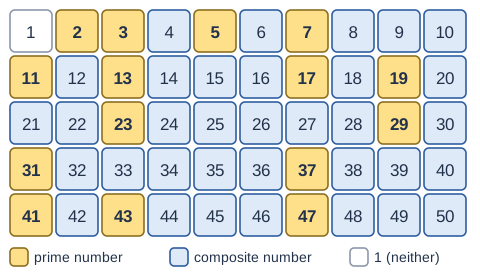
Step 2. Try 53 by 2, 3, 5 and 7. None divides it exactly. 53 can be divided only by 1 and 53. It is prime.
Show answerHide answer
1.8Solving problems
Follow four steps: understand the problem (underline what is given and what is asked), plan a strategy (draw a bar model, write a number sentence), solve, and check with the opposite operation.

Step 1. Shop B = 1 350 000 + 450 000 = 1 800 000.
Step 2. Total = 1 350 000 + 1 800 000 = 3 150 000 (3.15 million).
Step 3. Check: 3 150 000 − 1 800 000 = 1 350 000. Correct.
Number sentence: 3.12 million ÷ 60 × 3 = 3 120 000 ÷ 60 × 3 = 52 000 × 3 = 156 000 cups.