Mathematics questions, unit 1
Nama / NameKelas / ClassTarikh / Date
Whole Numbers and Operations
45 marks. Use Practice to check each answer as you go, or Exam to answer everything first.
Section A: objective questions
10 marksChoose the correct answer.
1
Question 1
Which numeral is five million sixty thousand four hundred and nine?
Show answerHide answer
B
5 millions, 0 hundred thousands, 6 ten thousands, 0 thousands, 4 hundreds, 0 tens and 9 ones = 5 060 409.
2
Question 2
What is the digit value of 3 in 8 035 214?
Show answerHide answer
D
The 3 is in the ten thousands place (8 | 0 | 3 | 5 | 2 | 1 | 4), so its digit value is 30 000.
3
Question 3
Convert 2.35 million to a whole number.
Show answerHide answer
A
2.35 × 1 000 000 = 2 350 000.
4
Question 4
Diagram 1 shows a number line. Each small step is 0.1 million. What is the value of P as a whole number?

Show answerHide answer
C
P is 6 steps after 2 million: 2 + 6 × 0.1 = 2.6 million = 2 600 000.
5
Question 5
1 250 000 + 0.75 million = ______
Show answerHide answer
B
0.75 million = 750 000. 1 250 000 + 750 000 = 2 000 000.
6
Question 6
Calculate 8 × 0.45 million. Give the answer as a whole number.
Show answerHide answer
D
8 × 0.45 = 3.6, so the answer is 3.6 million = 3 600 000.
7
Question 7
The number pattern is 4 120 500, 4 320 500, 4 520 500, 4 720 500, ... Which statement is true?
Show answerHide answer
A
4 320 500 − 4 120 500 = 200 000. The numbers get bigger, so the pattern is ascending by two hundred thousands.
8
Question 8
(9.6 million − 4 000 000) ÷ 8 = ______
Show answerHide answer
C
Brackets first: 9 600 000 − 4 000 000 = 5 600 000. Then 5 600 000 ÷ 8 = 700 000.
9
Question 9
Which of these is a prime number?
Show answerHide answer
C
51 = 3 × 17, 57 = 3 × 19 and 63 = 7 × 9 are composite. 59 can be divided only by 1 and 59.
10
Question 10
k + 3 × 0.2 million = 1.1 million. What is the value of k?
Show answerHide answer
B
Multiply first: 3 × 0.2 million = 0.6 million. k = 1.1 million − 0.6 million = 0.5 million.
Section B: structured questions
35 marksAnswer all questions. Show your working.
11
Question 11
Write the numbers.
[1 mark]
(a)Write 6 070 308 in words.
Show answerHide answer
Tick each point you got.
[1 mark]
(b)Write nine million two hundred and five thousand and forty in numerals.
Show answerHide answer
Tick each point you got.
12
Question 12
Study the number 4 906 215.
[1 mark]
(a)What is the digit value of the digit 4?
Show answerHide answer
Tick each point you got.
[1 mark]
(b)Partition the number by digit value.
Show answerHide answer
Tick each point you got.
13
Question 13
Diagram 2 shows a number pattern.

[2 marks]
(a)Fill in the two empty boxes.
Show answerHide answer
Tick each point you got.
[1 mark]
(b)State the number pattern.
Show answerHide answer
Tick each point you got.
14
Question 14
Complete each conversion.
[1 mark]
(a)0.8 million = ______ (whole number)
Show answerHide answer
Tick each point you got.
[1 mark]
(b)2¼ million = ______ (whole number)
Show answerHide answer
Tick each point you got.
[1 mark]
(c)4 500 000 = ______ (decimal of a million)
Show answerHide answer
Tick each point you got.
[1 mark]
(d)1 750 000 = ______ (fraction of a million, simplest form)
Show answerHide answer
Tick each point you got.
15
Question 15
The table shows the population of three towns.
| Town | Population |
|---|---|
| Bandar Jaya | 1 205 340 |
| Seri Muda | 0.93 million |
| Tanjung Baru | 23⁄10 million |
[2 marks]
(a)Find the total population of the three towns. Give the answer as a whole number.
Show answerHide answer
Tick each point you got.
[2 marks]
(b)How many more people live in the largest town than in the smallest town?
Show answerHide answer
Tick each point you got.
16
Question 16
Calculate.
[2 marks]
(a)5.2 million − 3 × 0.9 million. Give the answer in decimal of a million.
Show answerHide answer
Tick each point you got.
[2 marks]
(b)(1.8 million + 2⅕ million) ÷ 8. Give the answer as a whole number.
Show answerHide answer
Tick each point you got.
17
Question 17
Find the value of the unknown.
[2 marks]
(a)p − 0.35 million = 1.2 million. Give p as a whole number.
Show answerHide answer
Tick each point you got.
[2 marks]
(b)(m + 0.04 million) × 5 = 400 000
Show answerHide answer
Tick each point you got.
18
Question 18
Diagram 3 shows six number cards.

[1 mark]
(a)Write all the prime numbers on the cards.
Show answerHide answer
Tick each point you got.
[2 marks]
(b)Aina takes a composite number and Raj takes a prime number. The difference between their numbers is 14. What number does Aina take?
Show answerHide answer
Tick each point you got.
19
Question 19
Siti says: "13⁄5 million is 1 350 000, because 3⁄5 is 35."
[1 mark]
(a)Is Siti correct?
Show answerHide answer
No
⅗ is 0.6, not 0.35.
[2 marks]
(b)Explain her mistake and give the correct whole number.
Show answerHide answer
Tick each point you got.
20
Question 20
A factory made 3.6 million pencils. The pencils were packed equally into 90 boxes.
[1 mark]
(a)How many pencils are in one box?
Show answerHide answer
Tick each point you got.
[1 mark]
(b)A school bought 7 boxes. How many pencils did the school buy?
Show answerHide answer
Tick each point you got.
[1 mark]
(c)The school then received another 0.15 million pencils as a gift. How many pencils does the school have now?
Show answerHide answer
Tick each point you got.
21
Question 21
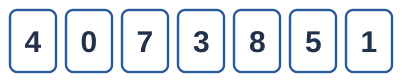
Amir has seven digit cards. He uses all seven cards to make seven-digit numbers. A number cannot start with 0.
[1 mark]
(a)What is the largest number he can make?
Show answerHide answer
Tick each point you got.
[1 mark]
(b)What is the smallest number he can make?
Show answerHide answer
Tick each point you got.
[1 mark]
(c)What is the smallest odd number he can make?
Show answerHide answer
Tick each point you got.