myUASARevision for UASA
Mathematics notes, unit 2

Fractions, Decimals and Percentages

Textbook Mathematics Year 6 SK (DLP, Semakan 2017), pages 61–102

What this chapter covers

  • You can divide proper fractions and mixed numbers by whole numbers, and by proper fractions (2.1)
  • You can multiply decimals with up to three decimal places and put the decimal point in the right place (2.2)
  • You can divide decimals by decimals by making the divisor a whole number (2.2)
  • You can convert between decimals, fractions and percentages, including percentages over 100% (2.3)
  • You can add and subtract percentages (2.3)
  • You can find the value of a percentage of a quantity and write one quantity as a percentage of another (2.3)
  • You can solve mixed operations with fractions, decimals and brackets in the correct order (2.4)
  • You can solve real-life problems with fractions, decimals and percentages (2.5)

2.1Dividing fractions

In Year 6 you divide fractions by whole numbers and by other fractions. Mixed numbers are always changed to improper fractions first, and you work from left to right.
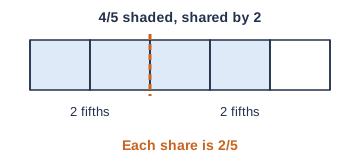
To divide by a fraction (or a whole number), multiply by its inverse. The inverse of 6 is 16. The inverse of 14 is 41, which is 4. Only the divisor (the number after ÷) is turned upside down.
A bar cut into 5 equal cells with 4 shaded and a dashed line splitting the shaded part into two groups of 2 cells
45 ÷ 2: the 4 shaded fifths are shared into 2 equal groups, so each share is 25.
Worked example: fraction ÷ whole number
Step 1. 34 ÷ 6: write 6 as 61.
Step 2. Change ÷ to × and turn the divisor over: 34 × 16.
Step 3. Cancel the 3 with the 6: 14 × 12 = 18.
Worked example: mixed number ÷ whole number
Step 1. 214 m ÷ 3. Change 214 to an improper fraction: 94.
Step 2. 94 ÷ 31 = 94 × 13 = 34.
Step 3. Each strip is 34 m.

Dividing by a fraction
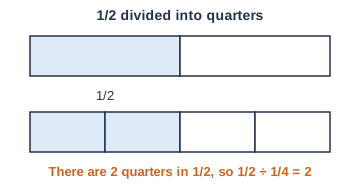
A half bar above a bar cut into four cells with two shaded; the shaded part holds 2 quarters
12 ÷ 14 asks "how many quarters fit in a half?" The answer is 2.
Worked example: mixed number ÷ fraction
How many 14 kg packs can be filled from 112 kg?
Step 1. 112 = 32.
Step 2. 32 ÷ 14 = 32 × 41.
Step 3. Cancel 2 and 4: 31 × 21 = 6 packs.
The question "how many 16 are there in 23?" means 23 ÷ 16 = 23 × 6 = 4.
Never cancel a numerator with a numerator, and never turn the first number upside down. In 34 ÷ 6, only the 6 becomes 16. Cancel only after you have changed ÷ to ×.
Calculate 56 ÷ 5 and 225 ÷ 6.
Show answerHide answer
56 × 15 = 16. 225 = 125, and 125 × 16 = 25.

2.2Multiplying and dividing decimals

Multiplication

Multiply as if there were no decimal points. Then put the decimal point so that the answer has as many decimal places as both numbers together.

Worked example: 0.3 × 0.4 and 0.6 × 0.39
Step 1. 3 × 4 = 12. 0.3 has 1 decimal place and 0.4 has 1, so the answer has 2 decimal places: 0.3 × 0.4 = 0.12.
Step 2. 6 × 39 = 234. 0.6 has 1 decimal place and 0.39 has 2, so 3 in all: 0.6 × 0.39 = 0.234.
Step 3. Check by fractions: 310 × 410 = 12100 = 0.12.
When the digits of the product are fewer than the decimal places you need, write 0s in front: 234 with 3 decimal places is 0.234, not .234 or 2.34.

Division

Make the divisor a whole number. Multiply the divisor and the dividend by the same 10, 100 or 1 000, then divide as usual.

Worked example: 2.5 ℓ ÷ 0.5 ℓ and 0.1 kg ÷ 0.002 kg
Step 1. 2.5 ÷ 0.5: multiply both by 10 to get 25 ÷ 5 = 5 bottles.
Step 2. 0.1 ÷ 0.002: 0.002 has 3 decimal places, so multiply both by 1 000 to get 100 ÷ 2 = 50 tea bags.
DivisorMultiply both numbers by
0.5, 1.910
0.15, 0.25100
0.002, 0.0121 000
Always multiply both numbers by the same number. Multiplying only the divisor changes the answer.
Calculate 4.8 × 2.5 and 6 ÷ 0.8.
Show answerHide answer
48 × 25 = 1 200, with 2 decimal places: 12.00 = 12. 60 ÷ 8 = 7.5.

2.3Percentages

A percentage is a fraction out of 100. In Year 6, percentages can be more than 100%.

Converting between decimals, fractions and percentages
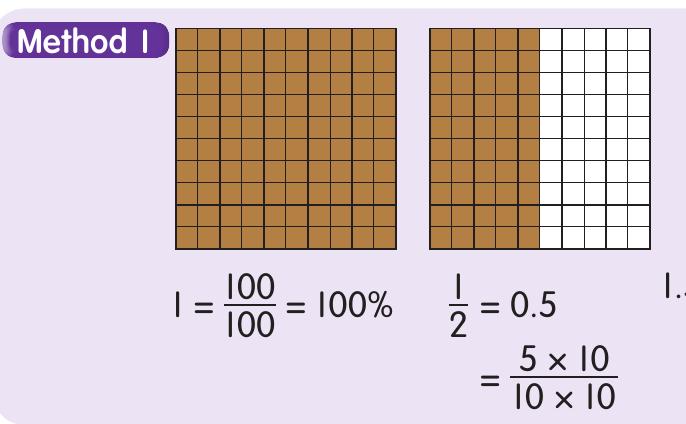
Two hundred-squares: the first completely shaded for 100%, the second half shaded for 50%, together 150%
1.5 = 1 + 0.5 = 100% + 50% = 150%.

Figure: Mathematics Year 6 (DLP) textbook, p. 73.

Decimal to percentage: × 100% (move the decimal point 2 places right).
Percentage to decimal: ÷ 100 (move the decimal point 2 places left).
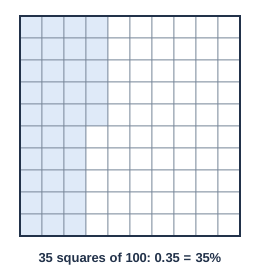
A hundred-square with 35 squares shaded
35 out of 100 squares: 0.35 = 35100 = 720 = 35%.
DecimalPercentage
1.5150%
0.3535%
1.75175%
9.1910%
910% = 910 ÷ 100 = 9.1, not 0.91. Move the point two places left every time, and always write the % sign on a percentage.

Adding and subtracting percentages

Add and subtract percentages exactly as you do whole numbers, then write % after the answer.

Worked example
Vitamin B6 is 46%, calcium is 24% and iron is 16% of a serving. Total: 46% + 24% + 16% = 86%. Difference between calcium and iron: 24% − 16% = 8%. And 67% − 18% − 9% = 40%.

Value of a quantity and comparing quantities

Worked example: percentage of a quantity
Find 90% of 2.5 m.
Step 1. 90% = 90100 = 0.9.
Step 2. 0.9 × 2.5 = 2.25 m.
And 240% of 1.8 ℓ = 2.4 × 1.8 = 4.32 ℓ.
Worked example: one quantity as a percentage of another
A jump of 1.6 m was followed by a jump of 1.68 m. The second jump as a percentage of the first:
Step 1. 1.681.6 × 100% = 168 ÷ 1.6 %.
Step 2. 1 680 ÷ 16 = 105. So it is 105% of the first jump.
Put the quantity you are comparing on top and the one you compare with at the bottom. 4.050.9 × 100% = 450%, not 4.5%.
Write 2.08 as a percentage. Find 125% of 8.4 m.
Show answerHide answer
2.08 × 100% = 208%. 125% = 1.25, and 1.25 × 8.4 = 10.5 m.

2.4Mixed operations

Follow the order. Brackets first, then × and ÷ from left to right, then + and − from left to right. Change fractions and decimals to the same form before you add or subtract.

Worked example: 1 + 34 − 0.8
Step 1. 34 = 0.75.
Step 2. 1 + 0.75 = 1.75, then 1.75 − 0.8 = 0.95 (or 1920 as a fraction).
Worked example: 16 × (5.5 + 314)
Step 1. Brackets first: 5.5 = 512, and 512 + 314 = 834.
Step 2. 16 × 834 = 16 × 354 = 4 × 35 = 140.
Worked example: 3 ÷ 1.5 + 110
Step 1. Divide first: 3 ÷ 1.5 = 30 ÷ 15 = 2.
Step 2. 2 + 110 = 2 + 0.1 = 2.1.
3 ÷ 1.5 is not 1.5 ÷ 3. The order matters in division: 3 ÷ 1.5 = 2, but 1.5 ÷ 3 = 0.5.
Calculate 9.5 + 3 × 4.2 and 4 kg − 3.15 kg + 112 kg.
Show answerHide answer
Multiply first: 3 × 4.2 = 12.6, then 9.5 + 12.6 = 22.1. 4 − 3.15 = 0.85, then 0.85 + 1.5 = 2.35 kg.

2.5Solving problems

Use four steps: understand the problem, plan a strategy (a bar diagram helps), solve, then check. Look for key words such as "more than", "times", "equal parts" and "compared to".

Worked example: containers of curd
Hana pours 145 l of curd equally into containers of 310 l each. How many containers?
Step 1. 145 = 95.
Step 2. 95 ÷ 310 = 95 × 103 = 3 × 2 = 6 containers.
Step 3. Check: 6 × 310 = 1810 = 145. Correct.
Worked example: mass compared in percentage
Class 6 Jaya collected 23.56 kg of newspapers. Class 6 Bakti collected 150% of that. 150% = 1.5, and 1.5 × 23.56 = 35.34 kg.
Look forIt usually means
equal parts, each, shareddivide
how many ... are there in ...divide by the small unit
compared to, as a percentage ofpart ÷ whole × 100%
% of a quantitychange % to a decimal, then multiply
Estimate first. If 150% of 23.56 kg were less than 23.56 kg, you would know at once that something went wrong, because 150% is more than the whole.
A wire of 334 m is cut into 5 equal parts. How long is each part? How many pieces of 18 m can be cut from one part?
Show answerHide answer
154 ÷ 5 = 34 m. Then 34 ÷ 18 = 34 × 8 = 6 pieces.