Mathematics notes, unit 4
Time
Textbook Mathematics Year 6 SK (DLP, Semakan 2017), pages 141-154
What this chapter covers
- You can explain why places in the world have different times, and name the Greenwich Meridian and GMT (4.1.1)
- You can read a time zone map and say whether a place is ahead of or behind another place (4.1.1)
- You can find the time difference between two places in hours and minutes, and in minutes (4.1.2)
- You can state the time in one place when you know the time in another place, in 12-hour and 24-hour systems (4.1.2)
- You can solve time zone problems, including those where the date changes (4.2.1)
4.1Time zones
Dr. Tan in Malaysia is chatting online with two friends. It is 8:00 p.m. in Kuala Lumpur, 5:30 p.m. in New Delhi and 10:00 p.m. in Brisbane. Why are their times different?
The Earth is round and it turns. The side that faces the Sun has daytime; the side turned away has night. So places far apart do not have the same time. The world is divided into time zones.
GMT (Greenwich Mean Time) is the local time at the Greenwich Meridian, the line (0°) that passes through Greenwich in London, England. Time zones are measured from this line, so GMT is the base for the world's 24 time zones.
- The time difference for every GMT step is 1 hour.
- Places to the east of Greenwich are ahead: their time is later (GMT +).
- Places to the west of Greenwich are behind: their time is earlier (GMT −).
- Malaysia has one time zone, GMT +8. China also uses one time zone (GMT +8), but some big countries, such as Russia, Australia and Indonesia, have two or more.
- Malaysia is GMT +8, so Malaysia is 8 hours ahead of Greenwich. Mexico City is GMT −6, so it is 6 hours behind Greenwich.
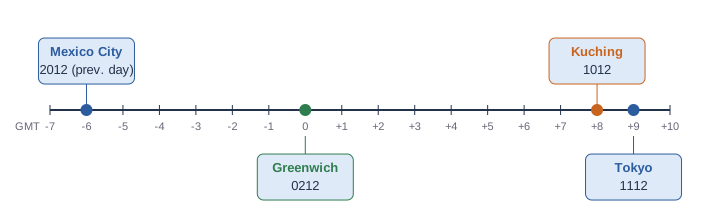
Remember: east is ahead. The Sun rises in the east first, so eastern places reach each time first. Tokyo is east of Kuching, so Tokyo is 1 hour ahead of Kuching.
Do not mix up "ahead" and "behind". A place that is ahead has a later clock time. To get its time you add. A place that is behind has an earlier time, so you subtract.
Based on the time zone map and examples in Mathematics Year 6 (KPM), pp.142-143.
Greenwich shows 1000 hours. What time is it in Kuala Lumpur (GMT +8)?
Show answerHide answer
Kuala Lumpur is 8 hours ahead, so add 8 hours: 1000 + 8 hours = 1800 hours (6:00 p.m.).
4.2Finding the time difference
The time difference is how many hours (and minutes) one place is ahead of the other.
Worked example: same day
Moscow shows 4:35 a.m. when Vladivostok shows 11:35 a.m. on the same day.Step 1. Vladivostok has the later time, so it is further east.
Step 2. Subtract the earlier time from the later time: 11:35 − 4:35 = 7:00.
Step 3. The time difference is 7 hours.
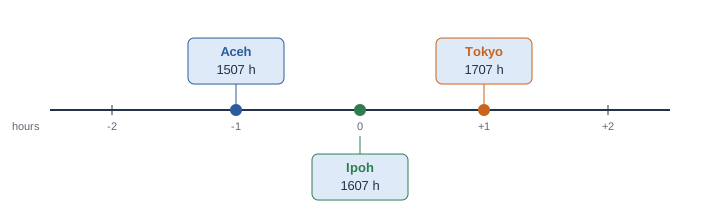
Worked example: the clocks pass midnight
Alor Setar shows 2310 hours on Thursday. Darwin shows 0040 hours on Friday.Step 1. From 2310 to 2400 is 50 minutes.
Step 2. From 0000 to 0040 is 40 minutes.
Step 3. 50 + 40 = 90 minutes = 1 hour 30 minutes. Darwin is ahead.
Converting the answer
1 hour = 60 minutes and 0.5 hour = 30 minutes. So 5 hours = 5 × 60 = 300 minutes and 1.5 hours = 1 hour 30 minutes = 90 minutes.
Worked example: difference in minutes
Malacca: 1545 hours. Amman, Jordan: 1045 hours.Step 1. 1545 − 1045 = 5 hours.
Step 2. 5 × 60 = 300 minutes.
When you subtract times, borrow 1 hour as 60 minutes, not as 100. Also check the date. If the clock of the later place reads a small number such as 0040, that place has already moved to the next day.
Sydney shows 1420 hours and Kota Kinabalu shows 1220 hours on the same date. Find the time difference in hours and in minutes.
Show answerHide answer
1420 − 1220 = 2 hours. 2 × 60 = 120 minutes.
4.3Finding the time in another place
Time in a place that is ahead = known time + time difference.
Time in a place that is behind = known time − time difference.
Time in a place that is behind = known time − time difference.
Worked example: Kuala Lumpur 10:00 p.m., Riyadh is 5 hours behind
Step 1. Change to the 24-hour system: 10:00 p.m. = 2200 hours.Step 2. Riyadh is behind, so subtract: 2200 − 5 hours = 1700 hours.
Step 3. In the 12-hour system 1700 hours = 5:00 p.m.
Worked example: the answer changes the date
London shows 11:15 p.m., 10 March. Putrajaya is 7 hours ahead.Step 1. 2315 + 7 hours = 3015 hours. That is more than 24 hours.
Step 2. 3015 − 2400 = 0615 hours, and the date moves on by 1 day.
Step 3. The time in Putrajaya is 6:15 a.m., 11 March.
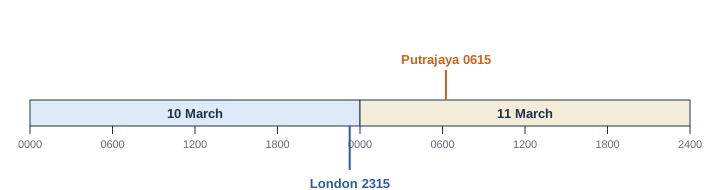
Going the other way (a place that is behind) can take you back to the previous day. If it is 0215 on Tuesday in a town that is 3 hours ahead of town X, then X is at 2315 hours on Monday.
Problems with several places
Worked example: live match at 2045 hours in Kuala Lumpur
Naypyidaw is 1.5 hours behind. Jakarta is 1 hour behind. Osaka is 1 hour ahead.Step 1. Naypyidaw: 2045 − 1 hour 30 minutes = 1915 hours.
Step 2. Jakarta: 2045 − 1 hour = 1945 hours.
Step 3. Osaka: 2045 + 1 hour = 2145 hours.
Step 4. Naypyidaw and Osaka are on opposite sides, so add the gaps: 1.5 + 1 = 2.5 hours = 2 hours 30 minutes.
Use Polya's steps: understand the problem, plan (add or subtract?), solve, check. A timeline or a clock face helps you see whether the answer should be earlier or later.
Two places on opposite sides of KL: add their gaps. Two places on the same side: subtract their gaps. The textbook also ignores daylight saving time in these questions.
The time in Arau is 11 hours ahead of Buenos Aires. What is the time in Buenos Aires when it is 1950 hours in Arau?
Show answerHide answer
Buenos Aires is behind, so subtract: 1950 − 11 hours = 0850 hours (8:50 a.m.).