Money
What this chapter covers
- You can explain cost price, selling price, profit and loss, and calculate any one of them from the other two (3.1.1, 3.1.2)
- You can calculate discount, rebate and voucher values, and the price after a discount or rebate (3.1.1, 3.1.2)
- You can read and complete an invoice, a bill and a receipt, and calculate service tax (3.1.1, 3.1.2)
- You can calculate interest on savings and dividend on an investment for one year (3.1.1, 3.1.2)
- You can tell an asset from a liability, and explain insurance and takaful (3.2.1, 3.2.2)
- {'You can solve money problems with several steps': 'understand, plan, solve and check (3.3.1)'}
3.1Cost price, selling price, profit and loss
A retailer buys goods and then sells them to customers. Two prices matter, and the difference between them decides whether the retailer gains or loses money.
Selling price: the price the buyer has to pay.
Profit: the money gained when the selling price is more than the cost price.
Loss: the money lost when the selling price is less than the cost price.
| To find | Use |
|---|---|
| Profit | Selling price − Cost price |
| Loss | Cost price − Selling price |
| Selling price (with profit) | Cost price + Profit |
| Cost price (with profit) | Selling price − Profit |
| Selling price (with loss) | Cost price − Loss |
| Cost price (with loss) | Selling price + Loss |
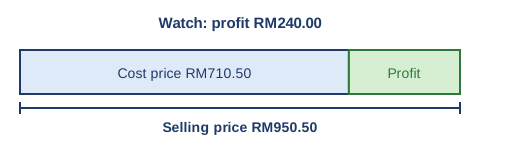
Step 2. Profit = RM10 800 − RM9 000 = RM1 800.
Step 3. A watch costs RM1 286.80 and is sold for RM1 100.50 in a clearance sale. Selling price is less, so there is a loss.
Step 4. Loss = RM1 286.80 − RM1 100.50 = RM186.30.
Show answerHide answer
3.2Discount, rebate and voucher
Rebate: a deduction from the total you must pay, or part of the money refunded after you pay. Examples are a toll fare rebate or a cash rebate on a receipt.
Voucher: a small piece of paper that gives the owner a discount, or can be exchanged for goods.
Step 2. Discount value = 20% × RM80 = 20/100 × RM80 = RM16.
Step 3. Price after discount = RM80 − RM16 = RM64.
Method 2. 100% − 10% = 90%. 90% × RM51.50 = 9/10 × RM51.50 = RM46.35.
A voucher has a value and often a condition, for example "RM10 voucher if you spend RM50 and above in one receipt, valid for 14 days". Read the condition before you use it.
Show answerHide answer
3.3Invoice, bill, receipt and service tax
| Document | What it is | Who gives it |
|---|---|---|
| Invoice | A list of goods or services with prices, sent to the buyer to ask for payment. It shows the invoice number and the sales discount. | The supplier, before payment |
| Bill | A detailed statement of the price of goods or services received, such as a restaurant, telephone or electricity bill. | The seller or service provider, before payment |
| Receipt | An official statement that payment has been received. It shows the cash given and the balance. | The seller, after payment |
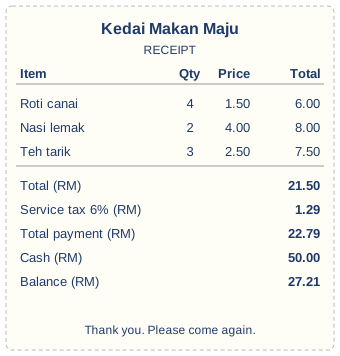
Step 2. Service tax = 6% × RM21.50 = 6/100 × RM21.50 = RM1.29.
Step 3. Total payment = RM21.50 + RM1.29 = RM22.79.
Step 4. Balance = RM50.00 − RM22.79 = RM27.21.
Show answerHide answer
3.4Interest and dividend
Dividend: a share of the profit paid to you for the money you invest in a business or shares.
Both are found with a rate "per annum" (every year):
Dividend = Dividend rate × Investment. RM3 000 at 4% per annum: 4% × RM3 000 = RM120. Total after 1 year = RM3 120.
Show answerHide answer
3.5Asset, liability, insurance and takaful
Liability: money you owe, a financial commitment such as a home loan, car loan or education loan.
Some assets, like a house, can keep or gain value. Others lose value, such as a car or a phone. We call this depreciation: a decrease in value. A person is managing money well when the assets are larger than the liabilities.
| Insurance | Takaful | |
|---|---|---|
| Concept | Buy and sell | Contribution (donation) |
| Who bears the risk | The insurance company | The participants, in a group |
| Money paid | Premium, owned by the company | Contribution, owned by the takaful fund; the operator manages it |
| Law | Government laws; not syariah compliant | Syariah laws and government laws; syariah compliant |
Insurance and takaful protect us, our family and our property if something happens, for example medical expenses, an accident, travel loss or a house destroyed by fire. "Takaful" comes from the Arabic word kafala: to guarantee, protect or look after.
Show answerHide answer
3.6Solving money problems
Use the same four steps every time: understand the problem (underline the important information), plan a strategy (a table, a bar model or a number sentence), solve, and check your answer by working backwards.
Step 1. Total = RM1 978 + RM1 150 = RM3 128.
Step 2. RM3 128 has three lots of RM1 000, so the rebate is 3 × RM50 = RM150.
Step 3. To pay = RM3 128 − RM150 = RM2 978. RM3 000 is enough.
Trial 1. 10 kg of beans (RM60) and 6 kg of chilli (RM60): total RM120.
Trial 2. 5 kg of beans (RM30) and 9 kg of chilli (RM90): total RM120.
Both work, so more than one answer is possible.
| Money words | Operation |
|---|---|
| total payment, altogether, with service tax | add |
| balance, after discount, after rebate, profit, loss | subtract |
| percent of, interest, dividend, discount value | multiply by rate / 100 |