Mathematics notes, unit 5
Measurement
Textbook Mathematics Year 6 SK (DLP, Semakan 2017), pages 155–164
What this chapter covers
- You can solve problems that mix length and mass, using proportion (5.1.1 (i))
- You can solve problems about length and volume of liquid, such as petrol used on a journey (5.1.1 (ii))
- You can solve problems about mass and volume of liquid, such as recipes (5.1.1 (iii))
- You can find the value of one unit first, then multiply or divide to find the value you need
- You can change between g and kg, mℓ and ℓ, and cm, m and km while solving a problem
- You can check an answer by working backwards or by another method
5.1Problems that mix length, mass and volume
In Year 6 you meet problems where two different measurements change together. A thicker book is heavier. A longer journey uses more petrol. More milk needs more chocolate. The two quantities stay in the same proportion, so one tool solves them all.
Proportion method: find the value for 1 unit (or an easy unit such as 10 or 100), then multiply or divide to reach the amount you need.
Use the steps below (the textbook calls this the Polya method).
- Understand the problem: what is given and what is asked?
- Plan the strategy: a table, a drawing or a number sentence.
- Solve: calculate step by step.
- Check: work backwards or use another method.
Make the units the same before you calculate. 0.96 ℓ must become 960 mℓ before you compare it with 120 mℓ.
| Change | Rule | Example |
|---|---|---|
| kg to g | × 1 000 | 1.5 kg = 1 500 g |
| ℓ to mℓ | × 1 000 | 3.6 ℓ = 3 600 mℓ |
| m to cm | × 100 | 0.6 m = 60 cm |
| km to m | × 1 000 | 2.4 km = 2 400 m |
| g to kg, mℓ to ℓ | ÷ 1 000 | 2 500 g = 2.5 kg |
5.2Length and mass
Worked example: two books
Books A and B have the same length and width. Book B is 2 cm thick and has mass 500 g. Book A is 4 cm thicker than book B. Find the mass of book A in kg.Step 1. Thickness of A = 2 cm + 4 cm = 6 cm.
Step 2. 6 cm is 3 × 2 cm, so the mass is 3 × the mass of B.
Step 3. 3 × 500 g = 1 500 g = 1.5 kg.
Check: 2 cm + 2 cm + 2 cm = 6 cm and 500 g + 500 g + 500 g = 1 500 g.
Worked example: metal rods
A 3 m rod has mass 2.664 kg. A 5 m rod of the same metal is cut from the same bar. Find its mass.1 m rod: 2.664 kg ÷ 3 = 0.888 kg.
5 m rod: 5 × 0.888 kg = 4.44 kg.
Worked example: spring scale
A 500 g weight stretches a spring by 3 cm. The most it can stretch is 6 cm. What stretch does 750 g give, and what is the heaviest weight allowed?250 g is half of 500 g, so it stretches 1.5 cm. 750 g = 500 g + 250 g, so the stretch is 3 cm + 1.5 cm = 4.5 cm.
6 cm is 2 × 3 cm, so the maximum weight is 2 × 500 g = 1 000 g = 1 kg.
Halving and doubling are the quickest steps. If 500 g gives 3 cm, then 250 g gives 1.5 cm and 1 000 g gives 6 cm.
A 1 cm thick book has mass 300 g. A pile of the same book is 7 cm thick. What is its mass in kg?
Show answerHide answer
7 × 300 g = 2 100 g = 2.1 kg.
5.3Length and volume of liquid
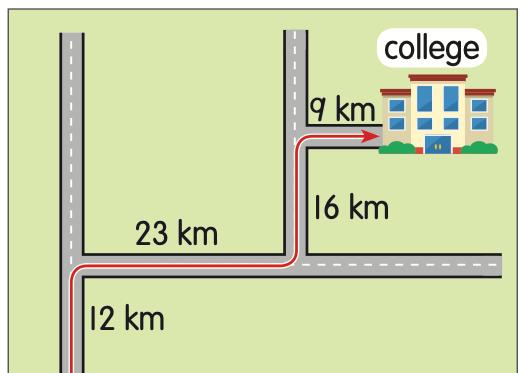
Figure: Mathematics Year 6 (DLP) textbook, p. 158.
Worked example: petrol for a round trip
A motorcycle uses 3 ℓ of petrol for every 100 km. How much petrol does it use for the round trip in the map?Step 1. One way: 12 + 23 + 16 + 9 = 60 km. Round trip: 60 × 2 = 120 km.
Step 2. 100 km uses 3 ℓ. 20 km (one fifth) uses 3 ℓ ÷ 5 = 0.6 ℓ.
Step 3. 120 km uses 3 ℓ + 0.6 ℓ = 3.6 ℓ (= 3 600 mℓ).
Check: 120 ÷ 100 × 3 = 3.6.
Worked example: level and volume
Glass Q holds juice of height 40 mm, volume 150 mℓ. Glass P has juice of height 110 mm. Find its volume.10 mm: 150 mℓ ÷ 4 = 37.5 mℓ. 110 mm = 11 × 10 mm, so 11 × 37.5 mℓ = 412.5 mℓ.
Same glass, same shape: the volume goes up in proportion to the height. This works only for a container with straight sides.
A car uses 8 ℓ for every 100 km. How much does it use for 250 km?
Show answerHide answer
50 km uses 4 ℓ. 250 km = 2 × 100 + 50, so 8 + 8 + 4 = 20 ℓ.
5.4Mass and volume of liquid
Worked example: chocolate milk
One glass uses 120 mℓ of fresh milk and 55 g of chocolate. How much chocolate is needed for 0.96 ℓ of milk?Step 1. 0.96 ℓ = 960 mℓ.
Step 2. Number of glasses: 960 ÷ 120 = 8.
Step 3. Chocolate: 8 × 55 g = 440 g.
Check: 440 g ÷ 55 g = 8 and 8 × 120 mℓ = 960 mℓ.
Worked example: fertiliser
1 kg of waste needs 150 g of black soil and 1 ℓ of water. For 2.5 kg of waste: soil = 2.5 × 150 g = 375 g; water = 2.5 × 1 ℓ = 2.5 ℓ.| Waste (kg) | Soil (g) | Water (ℓ) |
|---|---|---|
| 1 | 150 | 1 |
| 0.5 | 75 | 0.5 |
| 2.5 | 375 | 2.5 |
Worked example: butter soup
A 250 g block of butter gives 271.74 mℓ of melted butter. 5 blocks are melted and added to 2 000 mℓ of evaporated milk. Find the volume of the mixture.5 × 271.74 mℓ = 1 358.7 mℓ.
1 358.7 mℓ + 2 000 mℓ = 3 358.7 mℓ.
A table with the "for 1" row at the top shows every step and makes mistakes easy to spot.
2 ℓ of water dissolves 250 g of sugar and 20 g of jelly powder. How much jelly powder goes with 5 ℓ of water?
Show answerHide answer
1 ℓ needs 10 g, so 5 ℓ needs 50 g.