Mathematics notes, unit 6
Space
Textbook Mathematics Year 6 SK (DLP, Semakan 2017), pages 165-186
What this chapter covers
- You can draw and measure angles up to 180° with a protractor and a ruler (6.1.2)
- You can draw regular polygons with up to eight sides and measure their interior angles (6.1.1)
- You can name the centre, circumference, radius and diameter of a circle and relate the radius to the diameter (6.2.1)
- You can draw circles of a given radius with a modified ruler, a pair of pencils or a round object (6.2.2)
- You can solve problems about regular polygons and circles in daily life (6.3.1)
6.1Angles and regular polygons
Forming angles
An angle is formed when two straight lines meet at a point. In Year 6 you form angles up to 180° with a protractor and a ruler.
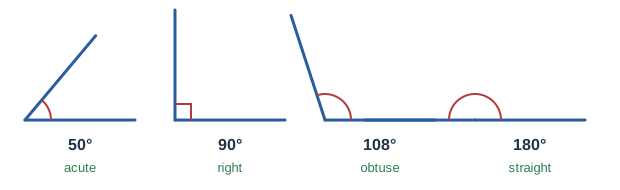
Worked example: form a 50° angle at A
Step 1. Draw a straight line and mark two points, A and B.Step 2. Place the baseline of the protractor exactly on AB and its centre exactly on A.
Step 3. Start at 0° on the scale that begins on line AB. Count up to 50°. Mark the point C.
Step 4. Remove the protractor. Join A and C with a ruler. Label the angle 50°.
A protractor has two scales. Start reading from the 0° that lies on your baseline. A 50° angle is acute, so it must look small. If your angle looks like 130°, you read the wrong scale.
Steps follow the Mathematics Year 6 (DLP) textbook, pp. 165-167.
What type of angle is 108°? Which scale of the protractor would you read to form it?
Show answerHide answer
It is an obtuse angle (more than 90°, less than 180°). Read the scale whose 0° is on the baseline.
Regular polygons
A regular polygon has all sides equal and all interior angles equal. An interior angle is an angle inside the shape at a corner.
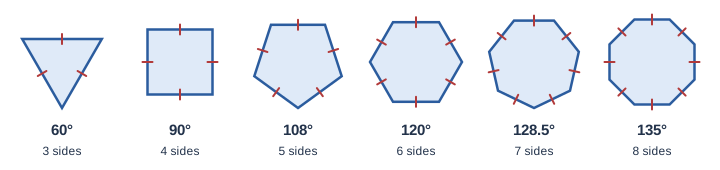
| Regular polygon | Sides | Each interior angle |
|---|---|---|
| Equilateral triangle | 3 | 60° |
| Square | 4 | 90° |
| Pentagon | 5 | 108° |
| Hexagon | 6 | 120° |
| Heptagon | 7 | about 128.5° |
| Octagon | 8 | 135° |
Ways to draw them
- Triangle grid paper: join three points the same number of units apart. Every angle is 60°.
- Ruler and protractor: draw a side, then measure the interior angle at each end (for a pentagon, 108° at A and at B) and mark the next side the same length.
- Hexagon: join six equilateral triangles at one point, or mark six points the same distance apart.
- Dotted or square grid paper: good for a square.
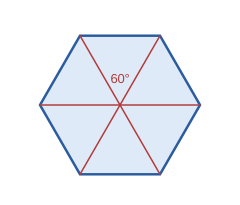
Worked example: the photo frame
Anding makes a six-sided photo frame with equal sides. The perimeter is 120 cm.Step 1. Six equal sides, so divide the perimeter by 6.
Step 2. 120 ÷ 6 = 20 cm for each side.
Perimeter of a regular polygon = number of sides × length of one side. A regular pentagon with 5 cm sides has perimeter 5 × 5 = 25 cm.
"Equal sides" is not enough. A slanted four-sided shape can have four equal sides, but its angles are not all 90°, so it is not a regular polygon.
A regular octagon has sides of 5 m. Find its perimeter and one interior angle.
Show answerHide answer
Perimeter = 8 × 5 = 40 m. Each interior angle is 135°.
6.2Circles
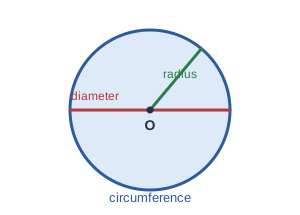
Centre: the point in the middle, usually called O.
Circumference: the curved line that forms the boundary of the circle.
Radius: a straight line from the centre to the circumference.
Diameter: a straight line between two points on the circumference that passes through the centre.
Circumference: the curved line that forms the boundary of the circle.
Radius: a straight line from the centre to the circumference.
Diameter: a straight line between two points on the circumference that passes through the centre.
All the radii of one circle are equal. The diameter is twice the radius, so radius = diameter ÷ 2.
Worked example
The diameter of a circle is 7 cm. The radius is 7 ÷ 2 = 3.5 cm. A circle with radius 4 cm has a diameter of 4 × 2 = 8 cm.Do not mix up radius and diameter. A diameter must pass through the centre. A line between two points on the circumference that misses the centre is not a diameter.
Drawing a circle
- Modified ruler: put one pencil at the 0 cm hole (the centre) and the other at the radius hole, for example 4 cm. Keep the centre still and move the other pencil round once.
- Round object: trace a cup. To find its centre, cut the circle out and fold it in four. The folds cross at the centre.
- Label the centre and draw and label one radius.
A compass is not used in this chapter. The two-pencil trick works the same way: the pencil at the centre must not move.
A circle has a diameter of 18 cm. What is its radius? What radius does a circle of diameter 9.4 cm have?
Show answerHide answer
18 ÷ 2 = 9 cm. 9.4 ÷ 2 = 4.7 cm.
6.3Solving problems
Understand the problem, plan a strategy, solve, then check. Draw a plan when the question asks for a shape in a space.
Worked example: a circle cut from a square plank
Chee Cheong has a 25 cm × 25 cm plank. He wants a circle of radius 8 cm.Step 1. Diameter = 8 × 2 = 16 cm.
Step 2. 16 cm is less than 25 cm, so the circle fits. The space left across the plank is 25 − 16 = 9 cm.
Think smart: two polygons
Charles's regular polygon has 2 times as many sides as Raymond's. With up to eight sides, the pairs are: Raymond triangle (3) and Charles hexagon (6); Raymond square (4) and Charles octagon (8).A cake is baked in a tin with a radius of 10 cm. What is the smallest square paper side that covers the base?
Show answerHide answer
Diameter = 20 cm, so the paper must be at least 20 cm × 20 cm.
Summary
- Form an angle with a protractor: baseline on the line, centre on the vertex, read from 0°. Angles go up to 180°.
- Regular polygons have equal sides and equal angles: 60°, 90°, 108°, 120°, about 128.5° and 135° for 3 to 8 sides.
- Perimeter of a regular polygon = sides × side length.
- A circle has a centre, a circumference, radii and diameters. Diameter = 2 × radius.
- Draw a circle with a modified ruler or two pencils; the centre pencil stays still.