Coordinates, Ratio and Proportion
What this chapter covers
- You can find the horizontal distance and vertical distance between two points on the Cartesian plane (7.1.1)
- {'You can use a scale, such as 1 cm represents 1 km or 1': '100 000, to find actual distances (7.1.1)'}
- You can state the ratio of two quantities and write it in the simplest form (7.2.1)
- You can convert units before finding a ratio (7.2.1)
- You can find the missing quantity when a ratio is given, using a bar model (find the value of one part first) (7.3.1)
- You can solve problems that combine coordinates, ratio and proportion (7.4.1)
7.1Distance between two coordinates
A point on the Cartesian plane is written as (x, y). The first number is how far across (horizontal) and the second is how far up (vertical) from the origin O. A scale tells us what one unit on the plane stands for in real life.
Vertical distance: the difference between the two y values.
Always take the smaller number from the larger.
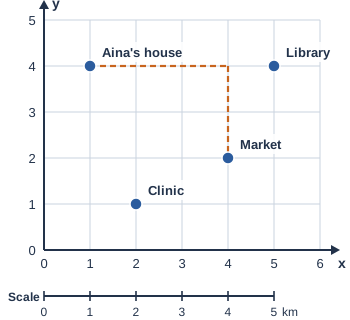
Step 1. Horizontal distance = 4 − 1 = 3 units = 3 km.
Step 2. Vertical distance = 4 − 2 = 2 units = 2 km.
So the market is 3 km horizontally and 2 km vertically from Aina's house.
Step 3. Library (5, 4) from Aina's house: horizontal 5 − 1 = 4 km, vertical 4 − 4 = 0 km. They are on the same horizontal line.
Using a scale
The scale may not be 1 unit = 1 km. Always read the scale first. Multiply the units by what one unit stands for.
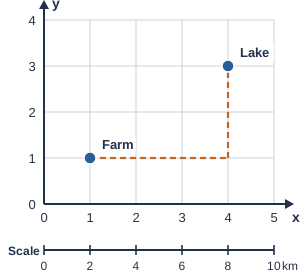
Step 2. Vertical: 3 − 1 = 2 units. 2 × 2 km = 4 km.
The lake is 6 km horizontally and 4 km vertically from the farm.
100 000 cm = 1 000 m = 1 km. So 1 cm represents 1 km.
Show answerHide answer
7.2Ratio between two quantities
To write a ratio in its simplest form, divide both numbers by the same number until no number (other than 1) divides both. This is just like simplifying a fraction. The value of the ratio does not change.
Step 1. Divide both by 2: 12 : 18 = 6 : 9.
Step 2. Divide both by 3: 6 : 9 = 2 : 3.
Shortcut: divide by 6 straight away, the biggest number that goes into both.
Same units first
Both quantities must have the same unit before you write the ratio.
| Type | Convert | Ratio |
|---|---|---|
| Mass | 1 kg = 1 000 g | 3 kg : 500 g = 3 000 : 500 = 6 : 1 |
| Length | 1 m = 100 cm | 2 m : 50 cm = 200 : 50 = 4 : 1 |
| Money | RM1 = 100 sen | 20 sen : RM1 = 20 : 100 = 1 : 5 |
| Volume | 1 ℓ = 1 000 mℓ | 600 mℓ : 2 ℓ = 600 : 2 000 = 3 : 10 |
Step 1. 4 000 g = 4 kg. Total = 2 kg + 4 kg = 6 kg.
Step 2. Chicken : total = 2 : 6 = 1 : 3.
Show answerHide answer
7.3Proportionate quantity
If you know the ratio and one of the quantities, you can find the other. Two ways: a bar model (find the value of one part) or multiply both sides of the ratio by the same number.
Method 1 (parts). 3 parts = 12 comics, so 1 part = 12 ÷ 3 = 4. Wong has 2 parts = 2 × 4 = 8 comics.
Method 2 (multiply). 3 : 2 → ×4 → 12 : 8. Wong read 8 comics.
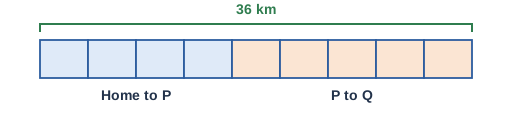
Step 2. 1 part = 36 km ÷ 9 = 4 km.
Step 3. Home to P = 4 × 4 = 16 km. P to Q = 5 × 4 = 20 km.
Check: 16 + 20 = 36 km. Yes.
Show answerHide answer
7.4Solving problems
Follow four steps: understand the problem, plan a strategy (drawing, table or bar model), solve, and check your answer.
Step 1. Boys now = 15 − 1 = 14. Girls now = 18 − 2 = 16.
Step 2. 14 : 16 = 7 : 8 (divide by 2).
Check: 7 × 2 = 14 and 8 × 2 = 16. Yes.
Horizontal: 5 − 2 = 3 km. Vertical: 5 − 4 = 1 km.
Kaswini is 3 km horizontally and 1 km vertically from Miss Norehan.