Science questions, unit 2
Nama / NameKelas / ClassTarikh / Date
Humans
44 marks. Use Practice to check each answer as you go, or Exam to answer everything first. Ask a grown-up to help you mark the written answers.
Section A: objective questions
8 marksChoose the best answer for each question.
1
Question 1
Which male reproductive organ produces sperms?
Show answerHide answer
A
The testes produce sperms. The penis only transfers them into the female parent.
2
Question 2
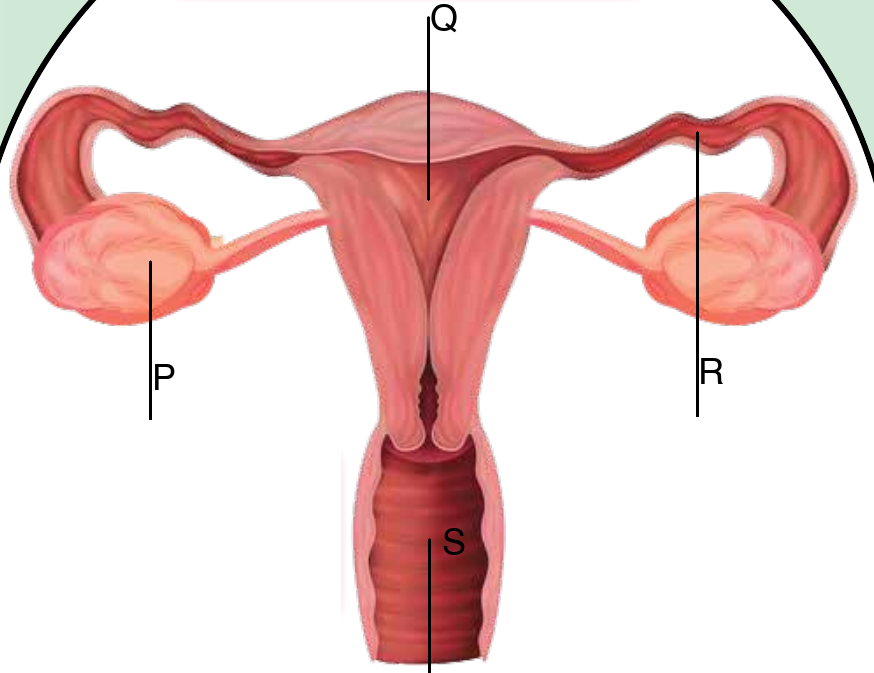
Diagram 1 shows the female reproductive organs. Which letter is the organ where the embryo develops and grows?
Show answerHide answer
B
Q is the uterus (womb). The embryo develops and grows there.
3
Question 3
In which part of the female reproductive system does fertilisation take place?
Show answerHide answer
C
A sperm fuses with an ovum in the Fallopian tube.
4
Question 4
What is formed when a sperm fuses with an ovum?
Show answerHide answer
D
The fertilised ovum is called a zygote. It later divides to form an embryo.
5
Question 5
Which parts make up the central nervous system?
Show answerHide answer
A
The central nervous system is the brain and the spinal cord. The nerves form the peripheral nervous system.
6
Question 6
Which of these is an involuntary action?
Show answerHide answer
B
The heart beats without us thinking about it. The other three are voluntary actions.
7
Question 7
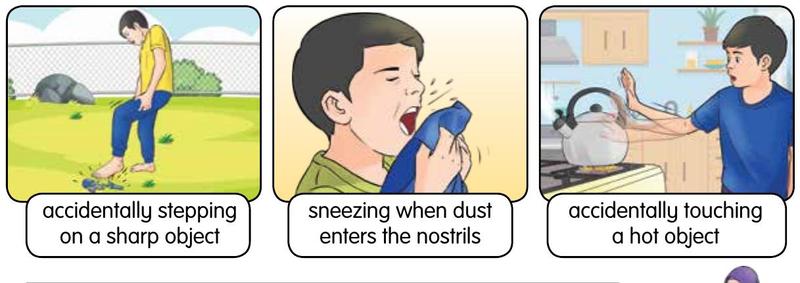
Diagram 2 shows three reflex situations. In the third picture, a boy touches a hot kettle and pulls his hand away at once. Which part of the body gives the command for this response?
Show answerHide answer
C
Pulling away is a reflex action. The spinal cord receives the signal and sends the command, so it is very quick.
8
Question 8
Why should a motorcyclist wear a helmet?
Show answerHide answer
D
The brain is part of the nervous system. A helmet protects it from injury in an accident.
Section B: structured questions
36 marksAnswer all questions. Circle the answer or write it in the space.
9
Question 9
Diagram 3 shows the female reproductive organs. Name the organs and state what they do.
[1 mark]
(a)Name organ P.
Show answerHide answer
Ovary
[1 mark]
(b)State the function of P.
Show answerHide answer
Tick each point you got.
[2 marks]
(c)A woman has both of her P removed because of a health problem. Can she become pregnant naturally? Explain.
Show answerHide answer
Tick each point you got.
10
Question 10
The statements below describe what happens from fertilisation to birth. Number them 1 to 5 in the correct order.
[1 mark]
(a)The embryo develops into a foetus in the uterus.
Show answerHide answer
4
[1 mark]
(b)The sperms swim towards the ovum.
Show answerHide answer
2
[1 mark]
(c)The mother gives birth to a baby.
Show answerHide answer
5
[1 mark]
(d)The penis transfers sperms into the vagina.
Show answerHide answer
1
[1 mark]
(e)The zygote divides to form an embryo.
Show answerHide answer
3
[1 mark]
(f)About how many months does the foetus stay in the uterus?
Show answerHide answer
Tick each point you got.
11
Question 11
Aini says that a baby gets its food and oxygen through its mouth and nose before it is born.
[1 mark]
(a)Is Aini correct?
Show answerHide answer
No
[1 mark]
(b)Name the part that joins the foetus to its mother.
Show answerHide answer
Tick each point you got.
[2 marks]
(c)State two things that this part does.
Show answerHide answer
Any 2 points
Tick each point you got.
12
Question 12
Encik Ahmad and his wife have three children. Imagine that no human on Earth could reproduce.
[1 mark]
(a)What would happen to the number of humans in the world over many years?
Show answerHide answer
Tick each point you got.
[1 mark]
(b)What would finally happen to the human species?
Show answerHide answer
Tick each point you got.
[1 mark]
(c)State one reason why reproduction is important.
Show answerHide answer
Any 1 points
Tick each point you got.
13
Question 13
Answer these questions about the human nervous system.
[1 mark]
(a)The system made of the brain and spinal cord is the ____ nervous system.
Show answerHide answer
central
[1 mark]
(b)The system made of a network of nerves is the ____ nervous system.
Show answerHide answer
peripheral
[2 marks]
(c)State the function of the peripheral nervous system.
Show answerHide answer
Tick each point you got.
[1 mark]
(d)Name the part of the central nervous system that carries information between the body and the brain.
Show answerHide answer
Tick each point you got.
14
Question 14
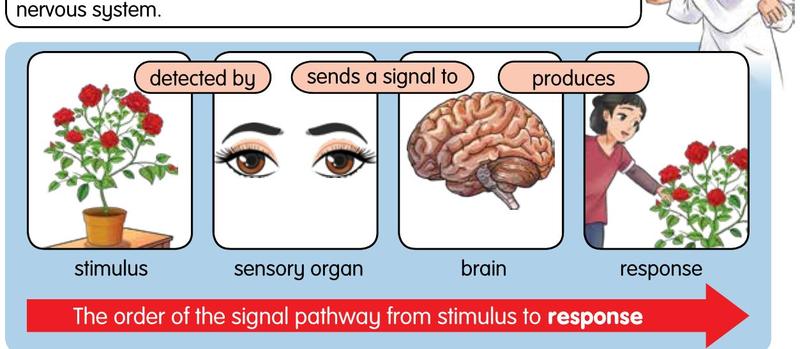
Siti looks at a rose in the garden on purpose. Diagram 4 shows how the signal travels.
[1 mark]
(a)Name the sensory organ that detects the rose.
Show answerHide answer
Tick each point you got.
[1 mark]
(b)Name the part of the body that receives the signal and coordinates the response.
Show answerHide answer
Tick each point you got.
[1 mark]
(c)Looking at the rose is a voluntary action. What is a voluntary action?
Show answerHide answer
Tick each point you got.
[1 mark]
(d)Give one example of an involuntary action.
Show answerHide answer
Tick each point you got.
15
Question 15
Hamid accidentally steps on a sharp nail and lifts his foot at once.
[1 mark]
(a)What type of action is this?
Show answerHide answer
Reflex action
[2 marks]
(b)Arrange the signal pathway: spinal cord, response, stimulus, sensory organ.
Show answerHide answer
Tick each point you got.
[1 mark]
(c)Why is a reflex action important?
Show answerHide answer
Tick each point you got.
16
Question 16
A man has Bell's palsy. One side of his face droops and he cannot close one eye.
[1 mark]
(a)Which system is damaged?
Show answerHide answer
Peripheral nervous system
The nerves that control the face muscles are part of the neural network.
[1 mark]
(b)Give one other problem that may happen when nerves in the legs are damaged.
Show answerHide answer
Tick each point you got.
17
Question 17
Danial wants to keep his nervous system healthy.
[1 mark]
(a)How many hours of sleep a day does he need?
Show answerHide answer
7 to 8 hours
[2 marks]
(b)Give two other ways he can take care of his nervous system.
Show answerHide answer
Any 2 points
Tick each point you got.
[1 mark]
(c)Why should he avoid alcoholic drinks?
Show answerHide answer
Tick each point you got.