Humans
What this chapter covers
- You can name the male and female reproductive organs and state what each one does (2.1.1)
- You can describe the process from fertilisation to birth in the correct order (2.1.2)
- You can explain why reproduction is important to humans (2.1.3)
- You can name the two parts of the nervous system and what each is made of (2.2.1)
- You can explain what the brain and the spinal cord do, and tell voluntary, involuntary and reflex actions apart (2.2.2)
- You can explain what the peripheral nervous system does and give examples of damage to it (2.2.3, 2.2.4)
- You can give ways to take care of the nervous system (2.2.5)
Your body can make new life and it can react in a split second. In this unit you will learn how humans reproduce and how the nervous system controls the body.
2.1Human reproduction
Male reproductive organs
The male reproductive organs are the testes and the penis.
| Organ | Function |
|---|---|
| Testis (plural: testes) | Produces sperms. |
| Penis | Transfers sperms into the female reproductive organ. |
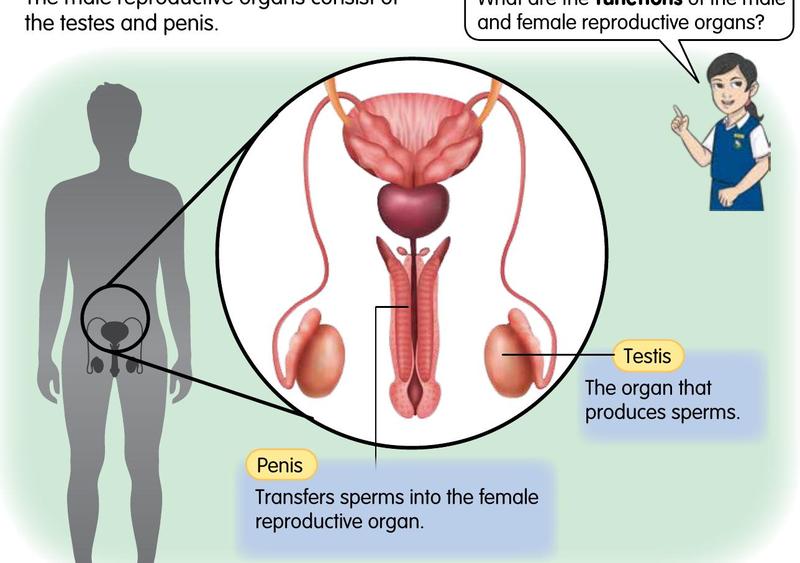
Figure: Science Year 6 textbook, p.14.
Female reproductive organs
The female reproductive organs are the ovaries, Fallopian tubes, uterus and vagina.
| Organ | Function |
|---|---|
| Ovary | Produces ova (eggs) every month. One is an ovum. |
| Fallopian tube | The place where a sperm and an ovum meet and fuse (fertilisation). |
| Uterus (womb) | The organ where the embryo develops and grows. |
| Vagina | A channel that receives sperms from the penis. |
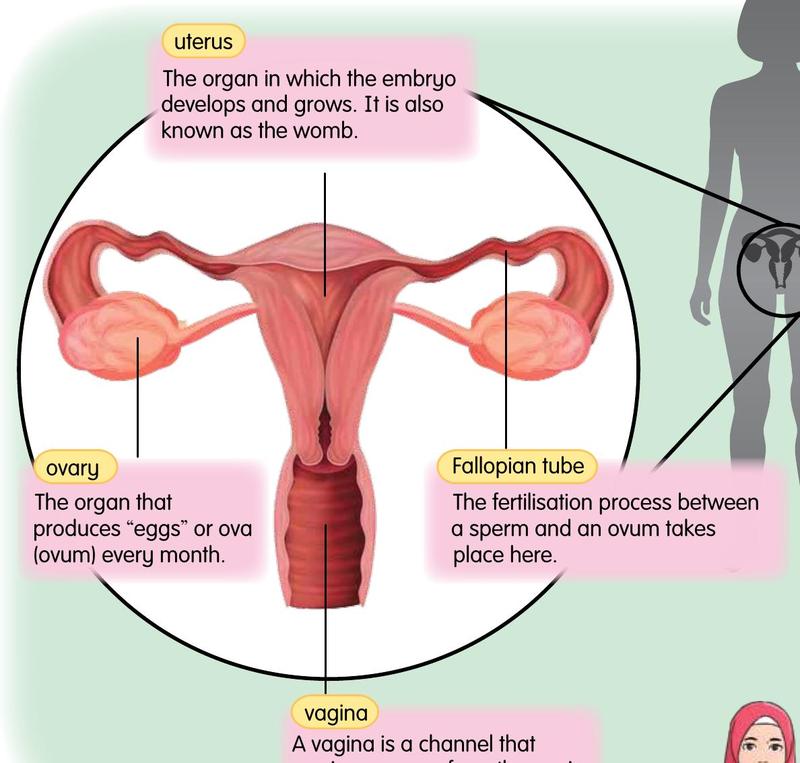
Figure: Science Year 6 textbook, p.15.
Show answerHide answer
From fertilisation to birth
- The penis transfers sperms into the vagina.
- Sperms swim towards the ovum using their tails. One sperm fuses with the ovum in the Fallopian tube. This is fertilisation.
- The fertilised ovum is a zygote. It divides again and again to form many cells called an embryo.
- The embryo moves to the uterus and develops into a foetus.
- The foetus stays in the uterus for about nine months until its organs are completely developed.
- The mother gives birth through the vagina. The foetus is now a baby.
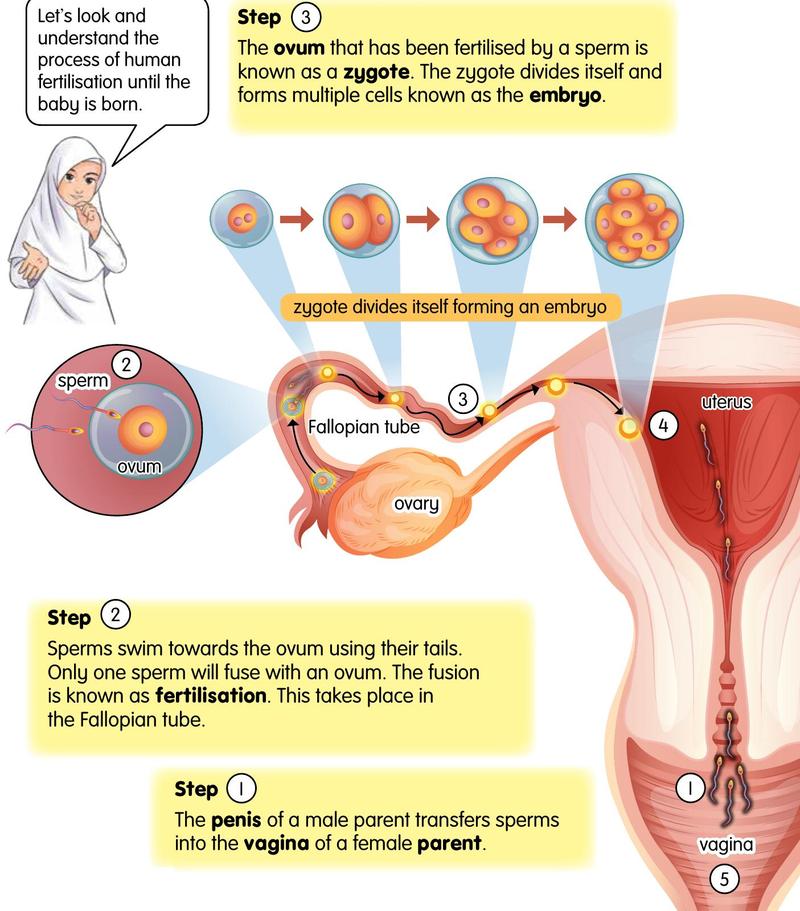
Figure: Science Year 6 textbook, p.16.
| Stage | Name |
|---|---|
| Ovum + sperm fused | Zygote |
| Zygote divides into many cells | Embryo |
| Embryo grows in the uterus | Foetus |
| Born after about nine months | Baby |
Show answerHide answer
Why reproduction is important
- It increases the number of humans (the population). A family with no new babies stays the same size and grows old.
- It makes sure the human species survives. If nobody reproduced, humans would become extinct.
2.2The human nervous system
When a mosquito bites your hand you shake it off. When you bite a sour orange you taste the sourness at once. The system that controls and coordinates all this is the nervous system. It detects a stimulus and tells the body how to respond.
Two parts of the nervous system
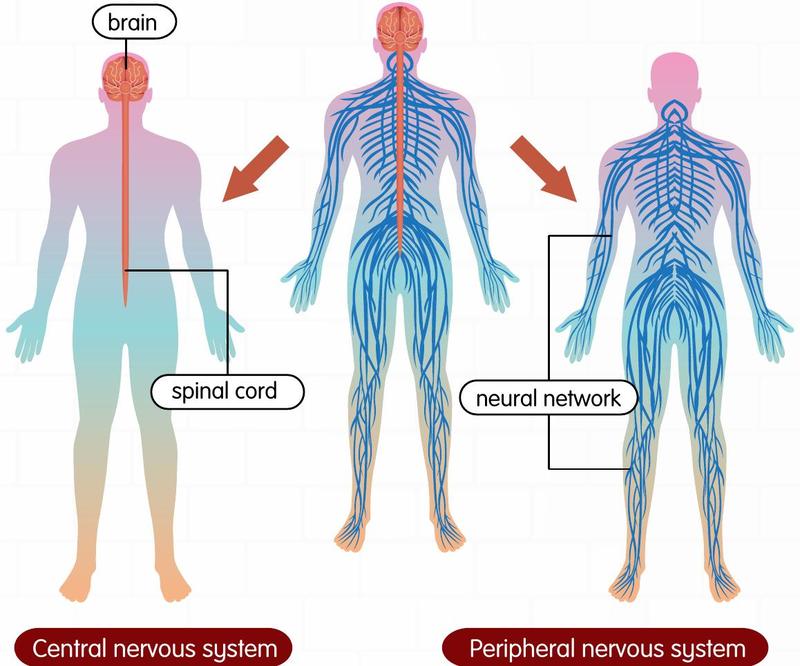
Figure: Science Year 6 textbook, p.21.
| Part | Made of | Job |
|---|---|---|
| Central nervous system (CNS) | Brain and spinal cord | Receives information from the sensory organs and coordinates the response. |
| Peripheral nervous system | Network of nerves (neural network) | Carries signals from the body to the CNS and commands from the CNS to the body. |
The brain: voluntary and involuntary actions
The brain coordinates both kinds of action.
| Action | Control | Examples |
|---|---|---|
| Voluntary | We choose it (conscious). | Dancing, observing, eating |
| Involuntary | It happens without thinking (unconscious). | Heartbeat, breathing, digestion, blood circulation |
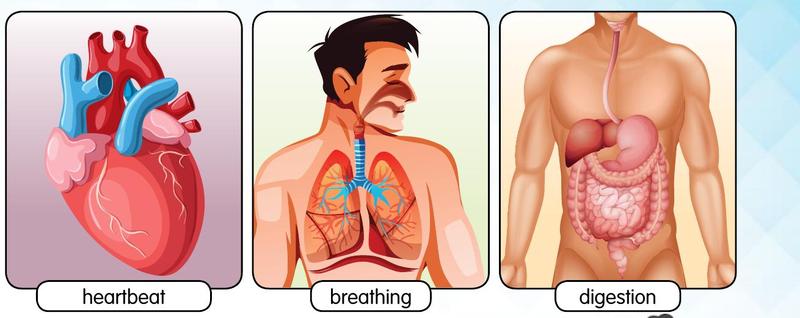
Figure: Science Year 6 textbook, p.23.
The path of a signal in a voluntary action, such as seeing a flower:
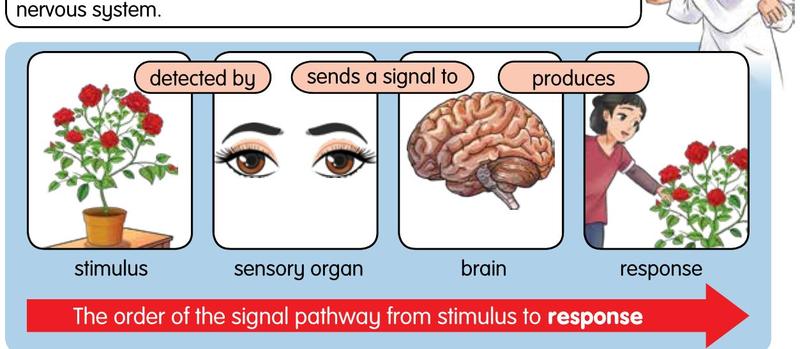
Figure: Science Year 6 textbook, p.22.
The spinal cord and reflex actions
The spinal cord is joined to the brain. It carries information from the whole body to the brain and from the brain to the whole body. It also controls some reflex actions.
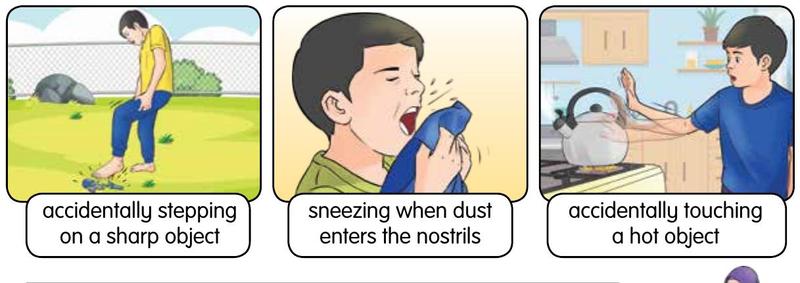
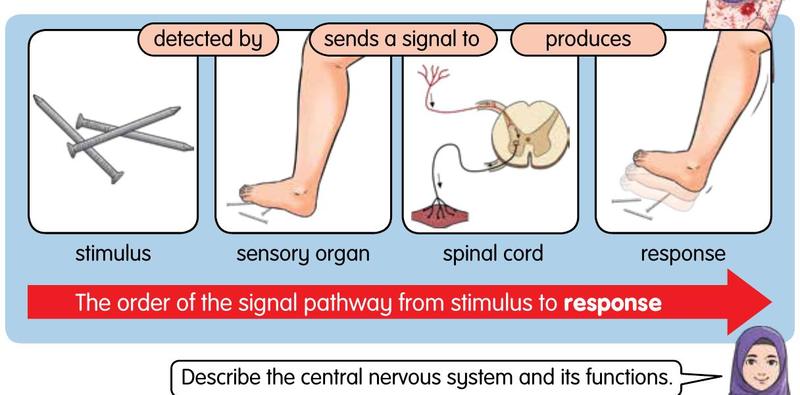
Figures: Science Year 6 textbook, p.24.
The peripheral nervous system
The nerves outside the brain and spinal cord carry signals from the body to the CNS and command signals from the CNS to the rest of the body. If it is damaged, signals are disturbed:
- Bell's palsy: the nerves to the face muscles are damaged. One side of the face droops, and it is hard to smile or close the eye.
- Body imbalance: damaged nerves in the legs make the body lose balance and fall.
Taking care of the nervous system
| What to do | Why |
|---|---|
| Eat a balanced diet | Vitamin B complex and minerals are good for the nerves. |
| Avoid alcoholic drinks | They slow down the signals in the nervous system. |
| Sleep seven to eight hours a day | It strengthens the neural network and memory. |
| Wear protective gear, such as a helmet | It prevents brain damage in an accident. |
| Keep good posture | It avoids damage to the nervous system. |