Microorganisms
What this chapter covers
- You can explain what a microorganism is (3.1.1)
- You can name the five types of microorganism (fungi, bacteria, algae, protozoa, viruses) and describe each one (3.1.2)
- You can show with investigations that microorganisms breathe, move and grow (3.1.3)
- You can explain the conditions that affect the growth of microorganisms - temperature, water, air, nutrients and acidity (3.1.4)
- You can explain how microorganisms are useful to us (3.1.5)
- You can explain how microorganisms harm us, and how this affects daily life (3.1.5)
- You can plan, predict and record a simple investigation, such as a mould terrarium or making tempeh (3.1.6)
Some living things are far too small for us to see. They live in the soil, in water, in the air and even inside our bodies. In this unit you will find out what they are, how they live and how they help or harm us.
3.1Microorganisms
Most microorganisms can only be seen with a microscope. They can live alone or in groups.
Types of microorganisms
| Type | Where found | Key characteristics | Examples |
|---|---|---|---|
| Fungi | Air, water, soil, on other living things | Break down the object they live on and absorb the nutrients. Reproduce by spores. | Mould, yeast, Penicillium |
| Bacteria | Air, water, soil, on humans, animals and plants | Spherical, rod or spiral shapes. Absorb nutrients from other living things. | Spirillum, Streptococcus, E. coli, Salmonella |
| Algae | Water | Like plants: have chlorophyll and make their own food by photosynthesis. | Chlorella, Chlamydomonas, Volvox |
| Protozoa | Ponds, lakes, rivers | Like animals: can move to find food. | Paramecium, Amoeba |
| Viruses | Inside other living things | The smallest. Live and reproduce only inside other living things. Seen only with an electron microscope. | Bacteriophage, HIV, influenza virus |
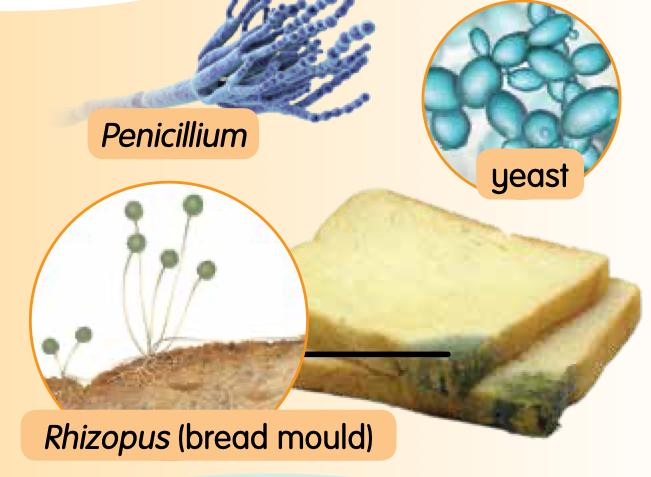
Textbook figure: Science Year 6 (KPM), p.34.
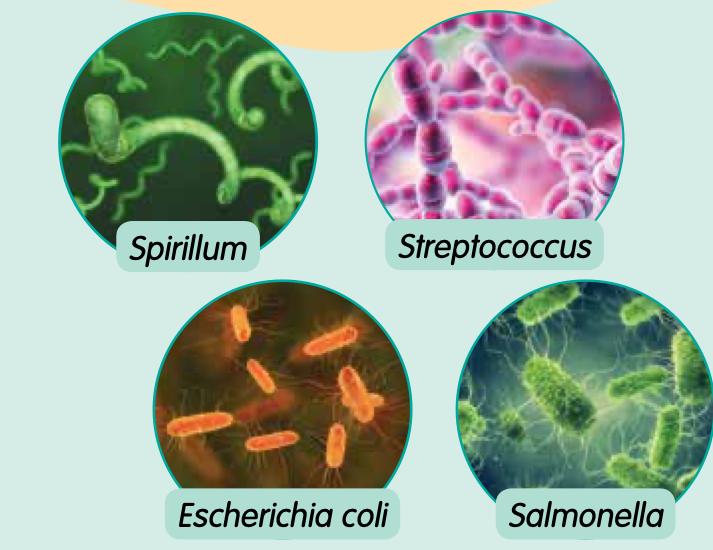
Textbook figure: Science Year 6 (KPM), p.34.
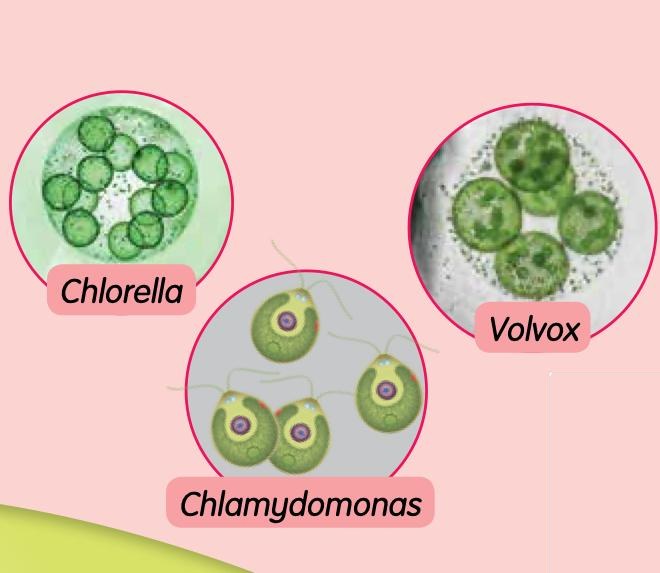
Textbook figure: Science Year 6 (KPM), p.35.
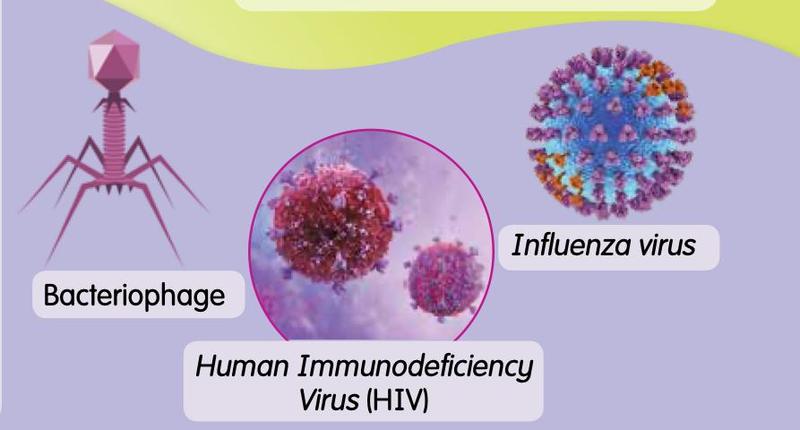
Textbook figure: Science Year 6 (KPM), p.35.
Show answerHide answer
3.2Life processes of microorganisms
Microorganisms are living, so they go through life processes. Three investigations in the book prove this.
| Life process | Investigation | Observation | Conclusion |
|---|---|---|---|
| Breathe | Yeast, sugar and warm water in a bottle with a balloon on top | The balloon's circumference gets bigger over 30 minutes. | Yeast breathes and gives out gas that fills the balloon. |
| Move | Look at a drop of pond water under a microscope; sketch positions each minute | The positions of the microorganisms change. | Microorganisms move. |
| Grow | Damp bread sealed in a ziplock bag in the dark, observed on days 5 to 7 | The patch of bread mould gets bigger. | Microorganisms grow. |
Yeast also helps dough rise: a dough with yeast and sugar becomes bigger because the yeast breathes and gives out gas. A dough with yeast but no sugar stays small because the yeast has no nutrients.
Show answerHide answer
3.3Factors affecting growth
Microorganisms grow only when their conditions are right. That is why dry yeast in a packet stays inactive until it gets warm water and sugar.
| Factor | What helps growth | Everyday example |
|---|---|---|
| Suitable temperature | Warm (room) temperature. Cold slows growth; boiling kills. | Milk is kept in a refrigerator so it stays fresh longer. |
| Presence of water | Moisture | Dried bread lasts longer than fresh bread; wet bread grows mould quickly. |
| Presence of air | Air (oxygen) | Vacuum-packed vegetables last longer. |
| Presence of nutrients | Food such as sugar or milk | Yeast needs sugar; bacteria grow in fresh milk but not in distilled water. |
| Suitable acidity | Not too acidic | Preserved mango in an acidic liquid; apple slice in vinegar stays fresh. |
Manipulated variable: the temperature of the milk. Responding variable: the condition of the milk. Constant: amount of milk, type of milk, time.
Expected result: milk at room temperature spoils fastest, because room temperature suits microorganisms.
Show answerHide answer
3.4Uses of microorganisms
| Use | How |
|---|---|
| Food products | Bacteria make yogurt. Bacteria and fungi make cheese. Fungi make tempeh. Yeast makes bread and fermented rice (tapai). |
| Medicine | Some fungi make penicillin, an antibiotic that stops harmful bacteria growing. Some fungi, bacteria and viruses are used to make vaccines, which help the body make antibodies. |
| Organic fertiliser | Bacteria decompose animal faeces mixed with sawdust. |
| Sewage treatment | Bacteria break down organic waste in sewage. |
3.5Harmful effects of microorganisms
| Harm | Cause |
|---|---|
| Food spoilage | Fungi grow on food and make it turn bad. |
| Tooth decay | Bacteria in the mouth turn sugar and food particles into acid, which damages teeth. |
| Food poisoning | Eating food contaminated with microorganisms such as Salmonella. |
| Damage to plants | Fungi on leaves disturb photosynthesis. |
| Infectious diseases | Influenza, mumps and measles are caused by viruses. Ringworm is caused by fungi. |
Show answerHide answer
3.6Activities: mould terrarium and tempeh
In the mould terrarium you spray food scraps with water, close the lid and never open it. You predict which scrap spoils first and what grows, then observe every three days for six days and compare with your prediction. Never open the lid or touch the microorganisms, and discard the terrarium properly afterwards. In making tempeh, soya beans are soaked, boiled, cooled, mixed with tempeh starter (a fungus) and kept in a bag with holes at room temperature for 36 to 48 hours.