Science questions, unit 6
Nama / NameKelas / ClassTarikh / Date
Force
41 marks. Use Practice to check each answer as you go, or Exam to answer everything first. Ask a grown-up to help you mark the written answers.
Section A: objective questions
10 marksChoose the best answer for each question.
1
Question 1
What is force?
Show answerHide answer
B
Force is a push or a pull that acts on an object.
2
Question 2
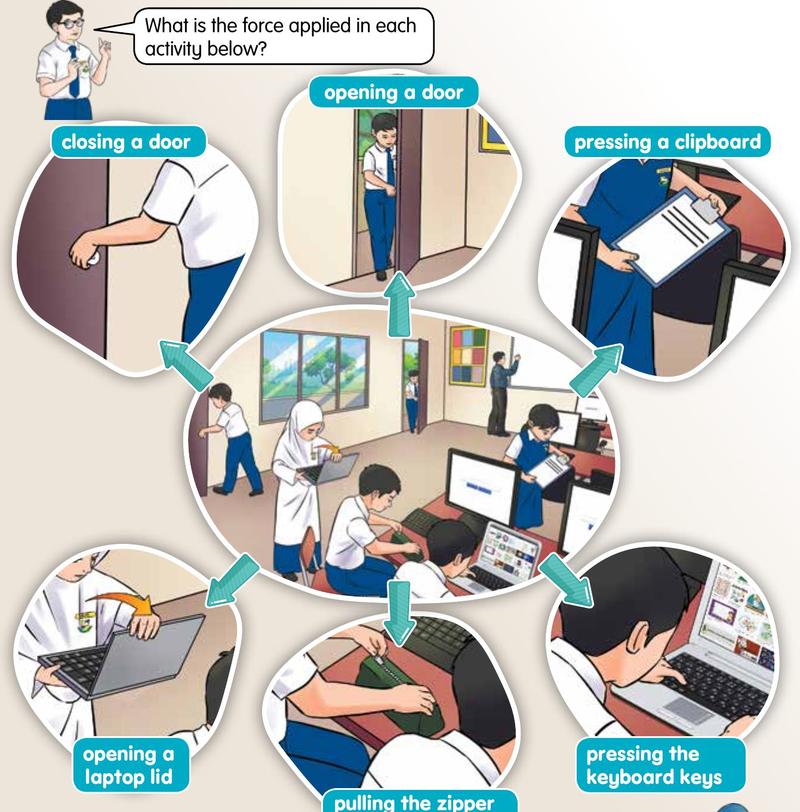
Diagram 1 shows pupils working in a school library. Which activity is a pull?
Show answerHide answer
D
A pull moves an object closer to us. Opening a lid brings it towards us. The other three are pushes.
3
Question 3
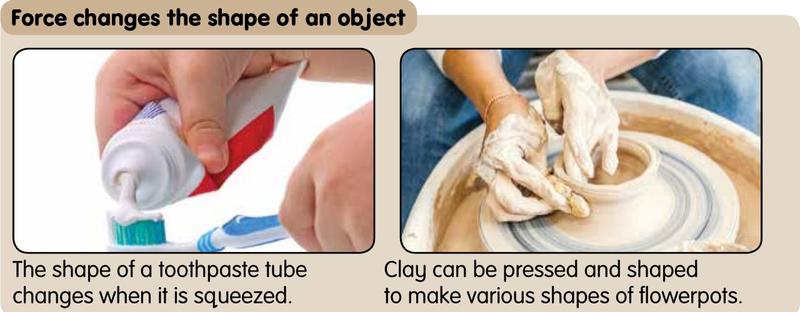
Diagram 2 shows a toothpaste tube being squeezed. What is the effect of the force?
Show answerHide answer
A
Squeezing changes the shape of the tube.
4
Question 4
A cyclist pedals harder and the bicycle goes faster. Which effect of force is this?
Show answerHide answer
C
More force on the pedals increases the speed of the bicycle.
5
Question 5
A scooter slowly stops after Adam stops pushing it. In which direction does the frictional force act?
Show answerHide answer
B
Frictional force always acts in the opposite direction to the movement of the object.
6
Question 6
Which is a disadvantage of frictional force?
Show answerHide answer
D
Friction wears out the soles. The other three are useful effects of friction.
7
Question 7
The chain of Aiman's bicycle is tight and noisy. What should he do to reduce the frictional force?
Show answerHide answer
A
Lubricating oil makes the surfaces smoother so friction is smaller.
8
Question 8
A balloon becomes bigger when more air is blown into it. Why?
Show answerHide answer
C
More particles mean more collisions with the surface, so the air pressure inside rises and the balloon expands.
9
Question 9
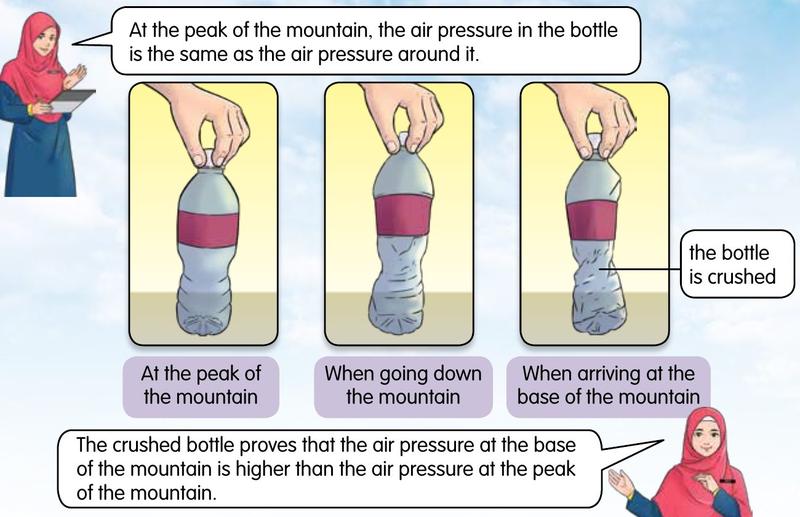
An empty plastic bottle is closed tightly at the peak of a mountain. When it reaches the base, the bottle is crushed, as in Diagram 3. What does this show?
Show answerHide answer
B
The higher air pressure outside at the base pushes the bottle inwards and crushes it.
10
Question 10
A plunger is used to clear a blocked sink. Which statement explains how it works?
Show answerHide answer
D
Pressing the plunger down gives a lower pressure inside; pulling it up lets the higher pressure in the sinkhole push the clogged waste out.
Section B: structured questions
31 marksAnswer all questions. Circle the answer or write it in the space.
11
Question 11
Aishah carries out some activities. Choose whether each one needs a push or a pull.
[1 mark]
(a)Closing a door
Show answerHide answer
Push
[1 mark]
(b)Pulling the zip of a pencil case
Show answerHide answer
Pull
[1 mark]
(c)A bar magnet attracts paper clips without touching them. Name another force that also acts without contact.
Show answerHide answer
Tick each point you got.
12
Question 12
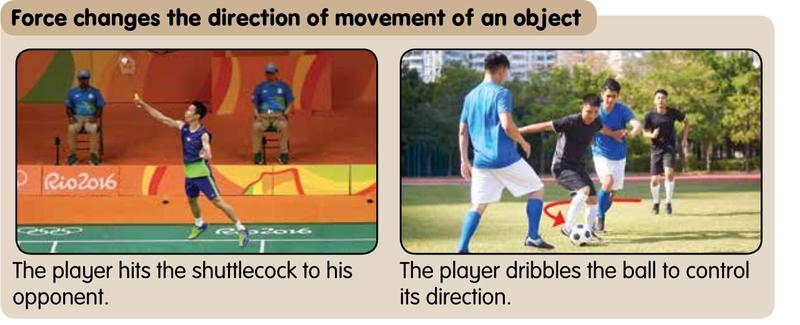
Diagram 4 shows a footballer dribbling a ball and a shuttlecock being hit.
[1 mark]
(a)State the effect of the force on the ball when it is dribbled.
Show answerHide answer
Tick each point you got.
[1 mark]
(b)A goalkeeper dives and catches a fast shot. State the effect of the force on the ball.
Show answerHide answer
Tick each point you got.
[1 mark]
(c)A stationary trolley starts to move when a worker pulls it. State this effect of force.
Show answerHide answer
Tick each point you got.
13
Question 13
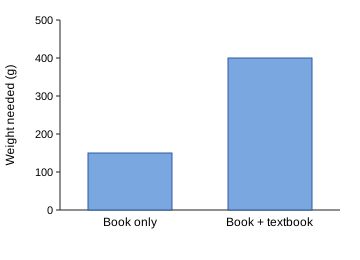
Mei Ling adds 50 g weights to a thread until a book begins to move on a desk. She repeats it with a textbook on top of the book. Diagram 5 shows the weights she needed (practice numbers, not from the book).
[1 mark]
(a)What is the manipulated variable?
Show answerHide answer
Tick each point you got.
[1 mark]
(b)How much more weight was needed to move the books with the textbook?
Show answerHide answer
Tick each point you got.
[1 mark]
(c)Give an inference for the answer in (b).
Show answerHide answer
Any 1 points
Tick each point you got.
[1 mark]
(d)Predict the weight needed if Mei Ling puts a second textbook on top.
Show answerHide answer
Tick each point you got.
14
Question 14
A dry cell is rolled down a cardboard ramp onto different surfaces. The table shows how far it travels (practice numbers, not from the book).
| Surface | Distance (cm) |
|---|---|
| Paper | 85 |
| Cloth | 50 |
| Sandpaper | 20 |
| Carpet | 35 |
[1 mark]
(a)Which surface gives the largest frictional force?
Show answerHide answer
Sandpaper
The dry cell goes the shortest distance, so friction is largest.
[1 mark]
(b)How much farther does the dry cell travel on paper than on carpet?
Show answerHide answer
Tick each point you got.
[1 mark]
(c)State one variable that must be kept the same.
Show answerHide answer
Tick each point you got.
[2 marks]
(d)State the relationship between the type of surface and the frictional force.
Show answerHide answer
Tick each point you got.
15
Question 15
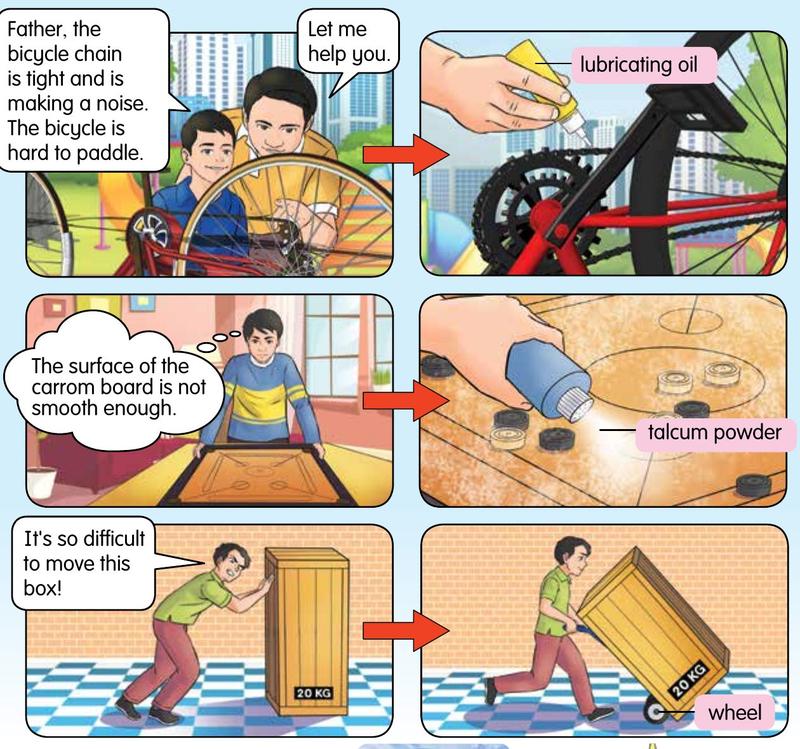
Diagram 6 shows three ways to deal with friction problems.
[1 mark]
(a)Why does the carrom board need talcum powder?
Show answerHide answer
Tick each point you got.
[1 mark]
(b)How does a trolley make it easier to move a heavy box?
Show answerHide answer
Tick each point you got.
[1 mark]
(c)Syafiq's hands slip when he holds a smooth racquet handle. Suggest how to stop this.
Show answerHide answer
Tick each point you got.
[1 mark]
(d)Give one disadvantage of frictional force in a car engine.
Show answerHide answer
Tick each point you got.
16
Question 16
Adam sips orange juice through a straw.
[1 mark]
(a)When he sucks, what happens to the number of air particles inside the straw?
Show answerHide answer
Decreases
[1 mark]
(b)Compare the air pressure inside the straw with the air pressure outside.
Show answerHide answer
Tick each point you got.
[2 marks]
(c)Explain why the juice goes into his mouth.
Show answerHide answer
Tick each point you got.
17
Question 17
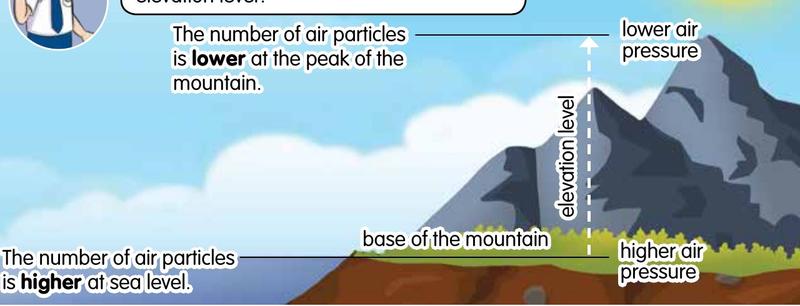
Many climbers carry oxygen tanks when they climb Mount Everest. Diagram 7 shows how air particles change with height.
[1 mark]
(a)Why do climbers need oxygen tanks near the peak?
Show answerHide answer
Tick each point you got.
[1 mark]
(b)How does the air pressure at the peak compare with the air pressure at sea level?
Show answerHide answer
Tick each point you got.
[1 mark]
(c)State the relationship between the height above sea level and air pressure.
Show answerHide answer
Tick each point you got.
[2 marks]
(d)A sealed packet of snacks is carried from the base to the peak. What happens to the packet? Explain.
Show answerHide answer
Tick each point you got.
18
Question 18
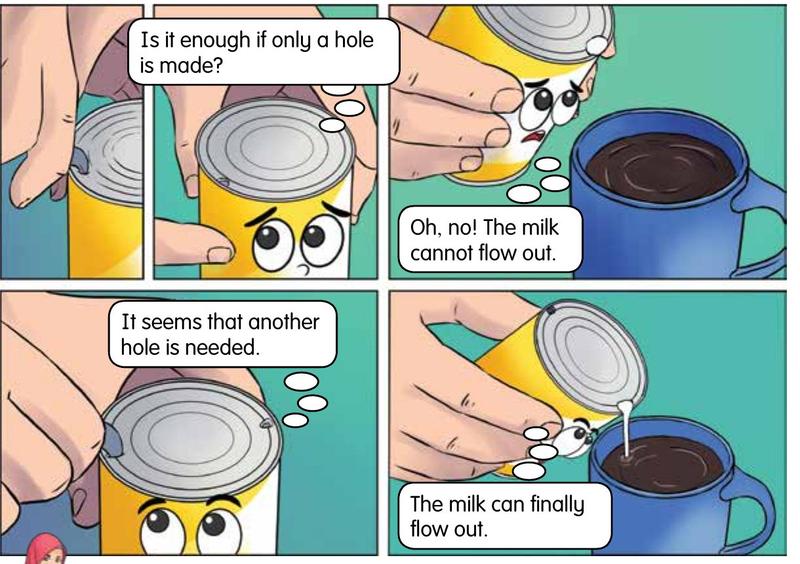
Diagram 8 shows a milk can with one hole. The milk will not flow out, but it flows when a second hole is made.
[1 mark]
(a)Why does the milk not flow out of the can with only one hole?
Show answerHide answer
Tick each point you got.
[1 mark]
(b)Why does the milk flow when a second hole is made?
Show answerHide answer
Tick each point you got.
[1 mark]
(c)Name one other tool that uses air pressure in daily life.
Show answerHide answer
Tick each point you got.