Force
What this chapter covers
- You can state that force is a push or a pull, and give examples (6.1.1)
- You can explain the five effects of force on an object (6.1.2)
- You can state what frictional force is and that it acts against movement (6.2.1)
- You can describe the advantages and disadvantages of frictional force (6.2.2)
- You can carry out fair tests to show how mass and type of surface affect frictional force (6.2.3)
- You can suggest ways to increase or reduce frictional force in daily life (6.2.4)
- You can explain that air pressure comes from air particles colliding with surfaces (6.3.1)
- You can describe how air pressure changes with height above sea level (6.3.2)
- You can explain everyday uses of air pressure such as the siphon, syringe and plunger (6.3.3)
Force is all around you. You open a door, kick a ball, brake a bicycle and sip a drink. In this unit you will learn what force is, how frictional force works against movement, and how air pressure comes from tiny air particles.
6.1Force and its effects
| Action | What it does | Examples |
|---|---|---|
| Push | Moves an object away from us | Closing a door, pressing keyboard keys, pressing a clipboard |
| Pull | Moves an object closer to us | Opening a door, opening a laptop lid, pulling a zip |
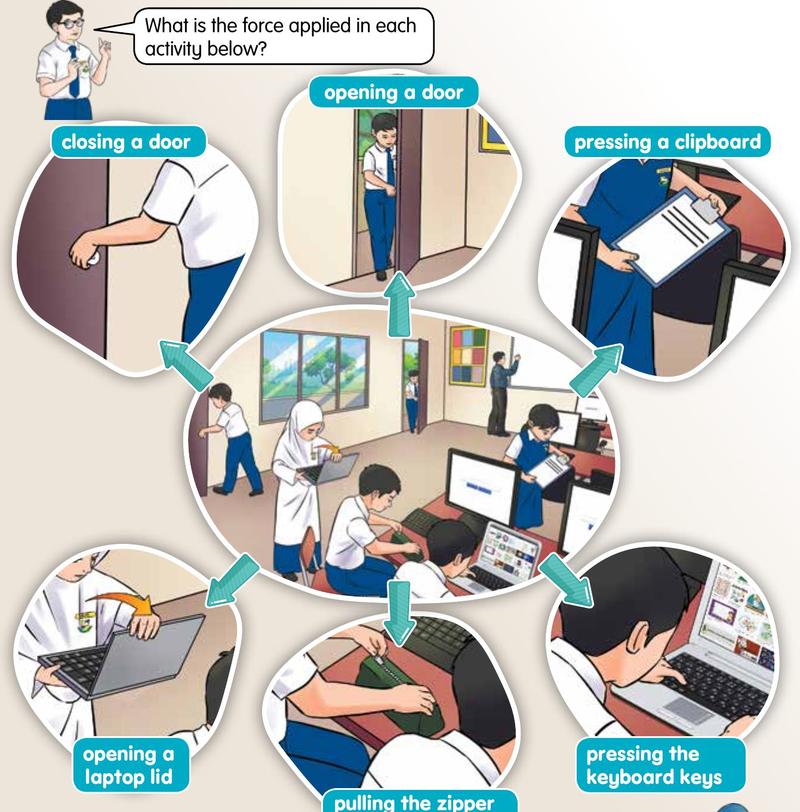
Some forces need contact, such as pushing a pencil case. Other forces act without touching: a magnet pulls paper clips, and the Earth's gravity pulls a ball back down. Gravity is a pulling force, because it pulls every object towards the centre of the Earth.
Effects of force
We cannot see a force, but we can see and feel what it does. A force can:
| Effect | Example |
|---|---|
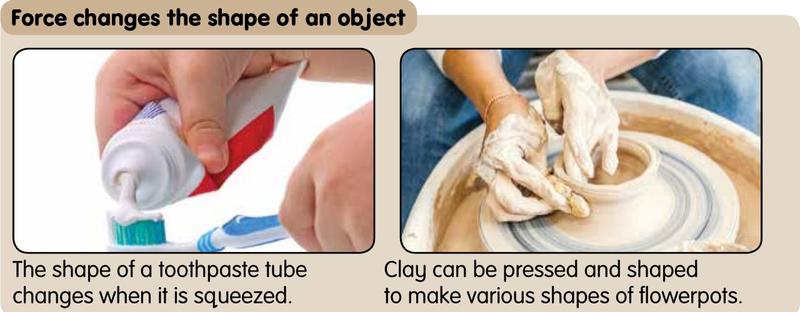
| Change the shape of an object | Squeezing a toothpaste tube; pressing clay into a flowerpot |
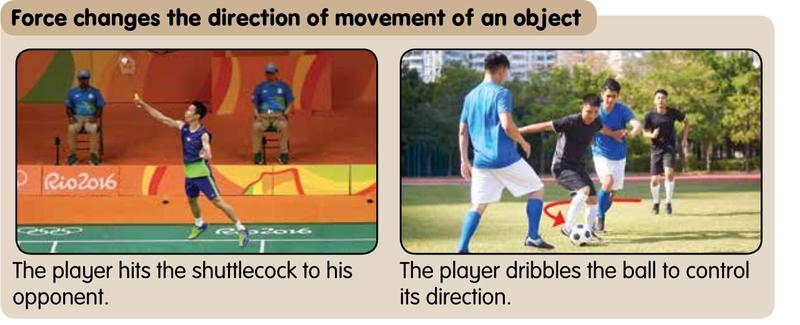
| Change the direction of movement | Hitting a shuttlecock back; dribbling a ball |
| Change the speed of an object | Pedalling harder to go faster; waves speeding up or slowing a kayak |
| Move a stationary object | Pulling a trolley of boxes; a bowling ball hitting pins |
| Stop a moving object | A goalkeeper stopping a ball; stopping a toy car |
Show answerHide answer
6.2Frictional force
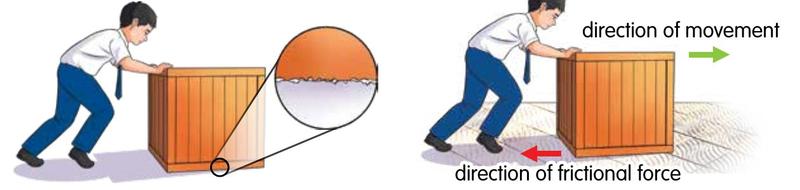
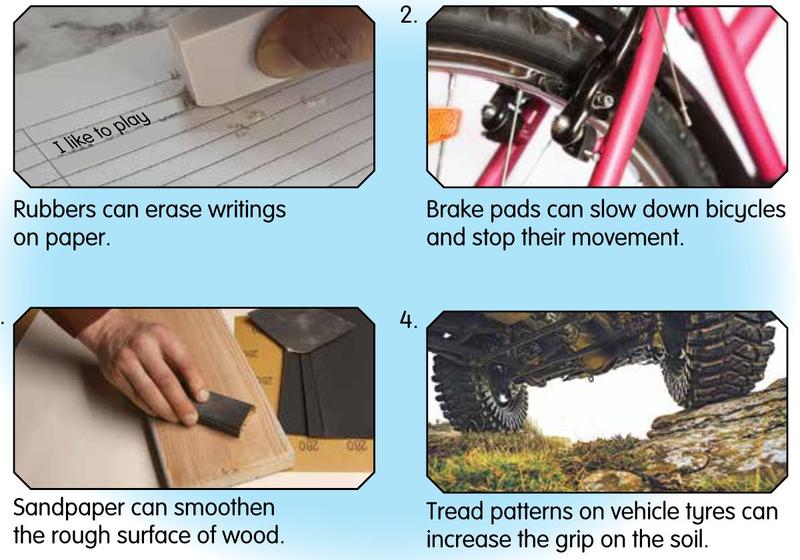
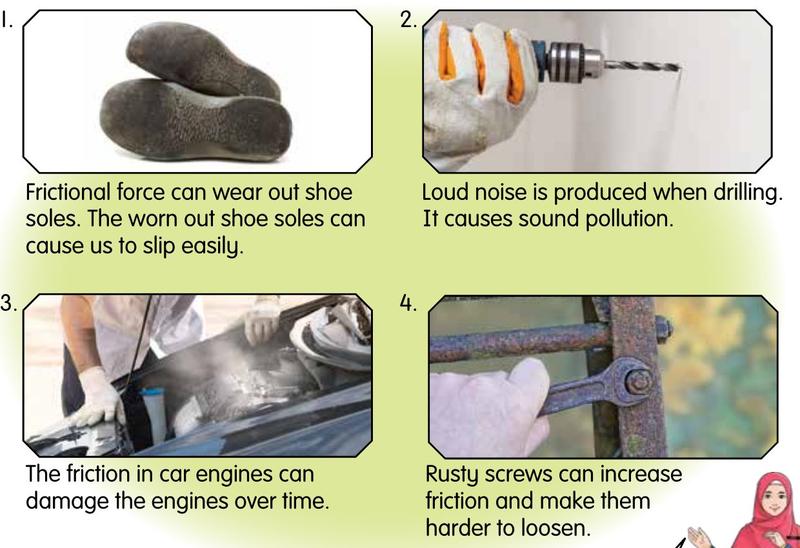
Effects of frictional force
| Advantages | Disadvantages |
|---|---|
| Rubber can erase writing on paper. | Shoe soles wear out, so we may slip. |
| Brake pads slow down and stop a bicycle. | Drilling makes loud noise (sound pollution). |
| Sandpaper smoothens rough wood. | Friction in a car engine damages it over time. |
| Tyre treads grip the ground. | Rusty screws are harder to loosen. |
Friction also produces heat. A match lights when the head rubs the rough side of the box, because the heat makes the coating burn.
Factors affecting frictional force
Two factors are tested in the textbook's fair tests.
| Factor | Change | Result |
|---|---|---|
| Mass of the object | Heavier object | Frictional force is larger. More weight is needed to move it. |
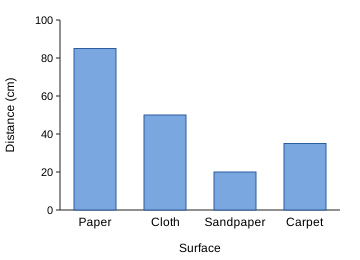
| Type of surface | Rougher surface | Frictional force is larger. A rolling cell stops sooner and goes a shorter distance. |
Responding: distance travelled by the dry cell.
Constant: the same dry cell, same slope, same starting point.
Conclusion: the rougher the surface, the larger the friction and the shorter the distance.
Show answerHide answer
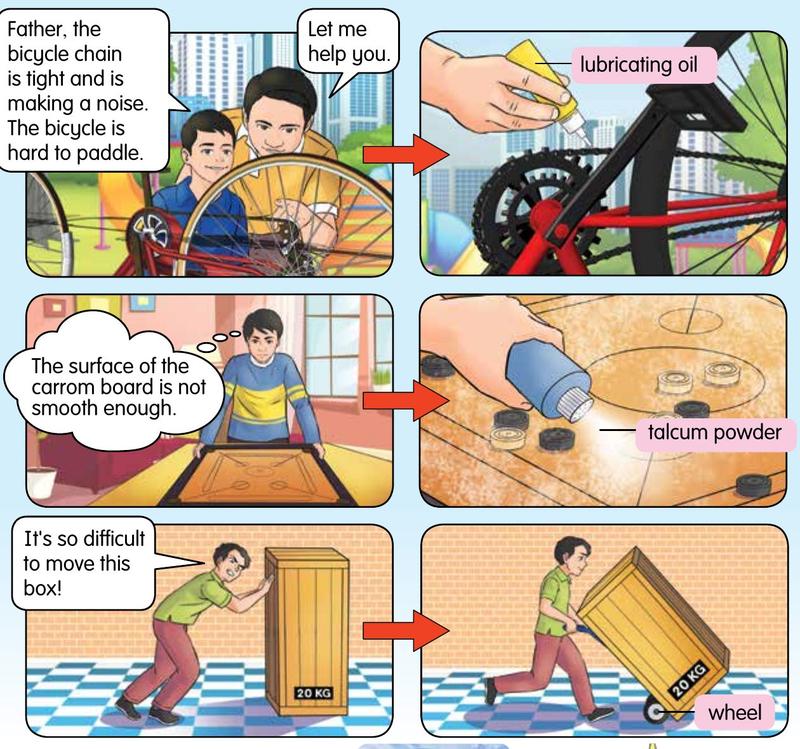
Frictional force in daily life
| Reduce friction | Increase friction |
|---|---|
| Oil a bicycle chain. | Use a cloth to grip a tight jar lid. |
| Sprinkle talcum powder on a carrom board. | Scrub a stain with a brush. |
| Put a heavy box on a trolley with wheels. | Wrap a grip on a racquet handle. |
Show answerHide answer
6.3Air pressure
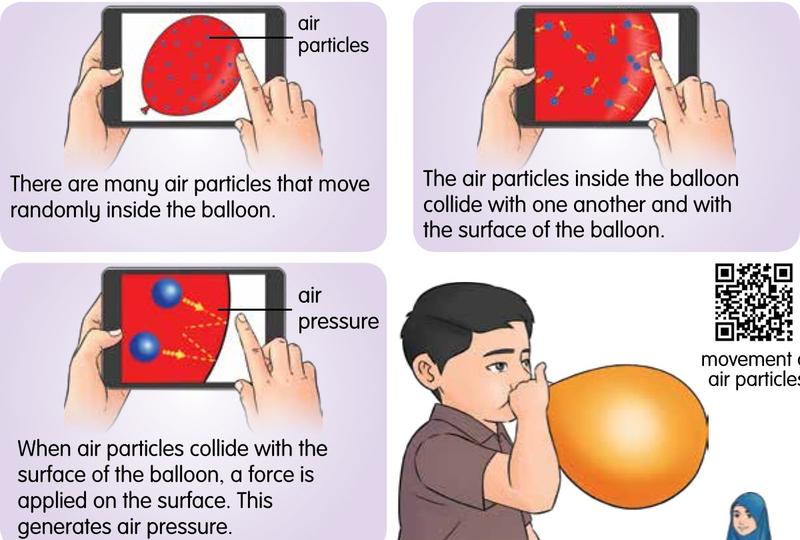
Presence of air pressure
- Sipping with a straw: sucking removes air particles from the straw, so pressure inside is lower. The higher air pressure outside pushes the water up the straw.
- Inverted glass of water with a card: the air pressure from below pushes up on the card, so the water stays in the glass.
- Bottle with holes: water spurts from the lower holes only when the top hole is opened, because air pressure then pushes on the water.
Air pressure and height
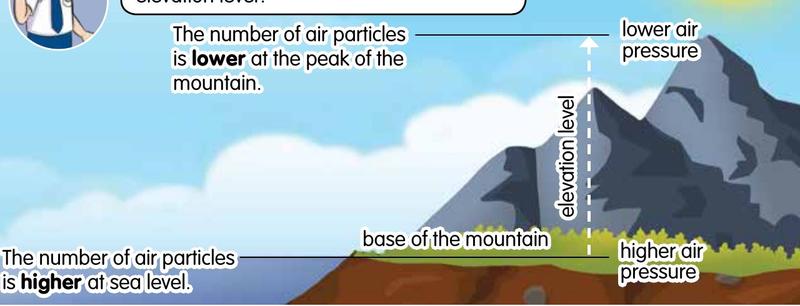
Earth is surrounded by a layer of air called the atmosphere. The higher you go above sea level, the fewer air particles there are, so there are fewer collisions and the air pressure is lower. Climbers on Mount Kinabalu find it hard to breathe for this reason.
| Place | Air particles | Air pressure |
|---|---|---|
| Peak of a mountain | Fewer | Lower |
| Base of a mountain / sea level | More | Higher |
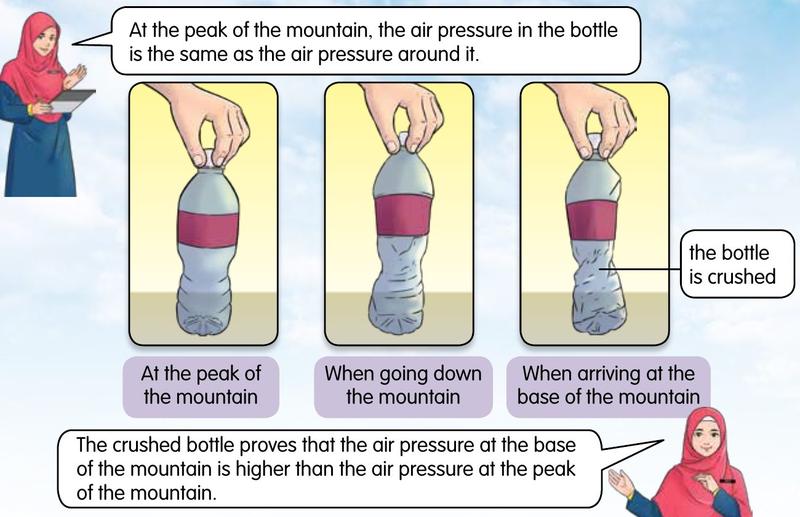
Show answerHide answer
Applications of air pressure
- Two holes in a milk can: with only one hole, the air pressure outside stops the milk flowing out. With two holes, the air pressure outside pushes the milk out.
- Siphon: a tube lets water flow from a higher container to a lower one. A lower pressure forms in the tube, and the higher pressure outside pushes the water into it.
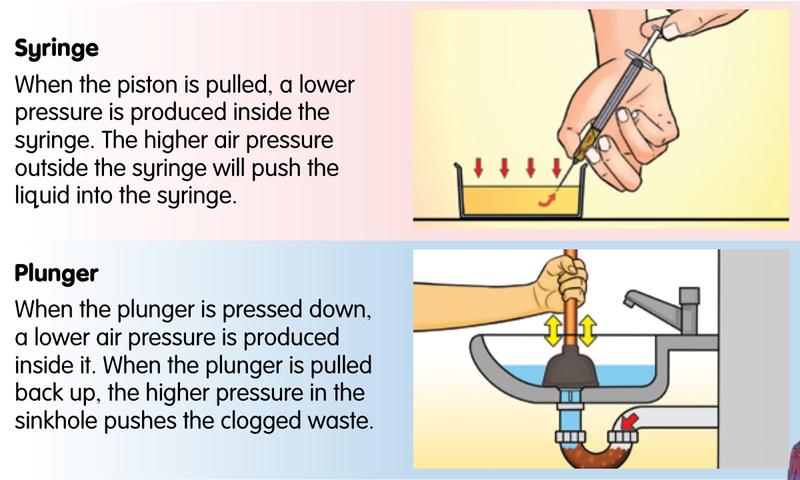
- Syringe: pulling the piston lowers the pressure inside, and the higher pressure outside pushes liquid in.
- Plunger: pressing it down gives a lower pressure inside it. When it is pulled back up, the higher pressure in the sinkhole pushes the blocked waste out.
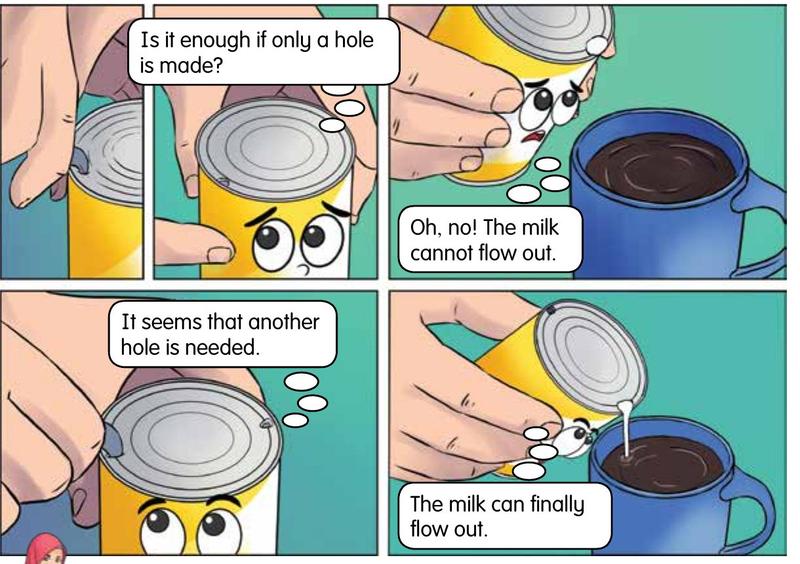
Show answerHide answer
Pictures: Science Year 6 (DLP) textbook, Unit 6: library scene p. 88, effects p. 90, frictional force p. 93, advantages p. 95, disadvantages p. 96, reducing friction p. 99, balloon p. 101, bottle p. 105, air pressure and height p. 106, milk can p. 107, syringe and plunger p. 108. The bar chart is drawn for this site.
Summary
| Idea | Remember |
|---|---|
| Force | A push or a pull. |
| Effects | Change shape, change direction, change speed, start movement, stop movement. |
| Friction | Two surfaces in contact; opposes movement; larger for heavier objects and rougher surfaces. |
| Reduce friction | Oil, powder, wheels. |
| Increase friction | Cloth, brush, grip. |
| Air pressure | Particles colliding with a surface; lower at a higher place. |
| Uses | Two holes in a can, siphon, syringe, plunger. |