Speed
What this chapter covers
- You can say what speed is and name its units: cm/s, m/s and km/h (7.1.1)
- You can explain that a faster object takes a shorter time over a fixed distance and goes farther in a fixed time (7.1.2)
- You can calculate speed, distance and time with Speed = Distance ÷ Time (7.1.3)
- You can write an operational definition of speed from an activity (7.1.4)
- You can solve problems about speed, including changing minutes to hours or seconds first (7.1.5)
Race cars, boats and drones all try to win by being fast. Being fast is about speed. In this unit you learn what speed is, how to measure it and how to calculate it.
7.1Speed, distance and time
What is speed?
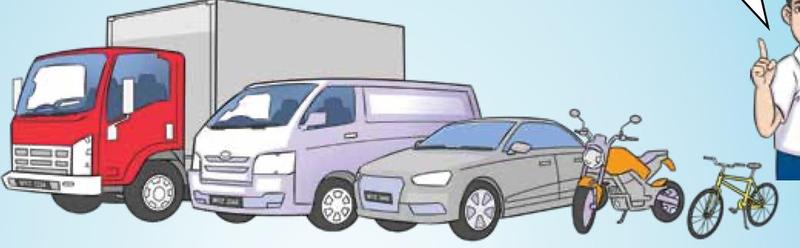
Picture: Science Year 6 (DLP) textbook, p. 114.
To find a speed we need two measurements: the distance the object travels and the time it takes.
| What we measure | Units |
|---|---|
| Distance | centimetre (cm), metre (m), kilometre (km) |
| Time | second (s), minute (min), hour (h) |
| Speed | centimetre per second (cm/s), metre per second (m/s), kilometre per hour (km/h) |
"Per" means "in each". A speed of 25 km/h means the cyclist travels 25 kilometres in each hour. A speed of 100 metre/minute means 100 metres in each minute.
| Moving thing | Sensible unit | Why |
|---|---|---|
| A snail or a tortoise | cm/s | It moves only a few centimetres in a second. |
| A runner | m/s | It covers some metres in a second. |
| A car or an aeroplane | km/h | It covers many kilometres in an hour. cm/s would give a huge number. |
Show answerHide answer
Speed, distance and time are linked
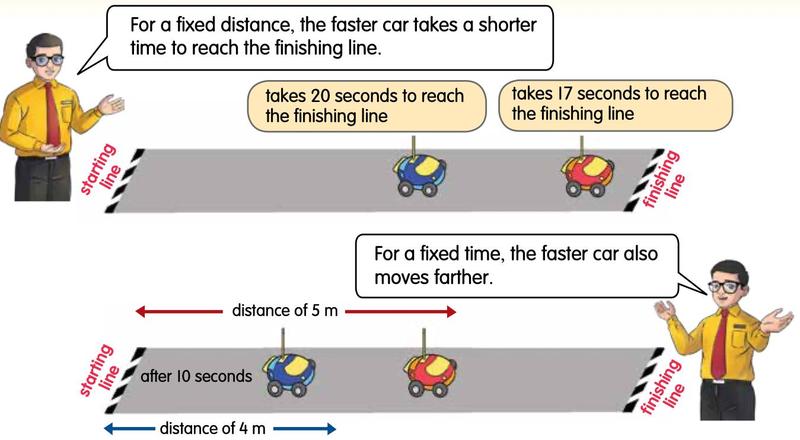
Two toy cars race over the same distance. The faster one gets to the finishing line first. Two cars also run for the same time. The faster one goes farther.
Picture: Science Year 6 (DLP) textbook, p. 116.
| The object moves faster, so it... | when we fix |
|---|---|
| takes a shorter time | the distance |
| travels a longer distance | the time |
Two fair tests
The textbook uses a ramp, made higher by adding books, to change the speed of a marble or a toy car. A higher ramp gives a faster speed.
| Speed and time | Speed and distance | |
|---|---|---|
| Manipulated variable | Number of books (speed) | Number of books (speed) |
| Responding variable | Time taken to reach the cardboard | Distance the toy car travels |
| Constant variables | Length of ramp, same marble | Same toy car, same time, same ramp |
| Conclusion | The faster the speed, the shorter the time | The faster the speed, the farther the distance |
Calculating speed
Picture: Science Year 6 (DLP) textbook, p. 119.
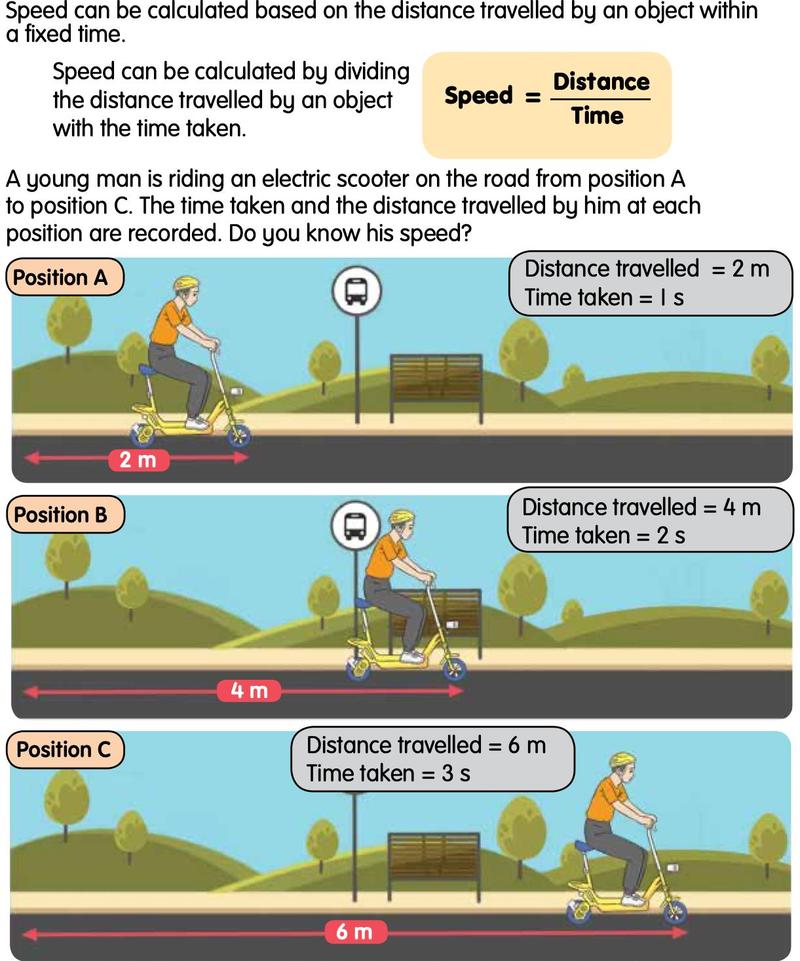
The speed is the same at every position, so the scooter moves at a steady 2 m/s: in every second it covers the same 2 m.
Using the formulae
| To find | Formula | Check the unit |
|---|---|---|
| Speed | Speed = Distance ÷ Time | Unit of distance per unit of time |
| Distance | Distance = Speed × Time | Time must be in the unit used in the speed |
| Time | Time = Distance ÷ Speed | Distance must be in the unit used in the speed |
Show answerHide answer
Show answerHide answer
Operational definition of speed
In the "My speed" activity, a runner runs 200 m and stopwatches are set at 50 m, 100 m, 150 m and 200 m. In a steady run the time at each station doubles when the distance doubles, so the speed stays the same. For example, 50 m in 10 s and 100 m in 20 s both give 5 m/s (sample numbers, not measured).
If the runner keeps the same pace for 400 m, the speed is predicted to stay the same, because the runner's pace is steady. In real life, a runner may tire and slow down.
Key points
- Speed is how fast an object moves from one place to another.
- Units of speed: cm/s, m/s, km/h.
- Faster means a shorter time for a fixed distance, or a longer distance in a fixed time.
- Speed = Distance ÷ Time; Distance = Speed × Time; Time = Distance ÷ Speed.