Food preservation technology
What this chapter covers
- You can explain what food spoilage is and what causes it (8.1.1)
- You can name the characteristics of spoilt food (8.1.2, 8.1.3)
- You can explain the meaning and purpose of food preservation (8.2.1)
- You can describe the methods of food preservation and link each to the growth factors of microorganisms (8.2.2, 8.2.3, 8.2.4)
- You can explain how food is preserved by combining methods (8.2.5)
- You can explain the importance of food preservation technology (8.2.6)
- You can carry out a food preservation project (8.2.7)
Have you ever opened a packet of nasi lemak that was left in a hot car for hours? It smells bad and you cannot eat it. In this unit you will find out why food spoils, how people stop it from spoiling, and why this technology matters.
8.1Food spoilage
Factors that make food spoil
Microorganisms grow well when they have these four things:
- water (and humidity in the air)
- air
- a suitable temperature (not too cold, not too hot)
- suitable acidity
Characteristics of spoilt food
We can use our senses of sight, smell, taste and touch to detect spoilt food: a change in texture or colour, a bad smell, a sour or unpleasant taste, and a sticky or slimy feel.
| Food | What happens when it is spoilt |
|---|---|
| Milk | Bubbly and lumpy; smells bad; tastes sour because bacteria produce acid. |
| Bread and rice | Covered with black spots called moulds; rice becomes slimy and smelly. |
| Fruits and vegetables | Mouldy; texture, taste and colour change. |
| Beef and chicken | Look blackish, smell bad and feel slimy. |
| Fish, squids and prawns | Texture changes, smell bad, feel sticky and mushy. |
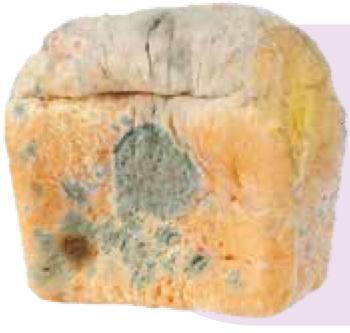
Figure: Science Year 6 textbook, p.128.
Show answerHide answer
8.2Food preservation
Each method of preservation takes away, or changes, one of the growth factors of microorganisms.
Methods of food preservation
| Method | How it works | Examples |
|---|---|---|
| Drying | Heat removes the water content, so microorganisms cannot survive. | Dried fish, dried chillies |
| Boiling | High temperature kills most microorganisms. | Durian jam, chilli paste |
| Cooling | About 4 °C slows down growth. | Vegetables, fruits, dairy products |
| Freezing | 0 °C and below stops growth. | Beef, fish, seafood |
| Vacuum packing | Air is removed, so microorganisms cannot grow. | Beef, vegetables, fruits |
| Canning | Food is cooked, sealed airtight in a can and heated; no air and high temperature. | Sardines, pineapple, vegetables |
| Bottling | Food is boiled, cooled and sealed in airtight bottles; high temperature and no air. | Sauces, beans, seafood |
| Pasteurising | Heated at 63 °C for 30 minutes or 72 °C for 15 seconds, then cooled quickly to 4 °C. UHT: 135 °C for 2 seconds. | Milk, juice |
| Pickling | Soaked in vinegar or a concentrated sugar or salt solution; unsuitable acidity. | Mangoes, fish, chillies |
| Salting | A large quantity of salt removes moisture. | Fish, eggs |
| Smoking | Slow drying with smoke removes water. | Beef, duck, chicken, fish, bananas |
| Waxing | A wax coat stops air and water from entering. | Vegetables, fruits |
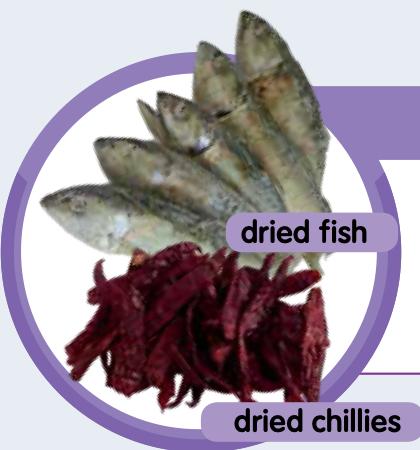
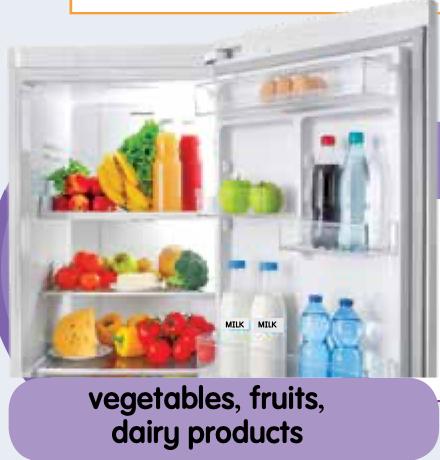
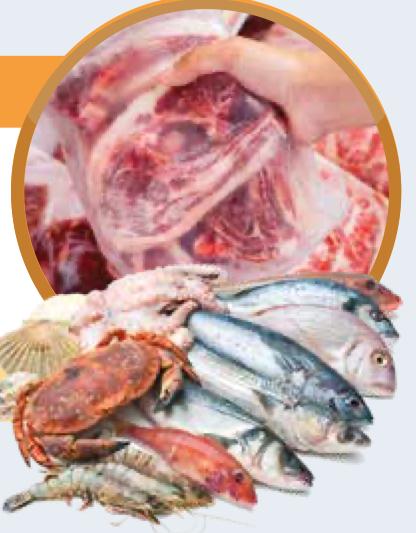
Figures: Science Year 6 textbook, p.132.
Show answerHide answer
One food, many methods
The same food can be preserved in more than one way. Chillies can be dried in the sun (water removed), pickled in vinegar, salt and sugar (acidity), frozen (low temperature) or boiled into a paste (high temperature). In the boiled chilli paste, cooking oil forms a layer on top that keeps air out.
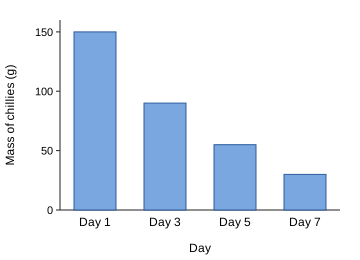
In the drying project the chillies lose mass because water leaves them, so the final mass is less than the initial mass.
Combining methods
Some foods are preserved by combining methods so they last longer. A cut fish is smeared with a large quantity of salt and then dried in the sun. Salting removes moisture and drying removes more water. Pickled fish uses salt and cooking oil: salt removes water and the oil keeps air out.
Show answerHide answer
8.3Importance of food preservation technology
| Importance | Example |
|---|---|
| Food has a longer shelf life | Cencaluk and crackers last until next year. |
| Food wastage is avoided | Leftover rendang is dried to make beef floss. |
| Food is easier to store | Canned and bottled food needs little space. |
| Out-of-season food is available all year | Durian, rambutan and mangosteen jam. |
| Food is easier to export | Coconut milk products sent by ship to other countries. |
| Instant food can be made | Instant porridge and ready-to-eat rice, useful in drought or disaster. |