Science questions, unit 10
Nama / NameKelas / ClassTarikh / Date
Eclipse
44 marks. Use Practice to check each answer as you go, or Exam to answer everything first. Ask a grown-up to help you mark the written answers.
Section A: objective questions
10 marksChoose the best answer for each question.
1
Question 1
When does an eclipse of the Moon occur?
Show answerHide answer
B
Earth blocks sunlight from the Moon, so Earth's shadow falls on the Moon.
2
Question 2
An eclipse of the Moon can only occur during which phase of the Moon?
Show answerHide answer
C
Earth is between the Sun and the Moon only at full moon.
3
Question 3
An eclipse of the Sun can only occur during which phase of the Moon?
Show answerHide answer
A
The Moon is between the Sun and Earth at new moon.
4
Question 4
Why does an eclipse of the Moon not happen at every full moon?
Show answerHide answer
D
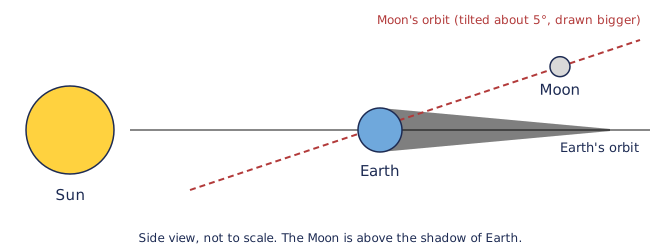
The Moon's orbit is tilted about 5 degrees from Earth's orbit.
5
Question 5
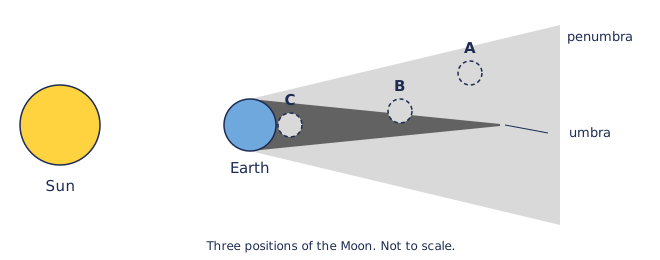
Diagram 1 shows the shadow of Earth and three positions of the Moon. What is seen when the Moon is at position C?
Show answerHide answer
C
C is completely inside the umbra of Earth's shadow, so a total eclipse of the Moon is seen.
6
Question 6
Which is a safe way to watch an eclipse of the Sun?
Show answerHide answer
C
A pinhole camera makes an image on a card, so you never look at the Sun. Sunglasses and unfiltered telescopes still damage the eyes.
7
Question 7
From which region on Earth can a total eclipse of the Sun be seen?
Show answerHide answer
A
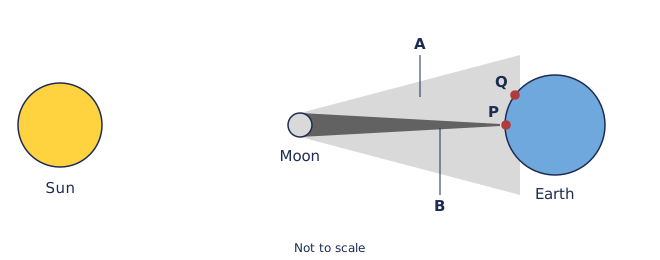
Only inside the umbra does the Moon block the whole Sun. In the penumbra only a partial eclipse is seen.
8
Question 8
What happens to the temperature of the surroundings during a total eclipse of the Sun?
Show answerHide answer
B
Less sunlight reaches Earth, so the surroundings become darker and cooler.
9
Question 9
What colour does the Moon often look during a total eclipse of the Moon?
Show answerHide answer
D
Sunlight bends through Earth's atmosphere and reaches the Moon, giving it a reddish-brown colour.
10
Question 10
Earth and the Moon form shadows because they are ______ objects.
Show answerHide answer
B
Light cannot pass through opaque objects, so a shadow forms behind them.
Section B: structured questions
34 marksAnswer all questions.
11
Question 11
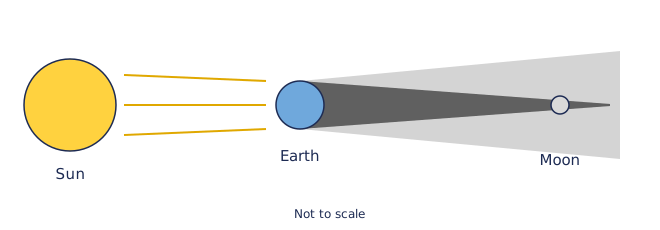
Diagram 2 shows the Sun, Earth and the Moon in a straight line.
[1 mark]
(a)What eclipse is shown?
Show answerHide answer
Eclipse of the Moon
[1 mark]
(b)Which phase of the Moon is it?
Show answerHide answer
Full moon
[1 mark]
(c)Why does a shadow form on the Moon?
Show answerHide answer
Any 1 points
Tick each point you got.
12
Question 12
Diagram 3 shows three positions of the Moon in the shadow of Earth.
[1 mark]
(a)What type of eclipse is seen when the Moon is at C?
Show answerHide answer
Total eclipse of the Moon
[1 mark]
(b)What type of eclipse is seen when the Moon is at B, only part of it inside the umbra?
Show answerHide answer
Partial eclipse of the Moon
[1 mark]
(c)At which position is the Moon only in the penumbra?
Show answerHide answer
Tick each point you got.
13
Question 13
Diagram 4 shows an eclipse of the Sun. P and Q are two places on Earth.
[2 marks]
(a)Name shadow A and shadow B.
Show answerHide answer
Tick each point you got.
[1 mark]
(b)What is seen at P?
Show answerHide answer
Tick each point you got.
[1 mark]
(c)What is seen at Q?
Show answerHide answer
Tick each point you got.
[2 marks]
(d)State two properties of sunlight that explain the shadows.
Show answerHide answer
Tick each point you got.
14
Question 14
Say whether each statement about eclipses is true or false.
[1 mark]
(a)An eclipse of the Sun can be seen at night.
Show answerHide answer
False
It only occurs in the daytime.
[1 mark]
(b)An eclipse of the Sun occurs at new moon.
Show answerHide answer
True
[1 mark]
(c)In an eclipse of the Moon, the Moon is between the Sun and Earth.
Show answerHide answer
False
Earth is between the Sun and the Moon.
[1 mark]
(d)It is safe to see an eclipse of the Moon with the naked eye.
Show answerHide answer
True
15
Question 15
Diagram 5 shows the Moon's orbit and Earth's orbit, side view.
[1 mark]
(a)About how many degrees is the Moon's orbit tilted from Earth's orbit?
Show answerHide answer
Tick each point you got.
[2 marks]
(b)Explain why an eclipse does not happen at every new moon or full moon.
Show answerHide answer
Tick each point you got.
[1 mark]
(c)About how many times a year can one kind of eclipse occur?
Show answerHide answer
Tick each point you got.
16
Question 16
Aina says, "I will look at the eclipse of the Sun with my naked eyes, just for a second."
[1 mark]
(a)Is Aina's plan safe?
Show answerHide answer
No
[1 mark]
(b)Give a reason.
Show answerHide answer
Tick each point you got.
[2 marks]
(c)State two safe ways to observe an eclipse of the Sun.
Show answerHide answer
Any 2 points
Tick each point you got.
17
Question 17
Predict the conditions on Earth during these events.
[2 marks]
(a)During a total eclipse of the Sun, what happens to the brightness and the temperature of the surroundings?
Show answerHide answer
Tick each point you got.
[1 mark]
(b)Birds see the darkness during a total eclipse of the Sun. What do they do?
Show answerHide answer
Tick each point you got.
[1 mark]
(c)What happens to the level of the sea tide during an eclipse of the Moon?
Show answerHide answer
Tick each point you got.
18
Question 18
Pupils make an eclipse model with a torch, a ball of modelling clay and a pin on the edge of a plastic circle.
[1 mark]
(a)What does the torch represent?
Show answerHide answer
Sun
[1 mark]
(b)What does the ball of modelling clay represent?
Show answerHide answer
Earth
[1 mark]
(c)What does the pin represent?
Show answerHide answer
Moon
19
Question 19
Plan how to use a torch, a ball and a white card in a dark room to show an eclipse of the Sun to your class.
[2 marks]
(a)Where would you put the ball, the torch and the card?
Show answerHide answer
Tick each point you got.
[1 mark]
(b)What will you see on the card?
Show answerHide answer
Tick each point you got.