Eclipse
What this chapter covers
- You can explain how an eclipse of the Moon happens and why it only occurs at full moon (10.1.1)
- You can explain how an eclipse of the Sun happens and why it only occurs at new moon (10.1.2)
- You can explain why eclipses do not happen every month, using the tilt of the Moon's orbit (10.1.1, 10.1.2)
- You can link eclipses to the properties of light, and name the umbra and the penumbra (10.1.3)
- You can tell a total eclipse from a partial eclipse and watch an eclipse of the Sun safely (10.1.3)
- You can predict the conditions on Earth during an eclipse (10.1.4)
- You can use a model and sketches to describe eclipses (10.1.5)
Sometimes the Sun seems to vanish in the middle of the day, or the full moon turns red. These are eclipses. In this unit you will find out how they happen, why they are rare, and how to watch them safely.
10.1Eclipse of the Moon and eclipse of the Sun
Eclipse of the Moon
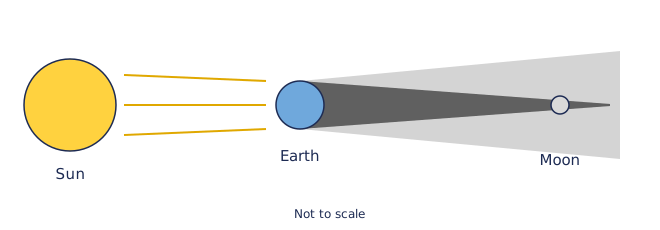
- It can only happen at the full moon phase.
- During the eclipse the Moon often turns reddish-brown.
Notes follow Science Year 6 (DLP), pp.166-167. Figures are redrawn, not to scale.
Eclipse of the Sun
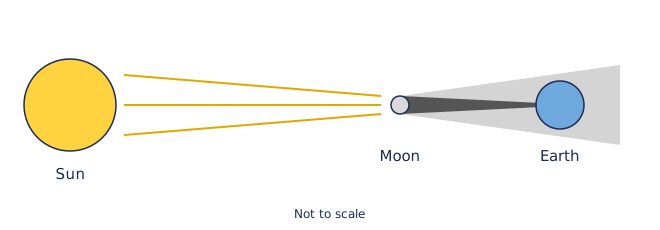
- It can only happen at the new moon phase. At new moon the Moon's surface facing Earth is dark, so we cannot see it.
- It can only be seen in the daytime.
| Eclipse of the Moon | Eclipse of the Sun | |
|---|---|---|
| Who is in the middle? | Earth | Moon |
| Whose shadow? | Earth's shadow on the Moon | Moon's shadow on Earth |
| Moon phase | Full moon | New moon |
| Time we see it | Night | Daytime |
Why not every month?
The Moon goes round Earth about once a month, so there is a full moon and a new moon every month. But there is not an eclipse every month. The Moon's orbit is tilted about 5° from Earth's orbit round the Sun. So at most full moons the Moon passes above or below Earth's shadow, and at most new moons its shadow passes above or below Earth.
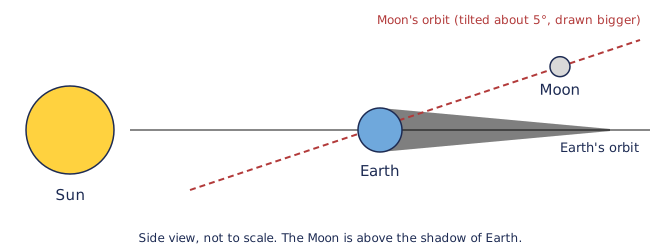
Each kind of eclipse can happen about twice a year.
Show answerHide answer
10.2Eclipses and the properties of light
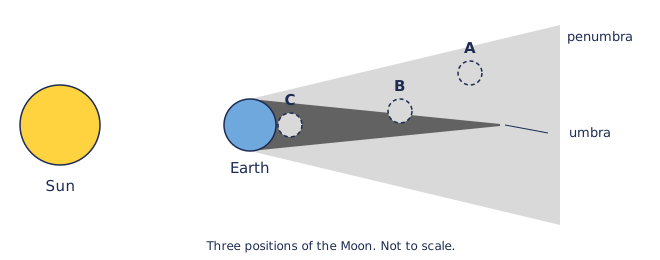
Sunlight travels in a straight line and cannot pass through opaque objects such as Earth and the Moon. That is why they make shadows. Every shadow in an eclipse has two parts.
| Where the Moon (or the observer) is | What is seen |
|---|---|
| Moon completely in Earth's umbra | Total eclipse of the Moon |
| Moon only partly in Earth's umbra | Partial eclipse of the Moon |
| On Earth inside the umbra of the Moon's shadow | Total eclipse of the Sun (and a partial one just before and after) |
| On Earth inside the penumbra of the Moon's shadow | Partial eclipse of the Sun only |
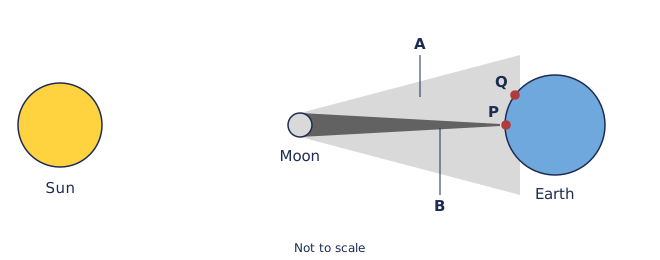
Show answerHide answer
Model and sketch
In the textbook activity, a torch is the Sun, a clay sphere is Earth and a pin on a plastic circle is the Moon. Move the pin into the line between the torch and the sphere in a dark room and look at the shadow on a white card. When you sketch, label the Sun, Earth, Moon, umbra and penumbra, and draw straight light rays.
10.3Conditions on Earth during an eclipse
- Eclipse of the Sun: the surroundings become darker, like evening, and the temperature falls. Animals react as if night is coming: birds return to their nests and some animals become quiet.
- Eclipse of the Moon: the level of the sea tide rises.
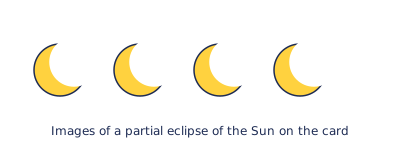
Pinhole camera: cut a square hole in a card, cover it with aluminium foil, and prick a few small holes in the foil. Hold a second white card behind it so sunlight through the holes forms an image on that card. Look at the card, never at the Sun.