Waste materials
What this chapter covers
- You can name the seven types of waste materials and give an example of each (9.1.1)
- You can explain what biodegradable and non-biodegradable waste mean (9.1.2)
- You can classify waste materials as biodegradable or non-biodegradable (9.1.3)
- You can explain why we must use biodegradable and non-biodegradable materials wisely (9.1.4)
- You can describe proper ways to manage waste, such as sorting, composting, reusing, recycling and repairing (9.1.5)
- You can explain the effects of poor waste management and suggest ways to keep life sustainable (9.1.6)
Every day we throw things away. What happens to them next? In this unit you will find out what waste materials are, why some rot away and some stay for years, and how to manage waste so that the environment stays healthy for the future.
9.1Managing waste materials
Seven types of waste
| Type of waste | Examples |
|---|---|
| Glass | Glass bottles, drinking glasses |
| Metal | Aluminium cans, scrap metal |
| Paper | Newspapers, boxes, books, magazines |
| Plastic | Food containers, plastic bottles, plastic bags |
| Food waste | Onion skin, chicken bones, egg shells, leftover vegetables, used cooking oil |
| Faeces | Waste matter of humans and animals |
| Toxic waste | Smog and chemical waste from vehicle workshops and factories |
Biodegradable and non-biodegradable waste
| Biodegradable | Non-biodegradable |
|---|---|
| Food waste | Plastic |
| Paper and boxes | Metals |
| Dry leaves | Glass |
| Faeces | Toxic waste |
Show answerHide answer
Using materials wisely
We must use both kinds of materials wisely, because both can harm the environment and living things if they are thrown away carelessly.
| Careless disposal | Effect |
|---|---|
| Leftover food thrown into a river (biodegradable) | It decomposes and uses up the oxygen in the water, so fish and other aquatic life die. |
| Plastic bottles and bags thrown into drains (non-biodegradable) | The drains are clogged and cause flash floods. |
| Plastic thrown into the sea | Turtles and other sea animals eat it or get trapped, and die. |
| Chemical waste dumped into a river | The water changes colour and smells bad, aquatic life dies, and people who breathe the toxic fumes become ill (as in the Kim Kim river pollution). |
Science info: plastic bottles can be recycled into clothes. They are cleaned, sorted by colour, crushed, made into fibres, spun into yarn and woven into cloth. A shirt needs only eight bottles.
Proper ways to manage waste
- Wrap and tie waste tightly in plastic bags before disposal, so pests such as rats and flies that carry diseases cannot get to it.
- Compost leftover food and other biodegradable waste into fertiliser.
- Use special containers for waste such as used cooking oil.
- Sort waste according to its type to make disposal easier.
- Donate things in good condition to people in need.
- Reuse waste for other purposes, like a lorry tyre made into a swing or old newspaper made into a kite.
- Recycle waste into new products.
- Repair faulty equipment to save money.
- Use reusable bags to cut down on plastic bags.
The 5R practices are Reduce, Reuse, Recycle, Repair and Refuse.
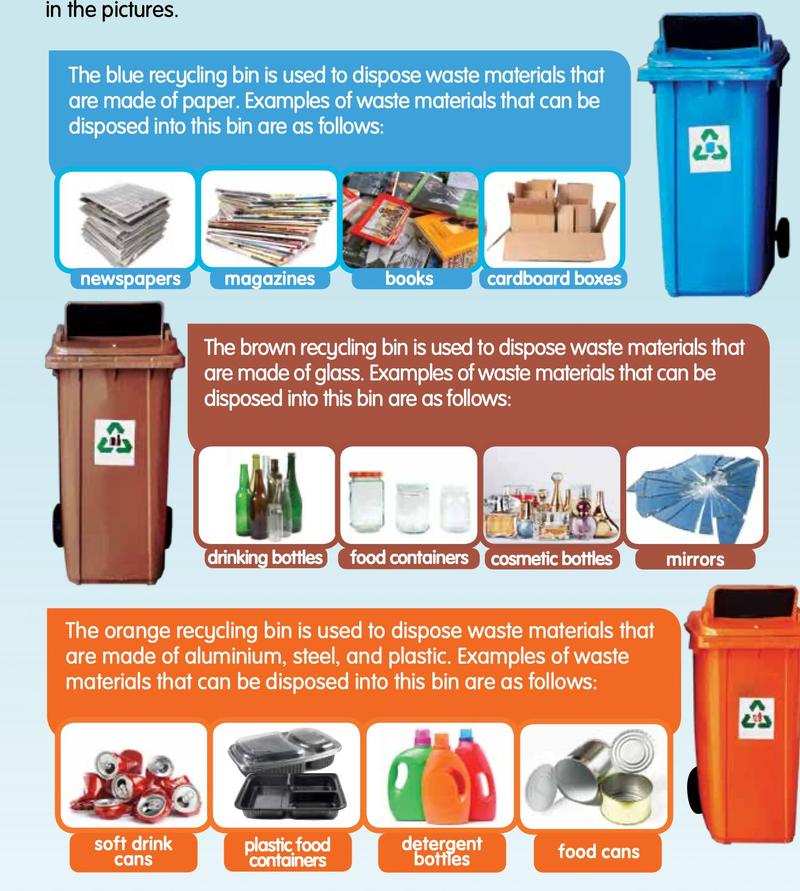
Recycling bins
| Colour of bin | For | Examples |
|---|---|---|
| Blue | Paper | Newspapers, magazines, books, cardboard boxes |
| Brown | Glass | Drinking bottles, food containers, cosmetic bottles, mirrors |
| Orange | Aluminium, steel and plastic | Soft drink cans, plastic food containers, detergent bottles, food cans |
What happens to the waste we throw away?
The local authority collects the waste and takes it to a centre for collection and sorting. There it is sorted into three groups.
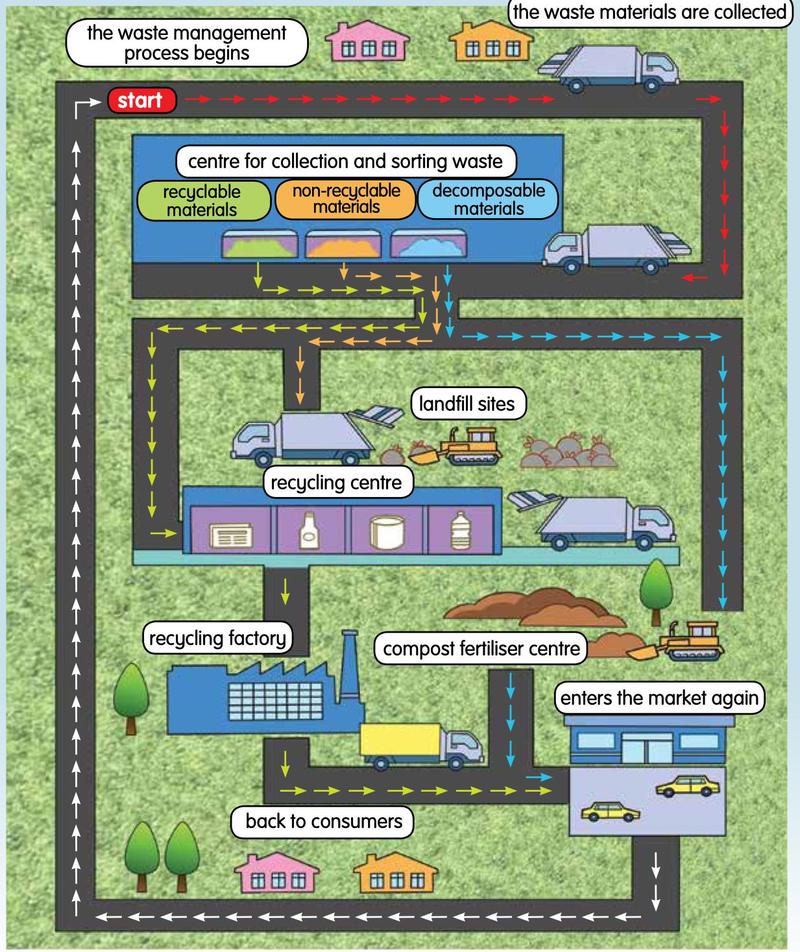
| Group | Goes to |
|---|---|
| Recyclable materials | Recycling centre, then recycling factory, then back to consumers as new products |
| Decomposable materials | Compost fertiliser centre |
| Non-recyclable materials | Landfill site |
Biodegradable: 6 + 5 = 11 kg. Non-biodegradable: 4 + 3 + 1 = 8 kg. The canteen can compost the food waste and recycle the glass, metal and plastic.
Making compost fertiliser
- Make a hole at the bottom of a flowerpot.
- Cut biodegradable waste (vegetable leftovers, egg shells, banana peels, newspaper, dry leaves) into small pieces.
- Put soil in as the first layer, then waste as the second layer. Repeat the layers until everything is used.
- Spray water on the mixture every day and cover the container.
- Stir once a week until everything has decomposed into compost fertiliser.
Show answerHide answer
Pictures: Science Year 6 (DLP) textbook, recycling bins p. 159 and waste management process p. 160. The canteen figures are drawn for this site.
Summary
| Idea | Key points |
|---|---|
| Waste materials | Materials we no longer need. Seven types: glass, metal, paper, faeces, plastic, food waste, toxic waste. |
| Biodegradable | Decomposed by microorganisms: food waste, paper, dry leaves, faeces. |
| Non-biodegradable | Not decomposed: plastic, metals, glass, toxic waste. |
| Effects of poor management | Water and air pollution, aquatic life dies, flash floods, health risks. |
| Proper management | Wrap, compost, sort, donate, reuse, recycle, repair, use reusable bags (5R). |