Science notes, unit 11
Galaxy
Textbook Science Year 6 (DLP, Semakan 2017), pages 179–192
What this chapter covers
- You can define a galaxy and say what it is made of (11.1.1)
- {'You can name the three shapes of galaxy': 'spiral, elliptical and irregular (11.1.1)'}
- You can describe the Milky Way as a barred spiral galaxy with two main arms (11.1.2)
- You can say that the Solar System is part of the Milky Way and where it is found (11.1.3)
- You can compare the size of the Solar System with the size of the Milky Way (11.1.4)
- You can use a model or simulation to show the size and shape of the Milky Way (11.1.5)
On a very dark night, Adam and his father see a dim band of light across the sky. It is the Milky Way, the galaxy that Earth belongs to. This unit is about what a galaxy is, the shapes galaxies have, and where we are in the Milky Way.
Pictures: Science Year 6 (DLP) textbook, pp. 182 and 184.
11.1Getting to know galaxies
Galaxy: a system made up of millions of stars, gases, dust and other types of matter. The stars revolve around the centre of their galaxy.
- There are billions of galaxies in the universe, of various shapes and sizes.
- A galaxy can hold from several million to several trillion stars.
- Galaxies are very far away. A picture taken by the Hubble Space Telescope shows thousands of little dots, and each dot is a galaxy.
- The Andromeda galaxy is a large spiral galaxy and the nearest large galaxy to Earth. On a very dark night it can be seen with the naked eye from the northern hemisphere.
Shapes of galaxies
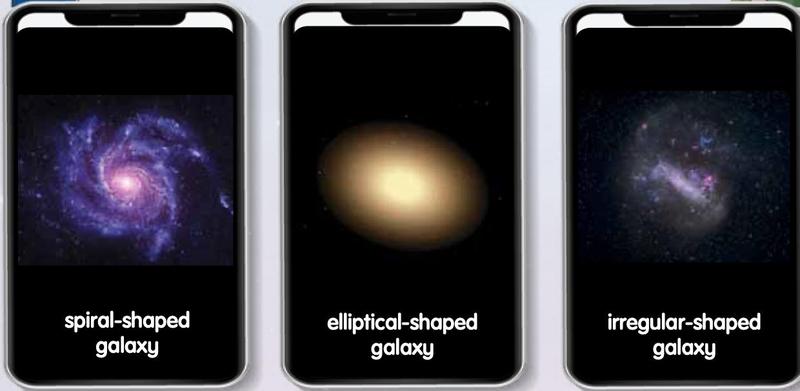
| Shape | What it looks like |
|---|---|
| Spiral | A bright centre with curved arms turning around it, like a whirlpool |
| Elliptical | A smooth, oval or round glow with no arms |
| Irregular | No regular shape |
Careful! A galaxy is not the same as the Solar System. The Solar System is only one small part of one galaxy.
Name the three shapes of galaxy.
Show answerHide answer
Spiral, elliptical and irregular.
11.2The Milky Way galaxy
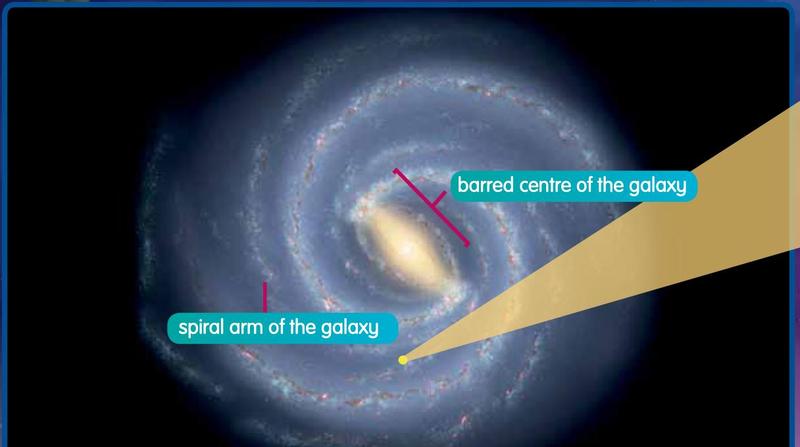
- The Milky Way is a barred spiral galaxy with two main arms and a bright, thick centre.
- From the side it looks like a thin disc that bulges at the centre.
- We see it as a dim band of stars in the night sky because Earth is inside this galaxy. Most stars we see at night belong to it.
- The name comes from the ancient Romans, who imagined the band as spilled milk.
- The Solar System (the Sun, Earth and seven other planets) is part of the Milky Way. It is at the edge of one of the spiral arms, and the Sun is one of the stars in the Milky Way.
- Because Earth is at the edge, we can only see a part of the Milky Way from Earth.
- Everything in the Solar System, such as asteroids, meteoroids and comets, is also part of the Milky Way.
Order of size, small to big: Earth, Solar System, Milky Way galaxy, universe.
Why can we see the Milky Way only as a band of light?
Show answerHide answer
Earth is inside the Milky Way, at the edge of one of its spiral arms, so we can see only a part of the galaxy.
11.3Comparing the sizes: how big is our galaxy?
The Solar System is tiny compared with the Milky Way. To picture this, imagine a simulation (not to real scale).
| Object | Imagined as |
|---|---|
| Solar System | The width of a pencil (or a hockey ball in the school field activity) |
| Milky Way galaxy | The whole school field |
Simulation on the school field
Pupil A stands in the middle as the centre of the Milky Way. Pupil B keeps a distance of 30 m from A and walks around A, sprinkling flour to make a circle. The circle is the galaxy and a hockey ball placed inside it is the Solar System. The ball is very small compared with the circle.Conclusion: the Solar System is very small compared with the Milky Way. The simulation is not to the actual scale and shape; it only helps us understand.
In the simulation the Solar System is a pencil width. What is the Milky Way?
Show answerHide answer
As big as the whole school field.