Stability and strength
What this chapter covers
- You can explain what the stability of objects and structures means (12.1.1)
- You can explain what the strength of objects and structures means (12.1.2)
- You can state how height and base area affect stability, and test them in a fair experiment (12.1.3)
- You can state how the type of material and the shape of a structure affect strength, and test them (12.1.4)
- You can explain why strong and stable structures are important for a sustainable life (12.1.5)
- You can define stability and strength operationally by building and testing a structure (12.1.6)
- You can design and make a model of a strong and stable structure from recycled materials (12.1.7)
Why does a tall pile of cups topple over so easily, while a wide pyramid of blocks stays put? Why do builders put triangles in bridges and roofs? In this unit you will learn what makes a structure stable and what makes it strong.
12.1Stability and strength of objects and structures
Stability
A stable structure does not collapse when a movement or force is applied to it. A tower of blocks that falls down when a fan blows on it is not stable.
Factors that affect stability
Two factors affect stability: height and base area.
| Factor | Change | Effect on stability |
|---|---|---|
| Height | Increases (taller) | Stability decreases |
| Height | Decreases (shorter) | Stability increases |
| Base area | Increases (wider) | Stability increases |
| Base area | Decreases (narrower) | Stability decreases |
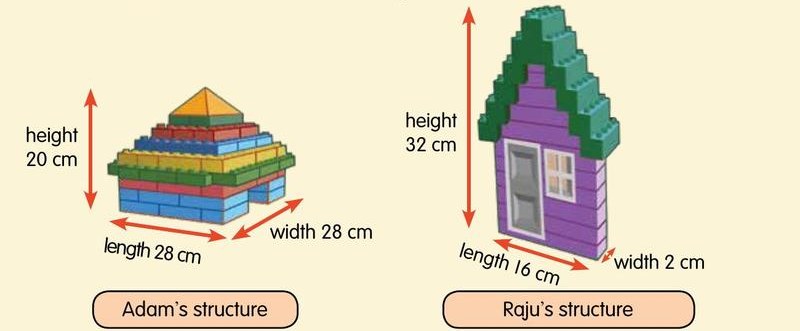
Figure: Science Year 6 (KPM), p.195.
Adam: 28 cm × 28 cm = 784 cm². Raju: 16 cm × 2 cm = 32 cm².
Adam's structure has the bigger base area and is also shorter (20 cm against 32 cm), so it is more stable.
Investigating height and base area
In a fair test only one variable is changed. The rest are kept the same.
| Height of structure | Base area of structure | |
|---|---|---|
| Aim | To find out how height affects stability | To find out how base area affects stability |
| Manipulated variable | Number of paper cups stacked (height) | Base area of the cans stacked |
| Responding variable | Time taken for a cup to fall | Time taken for a can to fall |
| Constant variable | Size of cups, cardboard, how it is moved | Size of cans, cardboard, how it is moved |
| Method | Move the cardboard back and forth, time how long until a cup falls | Same, using the different arrangements of cans |
| Result | Taller stack falls sooner | Smaller base falls sooner |
Show answerHide answer
Strength
Chua and his father used steel rods for the pillars of a rabbit cage so that the cage is stronger and lasts longer. Two factors affect strength: the type of material and the shape of the structure.
Type of material
| Material | Properties |
|---|---|
| Concrete | Strong, not flammable, does not rust or rot |
| Steel | Strong and durable metal |
| Plastic | Light and easy to shape |
| Wood | Strong, hard and easy to cut to size |
Different materials have different strength. In the test, paper, plastic and steel straws are held between supports and weights are added. The straw that carries the most weight before it bends is the strongest.
Shape of the structure
- Truss: poles joined to make triangles. Triangles resist heavy loads. Trusses are used in bridges and roofs.
- Arch: a curved structure that supports loads, used on bridges.
- Dome: a half-sphere shape that is strong and needs no pillars to hold it up. It is used for stadium roofs.
- Cylinder: strong and durable, and it reduces wind resistance. Lighthouses are cylinders.
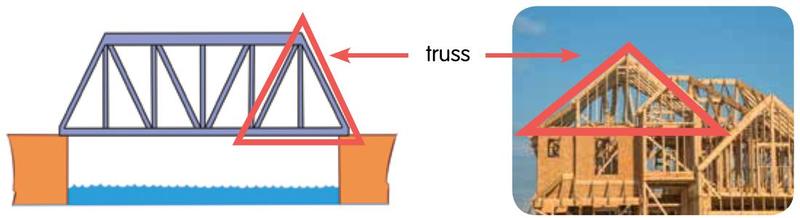
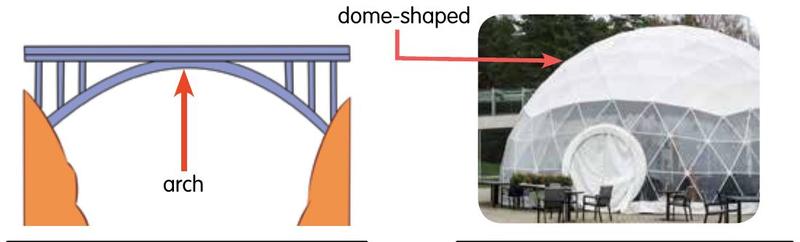
Figures: Science Year 6 (KPM), p.200.
Investigating shape
Four beams are made from the same size of manila card (24 cm × 12 cm): A is folded into a shape with four 3 cm lines, B a triangular beam, C a cylinder (rolled) and D a cuboid. Each beam is laid between two desks and weights are added until it bends or collapses. The beam that holds the most weight has the strongest shape.
| Variable | What it is |
|---|---|
| Manipulated | Shape of the beam |
| Responding | Mass of weights the beam holds before it changes |
| Constant | Size of the manila card, distance between the desks, type of card |
Show answerHide answer
Operational definitions
An operational definition says what you do and what you observe. For example:
Strength: a structure is stronger if it can hold more weights before it bends or collapses.
Why strong and stable structures are important
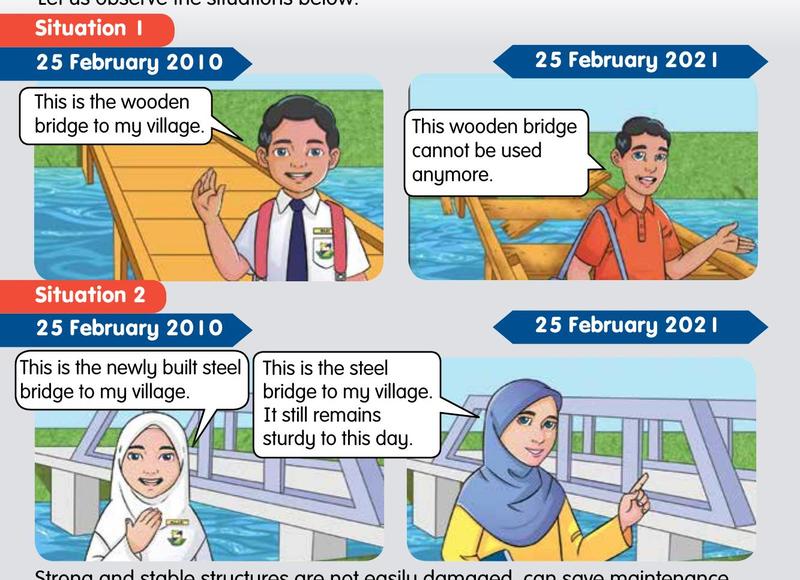
Figure: Science Year 6 (KPM), p.206.
- They are not easily damaged.
- They save maintenance cost.
- They are safe to use.
- They can be used for a long time, which helps a sustainable life.