Bonjour ! Saluer, compter et les objets du sac
What this chapter covers
- I can greet people and say goodbye (Bonjour !, Salut, ça va ?, Au revoir !, À bientôt !) and choose tu or vous (1.1)
- I can say my name and ask someone's name (Je m'appelle Aina. Comment tu t'appelles ?) (1.2)
- I can introduce a friend or a group (Je te présente Samuel. Je vous présente mes copines.) (1.2)
- I can use the subject pronouns and conjugate s'appeler and être in the present (je suis, tu es, il est, nous sommes, vous êtes, ils sont) (1.2, 1.3)
- I can count from 0 to 19 and write the numbers in letters (zéro … dix-neuf), and read simple sums (trois fois quatre égale douze) (1.4)
- I can name the objects in my school bag with un, une or des, and say what there is with il y a (Dans mon sac, il y a une trousse et des stylos.) (1.5)
- I can hear and say the silent final consonants and the liaisons in un‿agenda, des‿agendas, vous‿êtes (1.6)
- I can explain how French teenagers greet each other (la bise, serrer la main) and compare it with Malaysia (1.7)
Module 1 of Adosphère 1 is called Lucille. Lucille is a French girl of your age. In this module she says hello, tells us her name, introduces her friends (sa bande de copines), counts, and shows us what is in her school bag. By the end you can do the same in French: greet people, say who you are, count to 19 and name the things in your bag. In the UASA paper these topics come back in Partie 1 (grammar and vocabulary: numbers in letters, the verb être, word banks), Partie 2 (short texts with vrai ou faux) and Partie 3 (writing about yourself).
| Lesson | Book pages | You learn to |
|---|---|---|
| Leçon 1 : Je m'appelle Lucille | 14-15 | greet, say your name, ask a name, introduce someone; the verb s'appeler |
| Leçon 2 : Ma bande de copines | 16-17 | present your group of friends; the verb être; the numbers 0 to 19 |
| Leçon 3 : Dans mon sac, il y a… | 18-19 | name the objects in your bag; un, une, des; il y a |
| Leçon 4 : Les salutations | 20 | how French people greet each other |
| Mon cours de maths, Entraîne-toi, Évaluation DELF | 21-24 | sums in French, practice, a DELF-style test and the word list (Ton dico) |
1.1Saying hello and goodbye
Lesson 1 opens in a stationery shop. Lucille buys un cahier et un stylo and meets her friends Léa and Samuel. Read the start of the dialogue (book p. 14) and find the greetings.
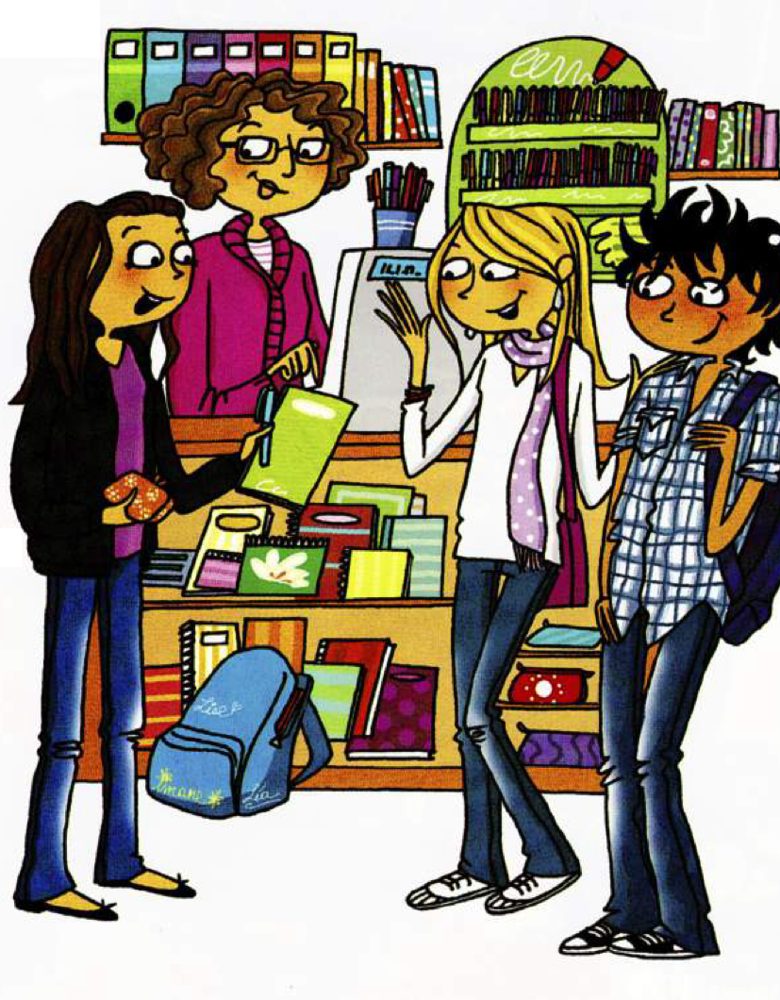
Adosphère 1, p. 14
Lucille – Merci madame !
Léa – Salut Lucille !
Lucille – Ah, bonjour Léa, ça va ?
Léa – Ça va. Et toi ? Je te présente Samuel.
Lucille – Salut !
Samuel – Bonjour Lucie.
Lucille – Ah non, je m'appelle Lucille, avec deux L.
Samuel – Oh pardon !
Greetings and polite words
| French | English | Say it to |
|---|---|---|
| Bonjour ! | Hello! / Good morning! | everyone (the polite, safe choice) |
| Salut ! | Hi! (also Bye!) | friends and family only |
| Ça va ? / Ça va bien, merci. | How are you? / I'm fine, thank you. | friends; with an adult, add monsieur or madame |
| Et toi ? | And you? | a friend |
| Au revoir ! | Goodbye! | everyone |
| À bientôt ! | See you soon! | everyone (also at the end of a message) |
| monsieur, madame, mademoiselle | sir / Mr, madam / Mrs, miss | adults you don't know well, teachers |
| merci | thank you | |
| pardon | sorry / excuse me | |
| Voilà… | Here is… / Here you are |
Tu or vous?
French has two words for "you". Use tu with one friend, a classmate or a family member. Use vous with an adult you must be polite to (a teacher, a shop assistant), and with more than one person. It is like kamu and awak versus cikgu or encik in Malay: you choose by who you are talking to.
| To a friend (tu) | To a teacher (vous) | |
|---|---|---|
| Hello | Salut ! Ça va ? | Bonjour monsieur. / Bonjour madame. |
| Your name? | Comment tu t'appelles ? | Comment vous vous appelez ? |
| Introduce | Je te présente Samuel. | Je vous présente Samuel. |
Saying
Writing
Writing
(a) You meet a new boy in your French class.
(b) You meet the new school principal.
(c) You talk to two new girls at the same time.
Show answerHide answer
(b) Comment vous vous appelez ? (polite, an adult)
(c) Comment vous vous appelez ? (more than one person)
1.2Saying your name and introducing someone
| You want to | French | English |
|---|---|---|
| say your name | Je m'appelle Lucille. Moi, c'est Léa. | My name is Lucille. I'm Léa. |
| ask a name | Comment tu t'appelles ? Comment vous vous appelez ? | What's your name? (friend) What's your name? (polite / more than one) |
| introduce someone | Je te présente Samuel. Je vous présente mes copines. | This is Samuel. (to a friend) Let me introduce my friends. (to a group / polite) |
| show someone | Voici Xavier. Voilà les photos. | Here is Xavier. There are the photos. |
Subject pronouns (les pronoms sujets)
| Singular | English | Plural | English | |
|---|---|---|---|---|
| 1st person | je (j' before a vowel) | I | nous | we |
| 2nd person | tu | you (one friend) | vous | you (polite, or more than one) |
| 3rd person | il / elle | he / she | ils / elles | they (boys or a mixed group) / they (only girls) |
The verb s'appeler (to be called)
| French | English |
|---|---|
| je m'appelle | my name is (I am called) |
| tu t'appelles | your name is |
| il / elle s'appelle | his / her name is |
| nous nous appelons | we are called |
| vous vous appelez | you are called |
| ils / elles s'appellent | their names are |
Spelling your name
In the book (p. 15, ex. 10), Théo spells his name: « T-H-E accent aigu-O ». French names often carry accents, and they are part of the name: Léa, Théo, Loïc (ï = tréma), Maël.
| Accent | French name | Example |
|---|---|---|
| é | accent aigu | Léa, Théo, téléphone |
| è | accent grave | mère, très |
| ê | accent circonflexe | vous êtes, bientôt (ô) |
| ç | cédille | ça va, garçon |
| ï | tréma | Loïc |
(a) Comment tu ______ ?
(b) Mes copains ______ Loïc et Oscar.
(c) Nous ______ la bande des trois M.
Show answerHide answer
(b) s'appellent (mes copains = ils)
(c) nous appelons (one L)
1.3My group of friends and the verb être
In Lesson 2 (p. 16) Lucille shows photos of sa bande de copines: « Nous sommes la bande des quatre. » Lise and Léa are twins (jumelles), and Imane is her best friend (sa meilleure copine).
| Boy (masculine) | Girl (feminine) | English |
|---|---|---|
| un garçon | une fille | a boy / a girl |
| un copain / des copains | une copine / des copines | a friend / friends |
| un ami | une amie | a friend |
| mon meilleur copain | ma meilleure copine | my best friend |
| des jumeaux | des jumelles | twins |
| une bande de copains / copines | a group (gang) of friends | |
| Il est sympa. Ils sont super ! | He is nice. They are great! | |
The verb être (to be)
| French | English | Example (book p. 16-17) |
|---|---|---|
| je suis | I am | Je suis sur la photo. |
| tu es | you are | Tu es Lucille ? |
| il / elle est | he / she is | Il est sympa. |
| nous sommes | we are | Nous sommes la bande des quatre. |
| vous êtes | you are | Vous êtes super ! |
| ils / elles sont | they are | Elles sont jumelles. |
(a) Je ______ Sam, et toi ?
(b) Lise et Léa ______ jumelles.
(c) Vous ______ dans la classe de français ?
(d) Nous ______ quatre.
Show answerHide answer
1.4Numbers from 0 to 19
The book teaches the numbers with a song (p. 17, ex. 11). Learn them in small groups, as the song does (1, 2, 3 / 4, 5, 6 / 7, 8, 9 / 10, 11, 12, then two at a time up to 19).
| 0-6 | 7-13 | 14-19 |
|---|---|---|
| 0 zéro | 7 sept | 14 quatorze |
| 1 un | 8 huit | 15 quinze |
| 2 deux | 9 neuf | 16 seize |
| 3 trois | 10 dix | 17 dix-sept |
| 4 quatre | 11 onze | 18 dix-huit |
| 5 cinq | 12 douze | 19 dix-neuf |
| 6 six | 13 treize |
Sums in French (Mon cours de maths, p. 21)
| Sign | French | Operation | Example |
|---|---|---|---|
| + | plus | une addition | 1 + 1 = 2 un plus un égale deux |
| − | moins | une soustraction | 19 − 5 = 14 dix-neuf moins cinq égale quatorze |
| × | fois | une multiplication | 3 × 4 = 12 trois fois quatre égale douze |
| ÷ | divisé par | une division | 16 ÷ 4 = 4 seize divisé par quatre égale quatre |
| = | égale |
(b) Work out and answer in French: Dix moins deux égale… ? Deux fois sept égale… ?
Show answerHide answer
(b) 10 − 2 = 8: huit; 2 × 7 = 14: quatorze
1.5In my school bag: un, une, des and il y a
Every French noun is either masculine or feminine, even objects. A pen is masculine (un stylo), a rubber is feminine (une gomme). There is no rule you can see from the object, so always learn the noun with its article, as the book advises (p. 23, apprendre à apprendre).
| Picture | French | English |
|---|---|---|
 | un sac à dos | a backpack |
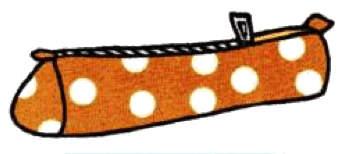 | une trousse | a pencil case |
 | un cahier | an exercise book |
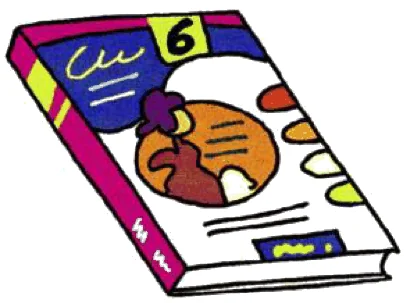 | un livre | a book |
 | un agenda | a diary, a planner |
 | un stylo | a pen |
 | une gomme | a rubber, an eraser |
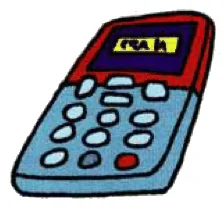 | une calculatrice | a calculator |
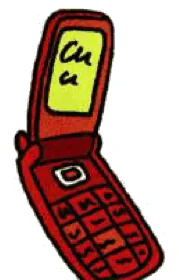 | un téléphone (portable) | a (mobile) phone |
 | une clé | a key |
 | un mouchoir / des mouchoirs | a tissue, a handkerchief / tissues |
Pictures: Adosphère 1, Ton dico illustré, p. 110
Indefinite articles (les articles indéfinis)
| Article | Examples (book p. 19) | English | |
|---|---|---|---|
| Masculine singular | un | un mouchoir, un garçon | a, an |
| Feminine singular | une | une clé, une fille | a, an |
| Plural (both) | des | des mouchoirs, des clés, des garçons, des filles | some (often not said in English) |
Il y a (there is, there are)
Il y a never changes, for one thing or many:
Dans la classe, il y a des filles et aussi des garçons. In the class there are girls and also boys.
Dans le sac A, il y a deux stylos, dans le sac B il y a trois stylos.
(b) Make singular (book p. 22, ex. 7): des téléphones → … ; des agendas → …
(c) Find the odd one out (p. 23, ex. 10): au revoir – bonjour – salut – une calculatrice
Show answerHide answer
(b) un téléphone ; un agenda
(c) une calculatrice (it is an object; the others are greetings)
1.6Pronunciation: silent letters and liaison
Silent final consonants (les consonnes muettes)
At the end of a French word, a consonant is usually not pronounced (book p. 23, ex. 13). The endings -s, -t and the verb ending -ent are silent.
| Written | You say |
|---|---|
| je suis, tu es, il est | [sɥi], [ɛ], [ɛ]: no s, no t |
| ils sont | [sɔ̃]: no t |
| ils s'appellent | sounds like s'appelle: -ent is silent |
| des stylos, des copains | the plural -s is silent |
Liaison
A liaison happens when a word that ends in a silent consonant comes before a word that starts with a vowel sound (a, e, i, o, u, é, ê, or a silent h). The silent consonant wakes up and joins the next word.
| Liaison | Sound | Examples |
|---|---|---|
| un + vowel | [n] | un‿agenda, un‿ami (book p. 23, ex. 14) |
| des + vowel | [z] | des‿agendas, des‿amis |
| pronoun + verb with a vowel | [z] | vous‿êtes, nous‿appelons, vous vous‿appelez (book p. 23, ex. 15) |
| no vowel, no liaison | un stylo, des mouchoirs, je suis, ils sont, nous sommes |
Show answerHide answer
1.7Greetings in France (les salutations)

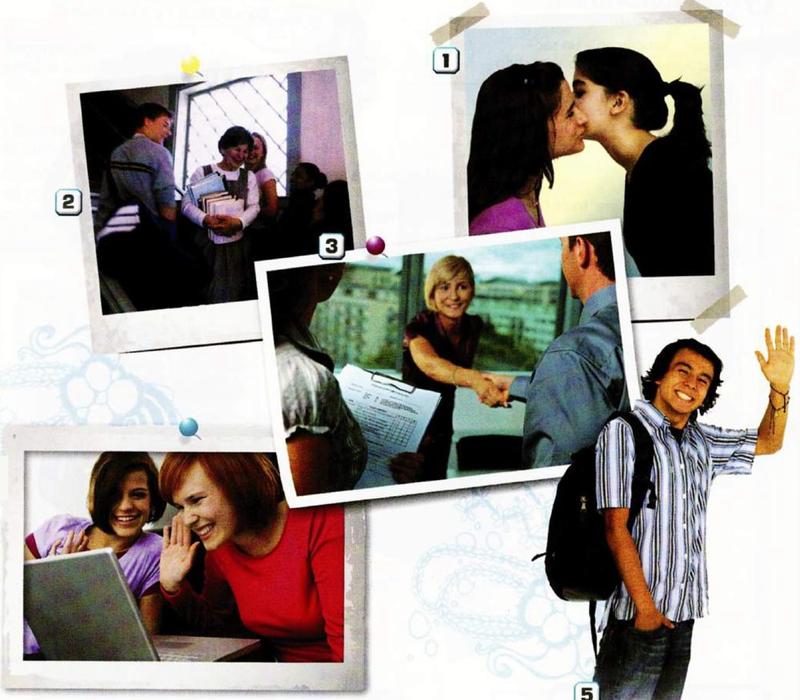
Adosphère 1, p. 20
| French | English | Who does it? |
|---|---|---|
| faire la bise | kiss on both cheeks (photo 1) | French girls with their friends, boys and girls who are close friends, family |
| serrer la main | shake hands (photo 3) | adults, people at work, boys often greet each other this way |
| faire un signe, dire bonjour ou au revoir | wave, say hello or goodbye (photos 4 and 5) | everyone, from a distance or online |
1. You say it to a friend. 2. You say it to an adult you don't know.
Show answerHide answer
Summary
| Topic | Remember |
|---|---|
| Greetings | Bonjour ! (everyone), Salut ! (friends), Ça va ? – Ça va bien, merci., Au revoir ! À bientôt ! |
| Name | Je m'appelle… / Moi, c'est…; Comment tu t'appelles ? (friend), Comment vous vous appelez ? (polite or more than one) |
| Introduce | Je te présente… (to one friend), Je vous présente… (to a group or an adult); Voici… |
| s'appeler | je m'appelle, tu t'appelles, il/elle s'appelle, nous nous appelons, vous vous appelez, ils/elles s'appellent |
| être | je suis, tu es, il/elle est, nous sommes, vous êtes, ils/elles sont |
| Numbers | zéro, un, deux, trois, quatre, cinq, six, sept, huit, neuf, dix, onze, douze, treize, quatorze, quinze, seize, dix-sept, dix-huit, dix-neuf; plus, moins, fois, divisé par, égale |
| Articles | un (masculine), une (feminine), des (plural); add a silent -s for the plural |
| School bag | un sac à dos, un cahier, un livre, un agenda, un stylo, un téléphone, un mouchoir; une trousse, une gomme, une calculatrice, une clé |
| il y a | there is / there are, never changes: Dans mon sac, il y a… |
| Sounds | final consonants are silent (suis, est, sont, appellent); liaison [n] in un‿agenda, [z] in des‿agendas, vous‿êtes |
| Culture | la bise between friends and family, serrer la main with adults; tu for friends, vous for adults |
1.
2.
3.
4.
5.