La ville : où j'habite et mon chemin
What this chapter covers
- I can say which town I live in and give my address (J’habite à Kuala Lumpur. J’habite rue du Parc. Chez moi, c’est au numéro 24.) (5.1)
- I can use chez with a name or a stressed pronoun (chez moi, chez toi, chez Xavier, chez elle) (5.1)
- I can name places in a town with the right article (la piscine, la bibliothèque, le collège, le musée, le pont) and say what there is in my area (Dans mon quartier, il y a…) (5.2)
- I can say where a place is (près de, loin de, dans, sur) and join de with le and les (près du collège, loin des jardins) (5.3)
- I can ask the way and give directions (C’est où, chez toi ? Tu tournes à droite, tu continues tout droit, tu traverses le pont.) and use the imperative (Tourne à gauche !) (5.4)
- I can say how I travel (à pied, à vélo, à rollers, en bus, en métro) and ask questions with où and quand (Où est-ce que tu traverses ?) (5.5)
- I can use the verb aller and join à with the article (Je vais au collège, à la piscine, à l’école, aux jardins.) (5.6)
- I can talk about Paris places and the rules of respect in a town (le Vélib’, la tour Eiffel, le passage piéton) (5.7)
In Module 5 you meet Imane, a girl who lives in Paris and goes everywhere by bicycle. You learn to say where you live, to name the places in a town, to say where a place is, to ask the way and give directions, and to talk about how you travel. The module also covers the verb aller (to go) and the small words au, à la, aux, du, des, which come up in every UASA paper.
Hello, my name is Imane! I live in Paris. I love my city because there are famous monuments, gardens and big squares, and because there is the Eiffel Tower! That's me in the photo. I'm on my bike. It's my way of getting around!
5.1Saying where you live: J’habite à…
In Lesson 1 (pp. 62-63) Xavier is lost on his bike. He phones Imane and asks: « C’est où, chez toi ? » (Where is your place?). To answer, you need the town, the street and the house number.
| To say | French | English |
|---|---|---|
| the town | J’habite à Paris. J’habite à Kuala Lumpur. | I live in Paris. I live in Kuala Lumpur. |
| the country | J’habite en Malaisie. J’habite en France. | I live in Malaysia. I live in France. |
| the street | J’habite rue du Parc. J’habite rue Goscinny. | I live in Parc Street. I live in Goscinny Street. |
| the number | Chez moi, c’est au numéro 24. Ma maison est au numéro 8 de la rue Goscinny. | My place is at number 24. My house is at number 8, Goscinny Street. |
| the full address | Imane habite 8 rue Goscinny. | Imane lives at 8 Goscinny Street. |
| the question | Tu habites où ? C’est où, chez toi ? Quelle est ton adresse ? | Where do you live? Where is your place? What is your address? |
Chez + a name or a stressed pronoun
Chez means "at the home of" or "to the home of". After it, use a name or a stressed pronoun (pronom tonique), never je, tu, il.
| Subject pronoun | Chez + stressed pronoun | English |
|---|---|---|
| je | chez moi | at my place / home |
| tu | chez toi | at your place |
| il | chez lui / chez Xavier | at his place / at Xavier's |
| elle | chez elle / chez Imane | at her place / at Imane's |
| nous | chez nous | at our place |
| vous | chez vous | at your place (plural or polite) |
| ils | chez eux / chez mes copains | at their place (boys or mixed) |
| elles | chez elles / chez mes copines | at their place (girls only) |
The possessive changes with the person too (p. 63): Ma maison est au numéro 8 (my house), Où est ta maison ? (your house), Sa maison est au numéro 22 (his or her house).
"
"
"
"
(a) Lucille habite rue Goscinny. Chez ______, c’est au numéro 22.
(b) Xavier et Oscar ? Chez ______, c’est loin.
(c) J’habite ______ Johor Bahru, ______ Malaisie.
Show answerHide answer
(b) eux (two boys)
(c) à (town), en (country)
5.2The town and its places: la ville
In Lesson 2 (pp. 64-65) Imane shows us mon quartier (my neighbourhood): « Dans mon quartier, il y a tout : une piscine, une bibliothèque, des jardins, une jolie place… »
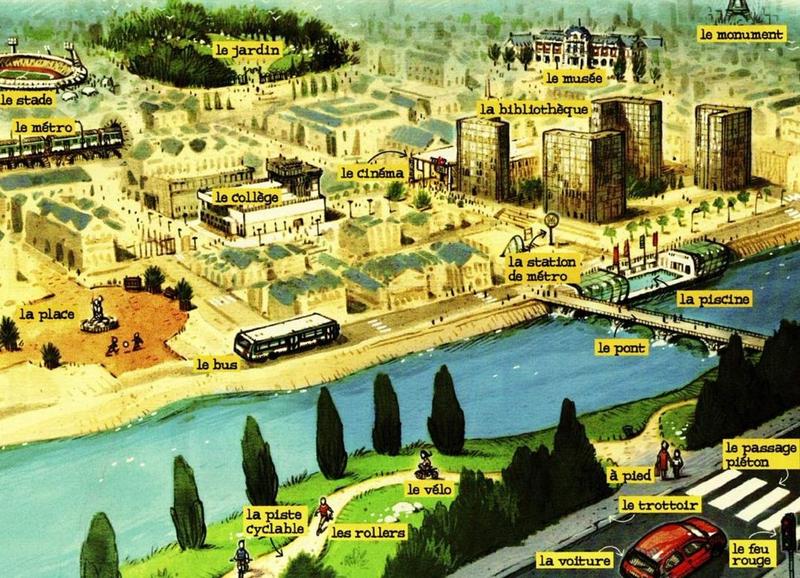
Adosphère 1, p. 113
| French | English | French | English |
|---|---|---|---|
| la ville | the town, the city | la piscine | the swimming pool |
| le quartier | the neighbourhood, the area | la bibliothèque | the library |
| la rue | the street | le collège | the secondary school (age 11-15) |
| la place | the square | le musée | the museum |
| le pont | the bridge | le jardin | the garden, the park |
| le monument | the monument | le cinéma | the cinema |
| la station de métro | the metro (underground) station | le stade | the stadium |
| le trottoir | the pavement | la piste cyclable | the cycle lane |
| le passage piéton | the zebra crossing | le feu (rouge / vert) | the (red / green) traffic light |
le musée is masculine, even though it ends in -ée.
le collège is masculine; la place and la piscine are feminine.
un collège is a secondary school (like an SMK), not a university college.
Learn each noun with its article: say "la bibliothèque", not just "bibliothèque".
Il y a + indefinite article, c’est + definite article
| Masculine | Feminine | Plural | |
|---|---|---|---|
| indefinite (a, some) | un collège | une piscine | des jardins |
| definite (the) | le collège, l’hôpital | la place, l’école | les jardins |
Il y a des jardins. Ce sont les jardins Abbé-Pierre.
Je suis dans un super collège : le collège Thomas-Mann !
Pronunciation: [ɑ̃] « an » and [œ̃] « in » (pp. 65, 71)
| Sound | Spellings | Examples |
|---|---|---|
| [ɑ̃] « an » | an, am, en, em | Mitterrand, dans, arrondissement, Maupassant, André |
| [œ̃] « in » | in, un, ain, ein | un, jardin, Saint-Martin, Saint-Germain |
Dans ma ville, il y a (a) ______ musée. C’est (b) ______ musée du Louvre. Il y a aussi (c) ______ grande place : c’est (d) ______ place des Vosges.
Show answerHide answer
5.3Saying where a place is: près de, loin de, dans, sur
| Preposition | English | Example (p. 65) |
|---|---|---|
| près de | near | Près de mon collège, il y a des jardins. |
| loin de | far from | Je n’habite pas loin de la station de métro. |
| dans | in, inside | Je suis dans un super collège. |
| sur | on | La péniche est sur la Seine. |
| à droite / à gauche | on the right / on the left | Regarde à droite, c’est mon collège ! (p. 72) |
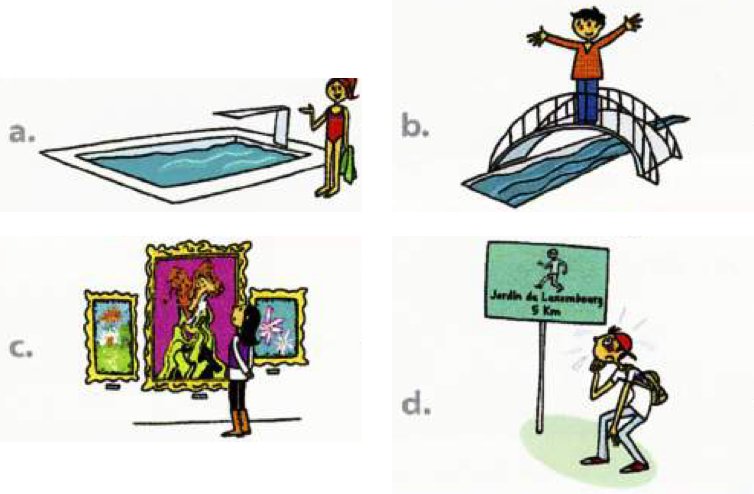
Adosphère 1, p. 71, ex. 9
De + article: du and des
Près de and loin de end in de. When the next word is le or les, the two words join (this is an article contracté):
| de + article | becomes | Example |
|---|---|---|
| de + le | du | près du collège, loin du pont |
| de + les | des | près des jardins |
| de + la | de la (no change) | près de la piscine |
| de + l’ | de l’ (no change) | loin de l’école |
"
"
"
(a) J’habite près ______ musée. (b) Le collège est loin ______ station de métro. (c) La bibliothèque est près ______ jardins.
Show answerHide answer
5.4Asking the way and giving directions
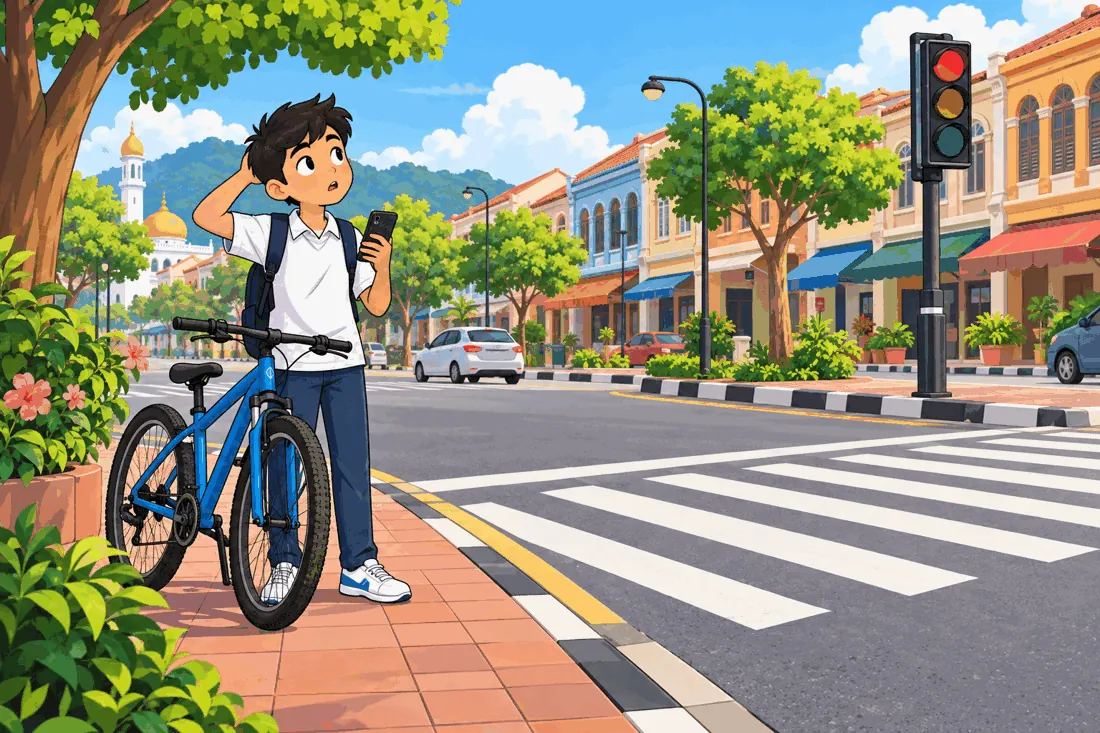
IMANE – Tu es où ? À la station de métro ?
XAVIER – Non, je suis sur le pont de Tolbiac.
IMANE – Tu traverses le pont et tu continues tout droit.
XAVIER – Tout droit après le pont, d’accord.
IMANE – Après tu tournes à gauche, rue des Frigos.
XAVIER – À gauche, rue des Frigos.
IMANE – Et après tu tournes à droite, rue Goscinny !
XAVIER – La rue Goscinny ? Mais, c’est chez Lucille !
IMANE – Oui, on habite la même rue ! Chez elle, c’est au numéro 22. Chez moi, c’est au numéro 8. À pied, c’est à 10 minutes du pont de Tolbiac.
XAVIER – Je ne suis pas à pied, je suis à vélo !
IMANE – À vélo ? Tu fais du vélo et tu téléphones ?
XAVIER – Non, je ne roule pas, je suis sur le trottoir.
IMANE – Je préfère !
Xavier: Hello, Imane? It's Xavier… I'm lost, where is your place? Imane: Where are you? At the metro station? Xavier: No, I'm on the Tolbiac bridge. Imane: You cross the bridge and you go straight on. … Then you turn left, rue des Frigos. … And then you turn right, rue Goscinny!
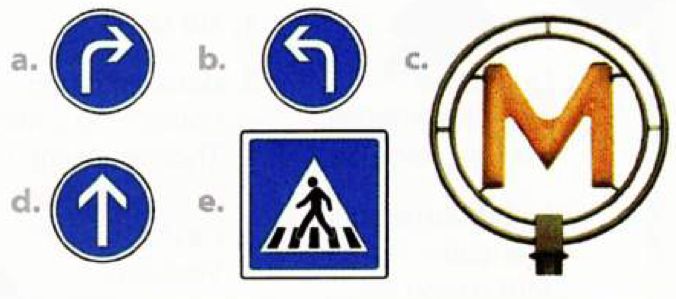
Adosphère 1, p. 63, ex. 7
| To give directions (p. 63) | English |
|---|---|
| Tu tournes à droite / à gauche. | You turn right / left. |
| Tu continues tout droit. | You go straight on. |
| Tu traverses le pont / la rue. | You cross the bridge / the road. |
| Après le pont / la station de métro… | After the bridge / the metro station… |
| C’est à 10 minutes à pied. | It's 10 minutes on foot. |
To ask the way: C’est où, chez toi ? Tu habites où ? Où est la bibliothèque, s’il te plaît ? When you are lost: Je suis perdu (boy) / Je suis perdue (girl).
The imperative: giving orders and instructions
Imane gives directions with tu + the present tense (tu tournes). You can also use the imperative (l’impératif), the form for orders and instructions (p. 122). Drop the subject pronoun. For -er verbs, the tu form also drops its final -s.
| Present | Imperative | English |
|---|---|---|
| Tu tournes à droite. | Tourne à droite ! | Turn right! |
| Tu continues tout droit. | Continue tout droit ! | Go straight on! |
| Tu traverses la rue. | Traverse la rue ! | Cross the road! |
| Nous tournons à gauche. | Tournons à gauche ! | Let's turn left! |
| Vous traversez le pont. | Traversez le pont ! | Cross the bridge! (to several people, or politely) |
| Tu vas à la piscine. | Va à la piscine ! | Go to the pool! (aller also drops the -s: p. 125) |
| Tu ne téléphones pas. | Ne téléphone pas à vélo ! | Don't phone on your bike! |
"
"
"
tout droit (straight on) is not the same as à droite (on the right).
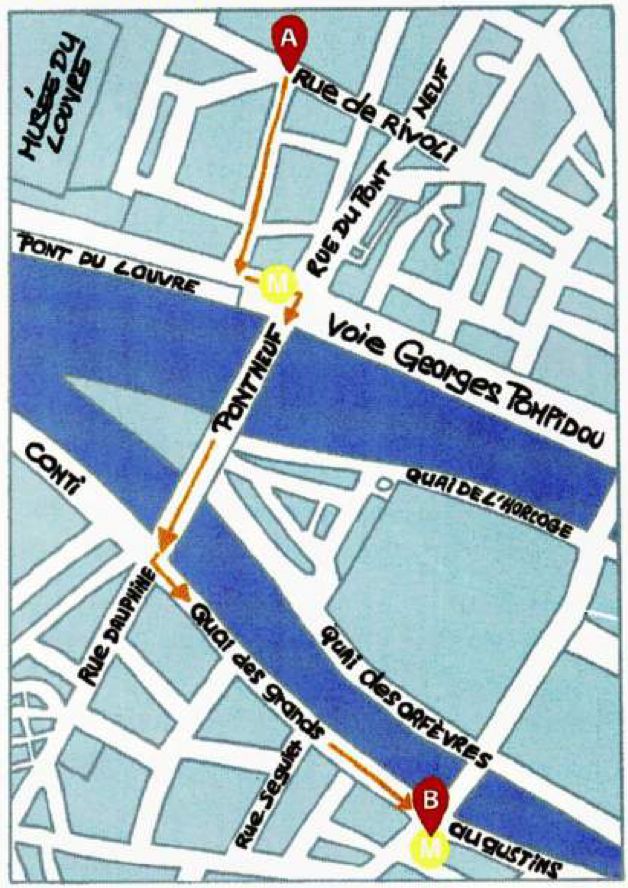
Adosphère 1, p. 71
From A, go straight on. At the metro station, turn left and cross the Pont-Neuf. After the bridge, turn left onto quai des Grands-Augustins and go straight on. B is the metro station. (Walking down the map, a turn towards the right-hand side of the page is a turn to your left.)
(a) Tu traverses le pont. (b) Tu tournes à gauche. (c) Vous continuez tout droit.
Show answerHide answer
5.5Getting around: les moyens de transport and the highway code

| à + transport (you are on it, or on your feet) | en + transport (you are inside it) |
|---|---|
| Je suis à pied. (on foot) Tu es à vélo. (by bike) Il est à rollers. (on roller skates) | Nous sommes en bus. (by bus) Vous êtes en métro. (by metro) Elle est en voiture. (by car) |
Also useful: Je prends le bus / le métro (I take the bus / the metro), Je marche (I walk), Je roule à vélo (I ride my bike). The words for things are le vélo, les rollers, le bus, le métro, la voiture (p. 72).
"
"
The textbook says à vélo; you may hear "en vélo" in France, but write à vélo in the exam.
The highway code game (pp. 66-67)
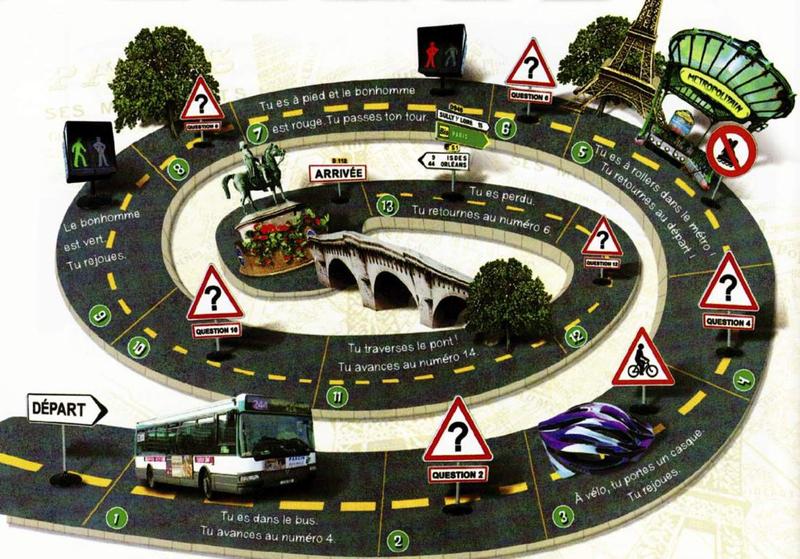
Adosphère 1, p. 66
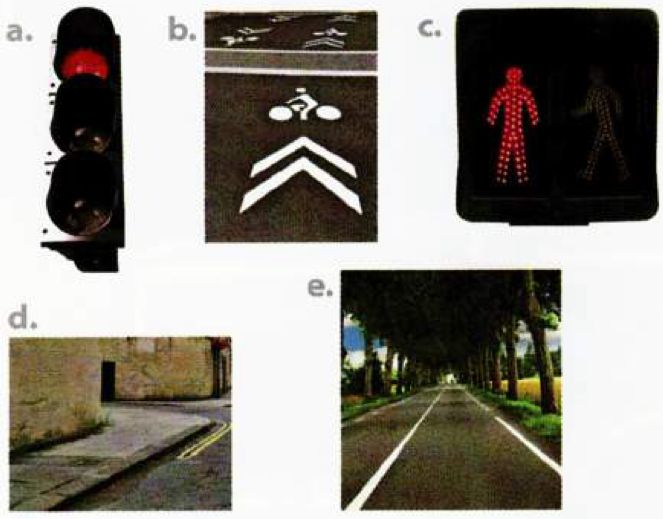
Adosphère 1, p. 67, ex. 3
| French | English |
|---|---|
| le bonhomme rouge / vert | the red / green man (pedestrian light) |
| Je traverse quand le bonhomme est vert. | I cross when the green man is on. |
| À vélo, je roule sur une piste cyclable. | On my bike, I ride in a cycle lane. |
| À vélo, tu portes un casque. | On a bike, you wear a helmet. |
| À rollers, tu portes un casque et des protections. | On roller skates, you wear a helmet and pads. |
| Tu avances. Tu retournes. Tu rejoues. Tu passes ton tour. | Move forward. Go back. Play again. Miss a turn. (game instructions) |
Questions with où (where) and quand (when)
| Question (two ways, p. 67) | Answer |
|---|---|
| Tu traverses où ? Où est-ce que tu traverses ? | Sur le passage piéton. |
| Tu traverses quand ? Quand est-ce que tu traverses ? | Je traverse quand le bonhomme est vert. |
(b) How does each person travel? Je roule sur une piste cyclable. / Je suis dans la station.
Show answerHide answer
(b) Il / Elle est à vélo. / Il / Elle est en métro.
5.6The verb aller and à + article
Aller (to go) is irregular: learn it by heart (p. 125). It is also used for the near future: Je vais visiter Paris (I am going to visit Paris, p. 122).
| Present | English | Imperative |
|---|---|---|
| je vais | I go / I am going | Va ! Allons ! Allez ! |
| tu vas | you go | |
| il / elle / on va | he / she / we go | |
| nous allons | we go | |
| vous allez | you go (plural or polite) | |
| ils / elles vont | they go |
À + article: au, à la, à l’, aux
After aller à (to go to), à joins with le and les, just as de does (p. 121, les articles contractés).
| à + article | becomes | Example |
|---|---|---|
| à + le | au | Je vais au collège. Tu vas au cinéma. |
| à + les | aux | Nous allons aux jardins Abbé-Pierre. |
| à + la | à la (no change) | Elle va à la piscine. |
| à + l’ | à l’ (no change) | Ils vont à l’école. |
| à + town | à | Vous allez à Paris ? |
J’habite près du musée. (de + le: I live near the museum)
"
"
"
"
(a) Le samedi, je ______ ______ stade.
(b) Imane et Lucille ______ ______ bibliothèque.
(c) Vous ______ ______ hôpital en bus ?
Show answerHide answer
(b) vont à la (la bibliothèque)
(c) allez à l’ (l'hôpital: silent h)
5.7Culture: Paris by bike and respect in town
Le Vélib’ (from vélo + liberté) is the Paris bike-share scheme: you take a bicycle from a street station and leave it at another one. The textbook (p. 68) suggests three bike routes:
| Route | Places |
|---|---|
| « Paris des Monuments » | la tour Eiffel, le musée du Louvre (its entrance is a glass pyramid), Notre-Dame de Paris (on an island in the Seine) |
| « Paris des Grandes Places » | la place Charles-de-Gaulle (also called place de l’Étoile: twelve avenues meet there like the points of a star, around l’Arc de triomphe), la place de la Concorde (with an obelisk), la place des Vosges |
| « Paris des Jardins » | le parc des Buttes-Chaumont, le jardin du Luxembourg, le bois de Vincennes |
The civics page (Mon cours d’instruction civique, p. 69) is about le respect on public transport and in town:
J’ai un ticket de transport. (I have a ticket.)
Je ne dessine pas sur le métro, les bus, etc. (I don't draw graffiti.)
Je respecte les autres. (I respect other people: I give my seat to an older person.)
Je ne téléphone pas à vélo. (I don't phone while riding.)
(a) Je suis une grande tour et je suis près de la Seine.
(b) Je suis une grande place en forme d’étoile.
(c) Mon entrée est une pyramide.
Show answerHide answer
Summary
| Topic | Key French |
|---|---|
| Where you live | J’habite à Paris / en Malaisie. J’habite rue du Parc. Chez moi, c’est au numéro 24. |
| Chez + stressed pronoun | chez moi, toi, lui, elle, nous, vous, eux, elles; chez Xavier |
| Places | la ville, le quartier, la rue, la place, le pont, la piscine, la bibliothèque, le collège, le musée, le jardin, le cinéma, la station de métro |
| Articles | Il y a une piscine. C’est la piscine Joséphine-Baker. |
| Saying where | près de, loin de, dans, sur, à droite, à gauche; de + le = du, de + les = des |
| Directions | Tu tournes à droite / à gauche. Tu continues tout droit. Tu traverses le pont. Après le pont… |
| Imperative | Tourne ! Continue ! Traverse ! Va ! (no -s); Tournons ! Traversez ! |
| Transport | à pied, à vélo, à rollers; en bus, en métro, en voiture |
| Questions | Tu traverses où ? = Où est-ce que tu traverses ? Tu traverses quand ? = Quand est-ce que tu traverses ? |
| Aller | je vais, tu vas, il va, nous allons, vous allez, ils vont |
| À + article | au collège, à la piscine, à l’école, aux jardins |
| Culture | le Vélib’, la tour Eiffel, le Louvre, la place de l’Étoile; le respect, le code de la rue |