Bahasa Perancis questions, module 7
Nama / NameKelas / ClassTarikh / Date
La famille, les pays et les transports
43 marks. Use Practice to check each answer as you go, or Exam to answer everything first. The questions follow the real UASA Bahasa Perancis paper: multiple choice, then Partie 1 (grammaire et vocabulaire), Partie 2 (compréhension écrite) and Partie 3 (production écrite). Instructions are in French with the English below.
Section A: questions à choix multiples
8 marksChoisissez la bonne réponse : A, B, C ou D. Choose the correct answer: A, B, C or D.
1
Question 1
Le frère de ma mère est mon ______ .
Show answerHide answer
C
My mother's brother is my uncle: l'oncle (mon oncle). A cousin is the uncle's child, the grandfather is the mother's father, and a nephew is the son of my brother or sister.
2
Question 2
You phone your friend Samuel. His mother answers: « Allô ? » What is the best thing to say?
Show answerHide answer
B
The caller greets, says who she is (c'est + name) and asks politely with vous because she speaks to an adult. A and C are what the person who answers says; D uses tu and does not ask for Samuel.
3
Question 3
Alice : « Boris est ______ frère et Victoria est ma sœur. »
Show answerHide answer
A
Frère is masculine singular, so 'my brother' is mon frère. Ma is for a feminine noun (ma sœur), mes for a plural, and sa means his or her.
4
Question 4
Léa adore ______ père. Il est très sympathique.
Show answerHide answer
D
The possessive agrees with the noun, not with the owner. Père is masculine, so it is son père, even though Léa is a girl. Sa and ma are for a feminine noun (sa mère, ma mère), and ses is for a plural.
5
Question 5
Cet été, nous allons ______ Portugal en voiture.
Show answerHide answer
B
Le Portugal is masculine (it does not end in -e), so 'to Portugal' is au Portugal (à + le = au).
6
Question 6
Mes cousins habitent ______ États-Unis, à New York.
Show answerHide answer
D
Les États-Unis is plural, so it takes aux (à + les): aux États-Unis. À is used for the city: à New York.
7
Question 7
Which sentence is correct?
Show answerHide answer
A
You sit inside a plane or a boat, so use en: en avion, en bateau. On foot is à pied.
8
Question 8
La Journée internationale de la francophonie, c'est le ______ .
Show answerHide answer
C
Tous les ans, le 20 mars, c'est la Journée internationale de la francophonie. (p. 92) 1 May and 30 June are the start and end of Alice's trip; 14 July is the French national day.
Partie 1: grammaire et vocabulaire
24 marksRépondez à toutes les questions. Answer all the questions.
9
Question 9
Regardez l'arbre généalogique de la famille Martin. Complétez à l'aide des mots suivants.
Look at the Martin family tree. Complete the sentences with the words below.
Look at the Martin family tree. Complete the sentences with the words below.
le grand-père / la tante / la cousine / le neveu / le beau-frère / la sœur
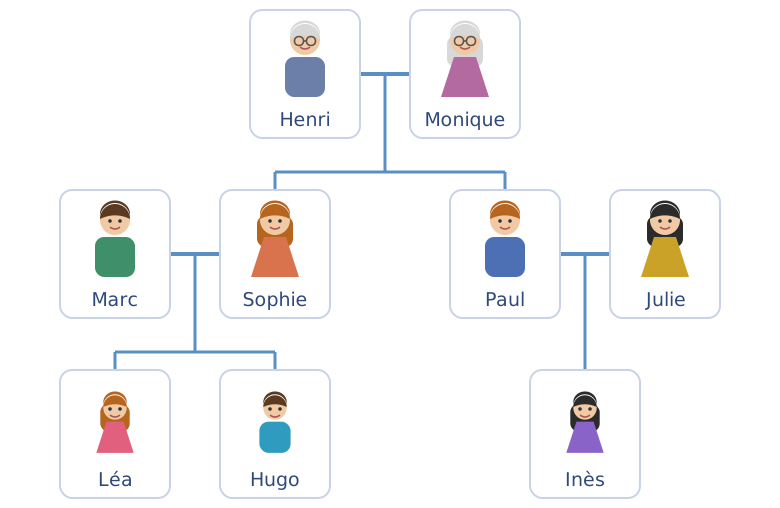
[1 mark]
(a)Henri est ______ d'Hugo.
Show answerHide answer
Tick each point you got.
[1 mark]
(b)Julie est ______ de Léa.
Show answerHide answer
Tick each point you got.
[1 mark]
(c)Inès est ______ d'Hugo.
Show answerHide answer
Tick each point you got.
[1 mark]
(d)Hugo est ______ de Paul.
Show answerHide answer
Tick each point you got.
[1 mark]
(e)Marc est ______ de Paul.
Show answerHide answer
The extra word is la sœur. Léa is the sister (la sœur) of Hugo, but no sentence needs it.
Tick each point you got.
10
Question 10
Regardez encore l'arbre généalogique de la famille Martin et cochez la bonne case : Vrai ou Faux.
Look again at the Martin family tree and tick True or False.
Look again at the Martin family tree and tick True or False.
[1 mark]
(a)Monique est la grand-mère d'Inès.
Show answerHide answer
Vrai
Inès is the daughter of Paul, and Paul is the son of Monique.
[1 mark]
(b)Paul est le père de Léa.
Show answerHide answer
Faux
Léa's father is Marc. Paul is her uncle (son oncle).
[1 mark]
(c)Sophie est la sœur de Paul.
Show answerHide answer
Vrai
Sophie and Paul are both children of Henri and Monique.
[1 mark]
(d)Hugo est le petit-fils de Julie.
Show answerHide answer
Faux
Julie is Hugo's aunt. Hugo is the grandson (le petit-fils) of Henri and Monique, and the nephew (le neveu) of Julie.
11
Question 11
Écrivez les nombres en lettres. Write the numbers in words.
[1 mark]
(a)Le grand-père Henri a 68 ans.
Show answerHide answer
Tick each point you got.
[1 mark]
(b)La tante Julie a 41 ans.
Show answerHide answer
Tick each point you got.
12
Question 12
Complétez les phrases avec le verbe « aller » au présent.
Complete the sentences with the verb aller in the present tense.
Complete the sentences with the verb aller in the present tense.
[1 mark]
(a)Je ______ au Québec chez mes grands-parents.
Show answerHide answer
Tick each point you got.
[1 mark]
(b)Mon frère et moi, nous ______ à la plage.
Show answerHide answer
Tick each point you got.
[1 mark]
(c)Mes parents ______ au marché à Dakar.
Show answerHide answer
Tick each point you got.
13
Question 13
Complétez avec « mon », « ma » ou « mes ». Complete with mon, ma or mes.
[1 mark]
(a)Je te présente ______ grand-mère, Victoire.
Show answerHide answer
Tick each point you got.
[1 mark]
(b)______ cousins habitent au Canada.
Show answerHide answer
Tick each point you got.
[1 mark]
(c)______ amie Aina est malaisienne.
Show answerHide answer
Tick each point you got.
14
Question 14
Complétez à l'aide des mots suivants : au / en / aux / à. Complete with au, en, aux or à. Use each word once.
[1 mark]
(a)Ma tante habite ______ Malaisie, à Ipoh.
Show answerHide answer
Tick each point you got.
[1 mark]
(b)Alice va ______ Sénégal en bateau.
Show answerHide answer
Tick each point you got.
[1 mark]
(c)Mes grands-parents sont ______ Pays-Bas.
Show answerHide answer
Tick each point you got.
[1 mark]
(d)Mon oncle travaille ______ Paris.
Show answerHide answer
Tick each point you got.
15
Question 15
Associez chaque phrase au bon moyen de transport. Match each sentence with the right means of transport.
[1 mark]
(a)Je traverse l'océan Atlantique et je regarde les dauphins.
Show answerHide answer
en bateau
You see dolphins in the sea from a boat.
[1 mark]
(b)Je vais de Kuala Lumpur à Paris en treize heures.
Show answerHide answer
en avion
Only a plane goes from Malaysia to France in thirteen hours.
[1 mark]
(c)Le collège est à trois cents mètres de ma maison. Je marche.
Show answerHide answer
à pied
Je marche = I walk, so à pied (on foot).
Partie 2: compréhension écrite
6 marksLisez le texte et répondez aux questions. Read the text and answer the questions.
16
Question 16
Une carte postale
Chère Camille,Je m'appelle Aina, j'ai treize ans et je suis malaisienne. J'habite à Ipoh. Je suis en vacances à Dakar, au Sénégal, avec ma famille : mon père, ma mère et mes deux petits frères, Danial et Irfan. Le Sénégal est un pays magnifique et les gens sont très sympathiques. Ils parlent français ! Aujourd'hui, nous visitons le marché. Demain, nous allons à l'île de Gorée en bateau. Mon oncle Hafiz habite en France, à Lyon. Samedi, nous allons chez lui en avion. Mes frères sont contents : ils adorent les avions !
Bisous,
Aina

[1 mark]
(a)Aina voyage avec ses parents et ses frères.
Show answerHide answer
Vrai
« avec ma famille : mon père, ma mère et mes deux petits frères ».
[1 mark]
(b)Au Sénégal, les gens parlent anglais.
Show answerHide answer
Faux
« Ils parlent français ! »
[1 mark]
(c)Demain, la famille va à l'île de Gorée en bus.
Show answerHide answer
Faux
They go to Gorée island en bateau (by boat). It is an island, so a bus cannot go there.
17
Question 17
Relisez la carte postale d'Aina (question 16) et répondez aux questions. Read Aina's postcard again and answer the questions.
[1 mark]
(a)Comment s'appellent les frères d'Aina ?
Show answerHide answer
Tick each point you got.
[1 mark]
(b)Où habite l'oncle d'Aina ?
Show answerHide answer
Tick each point you got.
[1 mark]
(c)Quelle est la nationalité d'Aina ?
Show answerHide answer
The postcard says « je suis malaisienne ». Aina is a girl, so the adjective is feminine (-ne), with a small m.
Tick each point you got.
Partie 3: production écrite
5 marksÉcrivez en français. Write in French.
18
Question 18
Vous êtes en voyage avec votre famille dans un pays francophone. Écrivez une carte postale à un copain ou une copine (40 à 60 mots).
You are travelling with your family in a French-speaking country. Write a postcard to a friend (40 to 60 words).
You are travelling with your family in a French-speaking country. Write a postcard to a friend (40 to 60 words).
- Où êtes-vous ? Where are you?
- Avec qui ? (deux membres de votre famille) Who with? (two family members)
- Comment voyagez-vous ? How do you travel?
- Qu'est-ce que vous faites ? Comment est le pays ? What do you do? What is the country like?
[5 marks]
(a)Votre carte postale : Your postcard:
Show answerHide answer
Cher Adam,
Je suis en vacances au Sénégal avec ma mère et mes cousins. Nous sommes à Dakar. Nous voyageons en avion de Kuala Lumpur à Dakar, puis nous visitons le pays en bus. La ville est très grande et les gens sont sympathiques. Aujourd'hui, nous allons à la plage. Demain, mon cousin et moi, nous allons au marché.
À bientôt !
Sara (model answer, about 60 words)
Je suis en vacances au Sénégal avec ma mère et mes cousins. Nous sommes à Dakar. Nous voyageons en avion de Kuala Lumpur à Dakar, puis nous visitons le pays en bus. La ville est très grande et les gens sont sympathiques. Aujourd'hui, nous allons à la plage. Demain, mon cousin et moi, nous allons au marché.
À bientôt !
Sara (model answer, about 60 words)
Common slips to check: en + feminine country but au + masculine; son / sa follow the noun; Cher to a boy, Chère to a girl.
Tick each point you got.