La famille, les pays et les transports
What this chapter covers
- I can make and answer a phone call (Allô, bonjour, c'est Alice. Est-ce que Samuel est là, s'il vous plaît ? / Ne quitte pas, je te le passe.) (7.1)
- I can name the members of my family and read a family tree (le grand-père, la tante, le cousin, le neveu, le beau-frère) (7.2)
- I can choose the right possessive for the noun, not for the owner (mon père, ma mère, mes frères ; son père, sa mère) (7.3)
- I can name countries with their article and say someone's nationality (le Sénégal, la France, les États-Unis ; il est malaisien, elle est malaisienne) (7.4)
- I can say where I go or where I am with the right preposition (au Sénégal, en France, aux États-Unis, à Dakar, à la Réunion) (7.5)
- I can conjugate the verb aller in the present (je vais, nous allons, ils vont) (7.6)
- I can say how I travel (en avion, en bateau, en bus, à vélo, à pied) (7.7)
- I can describe a country and place it on a map (La ville est très grande. Les gens sont sympathiques. La Belgique est au nord de la France.) (7.8)
In Module 7 you travel with Alice and her family. She says: « Voici mon père, ma mère, mon grand frère et ma petite sœur. Nous faisons un grand voyage dans les pays francophones ! » They leave on 1 May for la Réunion, cross to Africa (la Côte-d'Ivoire and le Sénégal) and arrive on 30 June in Québec, at her grandparents' home. On the way you learn to phone someone, talk about your family, name countries, say where you go and how you travel. In the UASA these come up as the family tree questions (Partie 1 and Partie 2) and the writing task « Vous vous présentez et parlez de votre famille ».
7.1Téléphoner: making a phone call
In the first dialogue Alice phones her friend Samuel. Samuel's mother answers first, so Alice is polite and uses vous: s'il vous plaît. Then Samuel comes to the phone and they use tu.
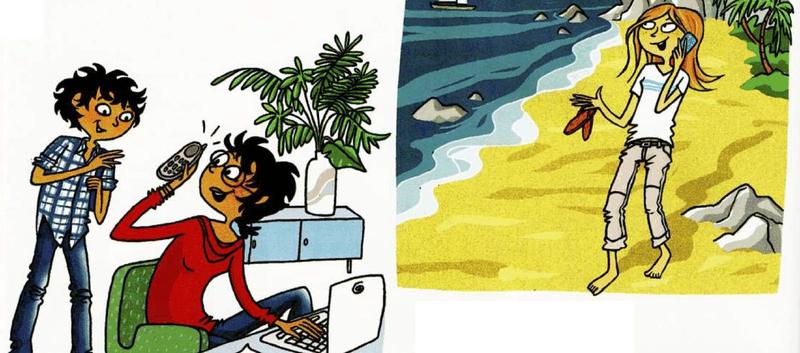
Picture: Adosphère 1, p. 86.
| To call (pour appeler) | To answer (pour répondre) |
|---|---|
| Allô Samuel ? C'est Alice. (to a friend) | Salut Alice. |
| Allô, bonjour, c'est Alice. Est-ce que Samuel est là, s'il vous plaît ? (to an adult) | Ne quitte pas, je te le passe. = Hold on, I'll pass him to you. Non, je suis désolé(e), il est au match de foot. = No, sorry, he is at the football match. |
Table « Pour téléphoner »: Adosphère 1, p. 87.
Useful phrases on the phone
| French | English |
|---|---|
| Allô ? | Hello? (only on the phone) |
| C'est toi ? / Oui, c'est moi. | Is that you? / Yes, it's me. |
| Tu es où ? | Where are you? |
| Qu'est-ce que vous faites ? | What are you (all) doing? |
| C'est une erreur. | It's a wrong number. |
| Au revoir ! / Bisous ! / À bientôt ! | Goodbye! / Kisses (to friends and family) / See you soon! |
«
«
To Samuel's mother: « Samuel est là,
(a) Salut Emma ! Oui, c'est moi. Je suis au Québec.
(b) Allô ?
(c) Au revoir, Emma. Bisous !
(d) Allô, Lucas ? C'est Emma. Tu es où ?
(e) Super ! Bon voyage !
Show answerHide answer
7.2La famille: family words and the family tree
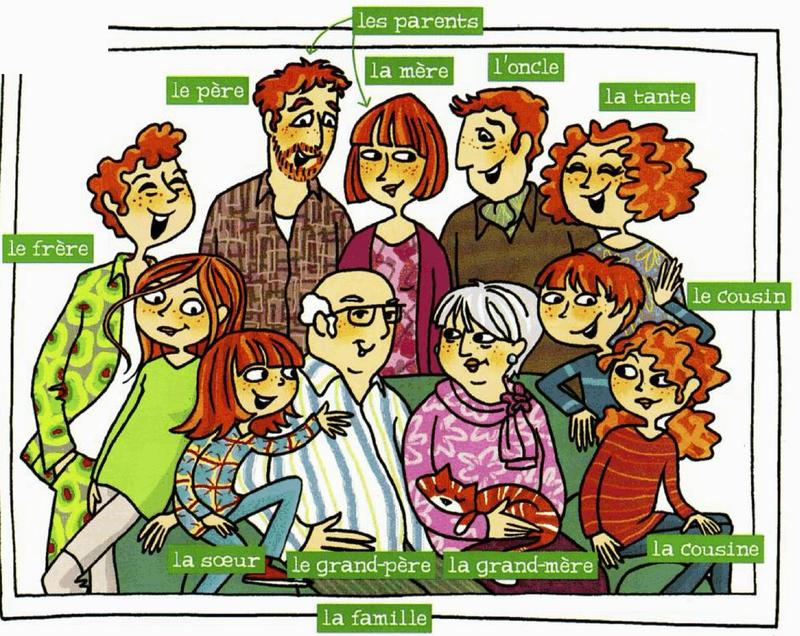
Ton dico illustré: Adosphère 1, p. 116.
| Masculine (le) | Feminine (la) | English |
|---|---|---|
| le père | la mère | father / mother (together: les parents) |
| le frère | la sœur | brother / sister |
| le grand-père | la grand-mère | grandfather / grandmother (together: les grands-parents) |
| l'oncle | la tante | uncle / aunt |
| le cousin | la cousine | cousin (boy) / cousin (girl) |
| le fils | la fille | son / daughter (la fille also means girl) |
| le mari | la femme | husband / wife (la femme also means woman) |
Ton dico, Adosphère 1, pp. 96 and 116 (the words for son/daughter and husband/wife are extra, for the family tree questions).
More family words (they appear in UASA papers)
The real UASA paper also uses these words in its family tree questions. Learn them with the tree below.
| Masculine | Feminine | Meaning |
|---|---|---|
| le petit-fils | la petite-fille | grandson / granddaughter (child of my son or daughter); together les petits-enfants |
| le neveu | la nièce | nephew / niece (child of my brother or sister) |
| le beau-frère | la belle-sœur | brother-in-law / sister-in-law (husband of my sister, wife of my brother, or my husband's or wife's brother or sister) |
| le beau-père | la belle-mère | father-in-law / mother-in-law (also: stepfather / stepmother) |
| le beau-fils (le gendre) | la belle-fille | son-in-law / daughter-in-law |
Alice's family tree
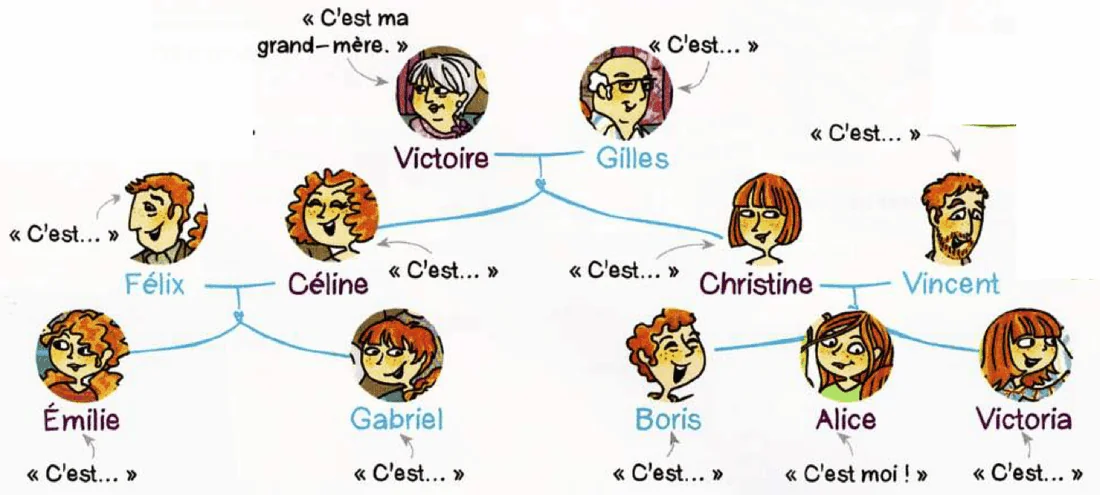
Exercise 5, Adosphère 1, p. 87.
Christine, c'est ma mère. Vincent, c'est mon père.
Boris, c'est mon frère. Victoria, c'est ma sœur.
Céline, c'est ma tante. Félix, c'est mon oncle. (Félix is married to Alice's aunt.)
Émilie, c'est ma cousine. Gabriel, c'est mon cousin.
And from the grandparents' side: Alice est la petite-fille de Victoire et de Gilles. From Céline's side: Alice est la nièce de Céline. Boris est le neveu de Céline.
« Émilie est
« Le frère de ma mère est mon
« la
«
(a) Gilles est … de Boris.
(b) Céline est … de Victoria.
(c) Gabriel est … de Christine.
(d) Le père de mon père est … .
Show answerHide answer
7.3Les adjectifs possessifs: mon, ma, mes
To say my, your, his/her in French, the word changes with the noun that follows: masculine, feminine or plural.
| Masculine noun | Feminine noun | Plural noun | |
|---|---|---|---|
| my | mon père | ma mère | mes parents |
| your (tu) | ton frère | ta sœur | tes cousins |
| his / her | son oncle | sa tante | ses grands-parents |
| our | notre père, notre mère | nos parents | |
| your (vous) | votre frère, votre sœur | vos cousins | |
| their | leur oncle, leur tante | leurs enfants | |
Précis grammatical « Les adjectifs possessifs »: Adosphère 1, p. 121.
In Malay and English, his and her depend on the person who owns. In French, son / sa depend only on the noun.
Aisyah's father:
Hakim's mother:
So son père can mean his father or her father.
(a) Je te présente … cousins, Gabriel et Émilie.
(b) Alice parle avec … frère Boris.
(c) Samuel téléphone à … grand-mère.
(d) … amie Lina habite à Penang.
Show answerHide answer
7.4Les pays et les nationalités
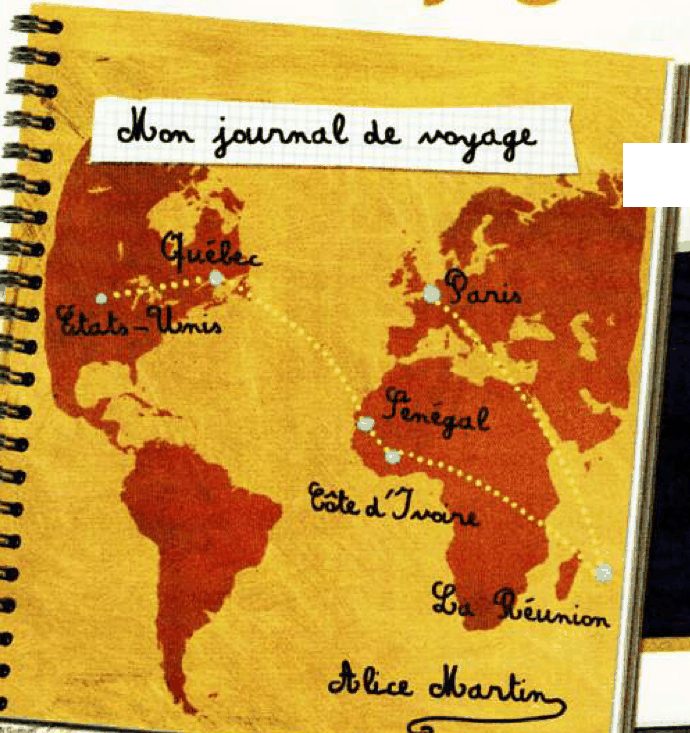
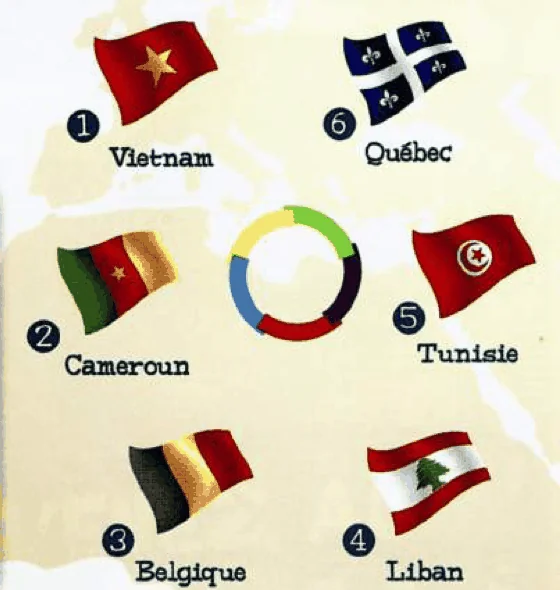
Pictures: Adosphère 1, pp. 88 and 92.
Every country in French has an article, like every noun: le, la, l' or les. The book's rule: « Presque tous les noms de pays qui se terminent par « e » sont féminins. » (Almost all country names that end in -e are feminine.)
| Masculine (le) | Feminine (la / l') | Plural (les) | Island (no rule: learn it) |
|---|---|---|---|
| le Sénégal, le Canada, le Québec, le Portugal, le Mali, le Cameroun, le Maroc, le Liban, le Vietnam, le Luxembourg, le Royaume-Uni | la France, la Malaisie, la Belgique, la Tunisie, la Suisse, la Côte-d'Ivoire, l'Algérie, l'Égypte, l'Italie, l'Espagne, l'Allemagne | les États-Unis, les Pays-Bas, les Antilles | la Réunion, Madagascar, l'île de Gorée |
Countries from Adosphère 1, pp. 88-89, 92-95.
Nationalities
A nationality is an adjective. Add -e for a girl or woman (and sometimes double the last letter). It is written with a small letter: Il est français.
| Country | He is … | She is … | Language |
|---|---|---|---|
| la Malaisie | malaisien | malaisienne | le malais |
| la France | français | française | le français |
| le Sénégal | sénégalais | sénégalaise | le français, le wolof |
| le Canada | canadien | canadienne | le français, l'anglais |
| la Belgique | belge | belge (already ends in -e) | le français, le néerlandais |
| les États-Unis | américain | américaine | l'anglais |
| l'Espagne | espagnol | espagnole | l'espagnol |
| la Chine | chinois | chinoise | le chinois |
« Je suis
« Elle est
« Il parle
7.5Prepositions: au Sénégal, en France, aux États-Unis, à Dakar
To say in or to a country, the preposition depends on the article of the country. With je vais (I go) and je suis (I am), it is the same preposition.
| Preposition | Used with | Examples |
|---|---|---|
| au | masculine country (à + le) | Je vais au Sénégal. Ils habitent au Québec. Mon oncle travaille au Canada. |
| en | feminine country, or a country starting with a vowel | Je suis en France. Nous allons en Allemagne. Ma tante habite en Malaisie. On va en Égypte. |
| aux | plural country (à + les) | Je rêve d'aller aux États-Unis. Ils sont aux Pays-Bas. |
| à | a town or city, an island | Je vais à New York. J'habite à Kuala Lumpur. Nous sommes à la Réunion. |
Table « Les prépositions devant les noms de pays ou de villes »: Adosphère 1, p. 89.
Places in a town: à la, à l', au, aux
The same à joins with the article of a place: à + le = au, à + les = aux; à la and à l' do not change.
| Rule | Example |
|---|---|
| à la + feminine noun | Je vais à la plage. |
| à l' + noun starting with a vowel | Allez à l'île de Gorée. |
| au + masculine noun | Je vais au musée. N'oubliez pas d'aller au marché. |
| aux + plural noun | Je vais aux toilettes. |
Table « Les prépositions de lieu »: Adosphère 1, p. 91.
« Je vais
« Il habite
« Je vais
« Ils sont
(a) Mes cousins habitent … Portugal.
(b) Nous allons … Tunisie en avion.
(c) Je suis … Paris avec ma sœur.
(d) Vous allez … Antilles en janvier ?
(e) Mon père travaille … Algérie.
Show answerHide answer
7.6Le verbe aller (to go)
Aller is irregular: learn it by heart. It is the verb you need for every trip in this module.
| Singular | Plural |
|---|---|
| je vais | nous allons |
| tu vas | vous allez |
| il / elle / on va | ils / elles vont |
Table « Le verbe aller »: Adosphère 1, p. 89.
Ensuite, je vais au Québec en avion… et peut-être aux États-Unis.
Je rêve d'aller à New York !
Journal, Adosphère 1, p. 88.
« Ils
« Je
« Vous
(a) Où est-ce qu'elles … ? (b) Tu … en France. (c) Nous … à la plage. (d) Il … au musée.
Show answerHide answer
7.7Les transports: en avion, à vélo

To say how you travel, use en for a vehicle you sit inside, and à when you sit on it or walk.
| en + transport (inside) | à + transport (on top, or on foot) |
|---|---|
| en avion (by plane) en bateau (by boat) en bus (by bus) en métro (by underground train) en voiture (by car) en train (by train) | à vélo (by bicycle) à pied (on foot) à moto (by motorbike) à rollers (on roller skates) |
Adosphère 1, pp. 67, 89 and 96. The book prints à vélo (p. 67) and once en vélo in a pronunciation sentence (p. 95): à vélo is the form to learn; en vélo is heard in everyday speech.
« Je vais à l'école
« Je vais au collège
« Nous voyageons
Phonétique, Adosphère 1, pp. 89 and 95.
(a) Je vais à l'école … pied. (b) Ma mère va au marché … voiture. (c) Mon frère va à la plage … vélo. (d) Nous traversons la mer … bateau.
Show answerHide answer
7.8Describing a country: Venez au Sénégal !
In lesson 3 Alice reads a tourist leaflet about Senegal. It describes the country with être + an adjective. The adjective agrees with the noun: la ville → grande, les gens → sympathiques.
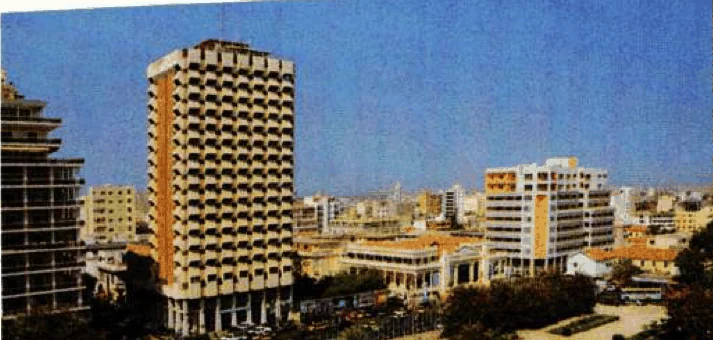
Leaflet « Venez au Sénégal ! »: Adosphère 1, p. 90.
| To describe a country (pour parler des caractéristiques d'un pays) | English |
|---|---|
| La ville est très grande. | The city is very big. |
| La Maison des Esclaves est un musée célèbre. | The House of Slaves is a famous museum. |
| Le fleuve Sénégal est magnifique. | The Senegal River is beautiful. |
| Promenez-vous dans les petits villages, près de l'océan Atlantique. | Walk in the small villages near the Atlantic Ocean. |
| Les gens sont sympathiques et ils parlent français. | The people are friendly and they speak French. |
| Au Sénégal, il y a des paysages… La capitale est Dakar. | In Senegal there are landscapes… The capital is Dakar. |
Table « Pour parler des caractéristiques d'un pays »: Adosphère 1, p. 91.
Where is it? au nord de, au sud de
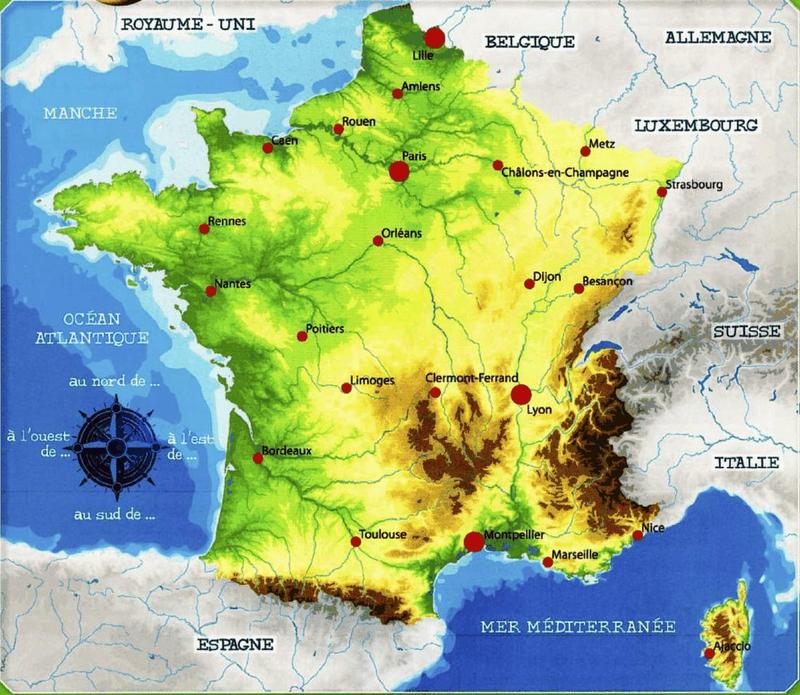
Map: Adosphère 1, p. 93.
| French | English | Example |
|---|---|---|
| au nord de | north of | La Belgique est au nord de la France. |
| au sud de | south of | L'Espagne est au sud de la France. |
| à l'est de | east of | La Suisse est à l'est de la France. |
| à l'ouest de | west of | L'océan Atlantique est à l'ouest de la France. |
(a) L'Italie est à l'ouest de la France.
(b) L'Allemagne est à l'est de la France.
(c) Marseille est au nord de Paris.
Show answerHide answer
Culture: la Journée internationale de la francophonie
Every year on 20 March (le 20 mars) French speakers celebrate the International Day of the Francophonie. The book says French is spoken in 55 countries (cinquante-cinq pays): 32 in Africa and the Middle East, 6 in America, 3 in Asia (for example Vietnam) and 14 in Europe. It is the world's language number 9. In Senegal, Cameroon and Côte d'Ivoire, French is the language of school and government, alongside local languages such as Wolof in Senegal.
Adosphère 1, p. 92.
Summary
| Topic | Remember |
|---|---|
| Phoning | Allô, bonjour, c'est Alice. Est-ce que Samuel est là, s'il vous plaît ? / Ne quitte pas, je te le passe. / Non, je suis désolé(e), il est au match de foot. |
| Family | le père, la mère, le frère, la sœur, le grand-père, la grand-mère, l'oncle, la tante, le cousin, la cousine; extra: le neveu, la nièce, le petit-fils, la petite-fille, le beau-frère, la belle-sœur |
| Possessives | Follow the noun: mon père, ma mère, mes parents; son père = his or her father; before a vowel: mon amie |
| Countries | Almost all in -e are feminine: la France, la Malaisie; le Sénégal, le Canada; les États-Unis |
| Prepositions | au + masculine, en + feminine or vowel, aux + plural, à + city or island; places: à la plage, à l'île, au musée, aux toilettes |
| Aller | je vais, tu vas, il/elle/on va, nous allons, vous allez, ils/elles vont |
| Transport | en avion, en bateau, en bus, en métro, en voiture, en train; à vélo, à pied, à moto |
| Nationality | il est malaisien / elle est malaisienne, small letter; language: le malais |
| Describing | La ville est très grande. Les gens sont sympathiques. La Belgique est au nord de la France. |