Mathematics notes, chapter 1
Rational numbers
Textbook Mathematics Form 1 (DLP), pages 2–28
What this chapter covers
- Recognise positive and negative numbers in real life, describe integers, show them on a number line and arrange them in order (1.1)
- Add, subtract, multiply and divide integers, follow the order of operations, use the laws of arithmetic and solve problems (1.2)
- Represent, compare and arrange positive and negative fractions, compute with them and solve problems (1.3)
- Represent, compare and arrange positive and negative decimals, compute with them and solve problems (1.4)
- Recognise rational numbers as p/q (q ≠ 0), compute with them and solve problems (1.5)
1.1Integers
Positive numbers are written with a "+" sign or no sign, such as +2, 45. Negative numbers are written with a "−" sign, such as −1, −10. We read −1 as "negative one".
Positive and negative numbers describe two opposite changes in daily life.
| Situation | Positive | Negative |
|---|---|---|
| Lift | Going up 2 floors: +2 | Going down 1 floor: −1 |
| Temperature | 45°C in a desert: +45 | 10°C below 0°C on a glacier: −10 |
| Movement | Car A moves 40 m to the right: +40 | Car B moves 50 m to the left: −50 |
| Business | Profit of RM2 000: +2 000 | Loss of RM500: −500 |
| Sea level | 20 m above sea level: +20 | 20 m below sea level: −20 |
Integers are the positive and negative whole numbers, together with zero: …, −3, −2, −1, 0, 1, 2, 3, …
Example 2 (textbook p. 4): integer or not?
15, 23, −3.4, −76, 0, 12, 6, 0.88, −45, 301, −239Integers: 15, 23, −76, 0, 6, 301, −239
Not integers: −3.4, 12, 0.88, −45 (they are not whole numbers)
Zero is an integer. It is neither positive nor negative.
Integers on a number line

- The further a positive integer is to the right, the greater its value. 3 means 3 more than 0.
- The further a negative integer is to the left, the smaller its value. −3 means 3 less than 0.
Comparing and arranging integers
Example 4(a) (textbook p. 6): arrange −3, 4, 2, −5, 6, 0, −1 in ascending order

Ascending order: −5, −3, −1, 0, 2, 4, 6
Descending order is the reverse: 6, 4, 2, 0, −1, −3, −5
Ascending = smallest to largest (going up). Descending = largest to smallest (going down). A positive number is always greater than a negative number.
Thinking −5 is greater than −2 because 5 is greater than 2. On the number line −5 is further left, so −5 < −2. The coldest temperature is the most negative one.
Arrange −4, 3, 1, −6, 5, 0, −2 in ascending order.
Show answerHide answer
−6, −4, −2, 0, 1, 3, 5
1.2Basic arithmetic operations involving integers
Adding and subtracting integers
| Operation | On the number line |
|---|---|
| Add a positive integer, + (+3) | Move right |
| Add a negative integer, + (−2) | Move left |
| Subtract a positive integer, − (+4) | Move left |
| Subtract a negative integer, − (−4) | Move right |
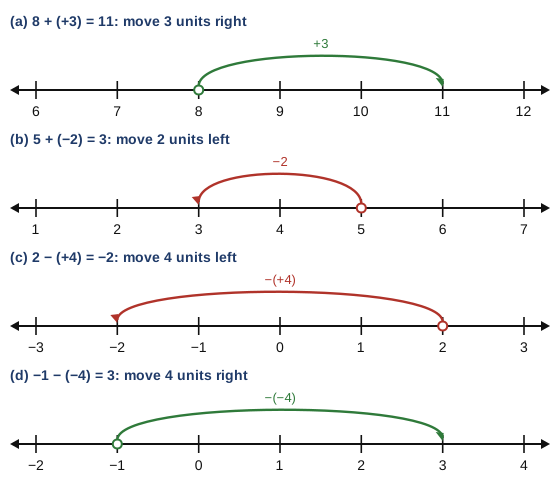
Two signs side by side can be joined: + (+) → +, + (−) → −, − (+) → −, − (−) → +. So 5 + (−2) = 5 − 2 = 3 and −1 − (−4) = −1 + 4 = 3.
Coloured chips: a yellow chip is +1 and a red chip is −1. One yellow and one red chip together make zero.
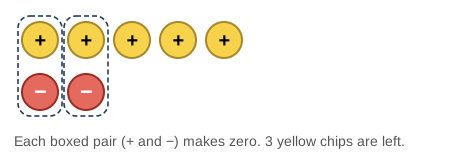
Solve (a) −4 + (−3) (b) −5 − (−3)
Show answerHide answer
(a) −4 − 3 = −7
(b) −5 + 3 = −2
(b) −5 + 3 = −2
Multiplying and dividing integers
| Signs | Product | Quotient |
|---|---|---|
| (+) and (+) | (+) × (+) = + | (+) ÷ (+) = + |
| (+) and (−) | (+) × (−) = − | (+) ÷ (−) = − |
| (−) and (+) | (−) × (+) = − | (−) ÷ (+) = − |
| (−) and (−) | (−) × (−) = + | (−) ÷ (−) = + |
Same signs give a positive answer. Different signs give a negative answer.
Example 6 (textbook p. 10)
(a) −5 × (−4) = +(5 × 4) = 20 (b) −6 × 4 = −(6 × 4) = −24(c) 6 ÷ (−2) = −(6 ÷ 2) = −3 (d) −12 ÷ (−2) = +(12 ÷ 2) = 6
Solve (a) −18 ÷ (−6) (b) 4 × (−8)
Show answerHide answer
(a) Same signs: +(18 ÷ 6) = 3
(b) Different signs: −(4 × 8) = −32
(b) Different signs: −(4 × 8) = −32
Combined operations: the order of operations
Work out brackets ( ) first, then × or ÷ from left to right, then + or − from left to right.
Example 7 (textbook p. 10)
(a) −8 × (−2 + 3)= −8 × 1 (brackets first)
= −8
(b) 7 + 2(−3) (a number next to a bracket means multiply)
= 7 + (−6)
= 1
(c) 4 − 12 ÷ (−2) + (−1)
= 4 − (−6) − 1 (÷ before + and −)
= 4 + 6 − 1
= 9
(d) −12 + (−16)−22 − (−24) = −282 = −14
Working from left to right without following the order. In 4 − 12 ÷ (−2), do 12 ÷ (−2) = −6 first. Doing (4 − 12) ÷ (−2) = 4 is wrong.
Evaluate (a) −9 × (−4 + 6) (b) 4 − 15 ÷ (−3) + (−8)
Show answerHide answer
(a) −9 × 2 = −18
(b) 4 − (−5) − 8 = 4 + 5 − 8 = 1
(b) 4 − (−5) − 8 = 4 + 5 − 8 = 1
Laws of arithmetic operations
| Law | Statement | Example |
|---|---|---|
| Commutative Law | a + b = b + a a × b = b × a | −3 + 5 = 5 + (−3) = 2 |
| Associative Law | (a + b) + c = a + (b + c) (a × b) × c = a × (b × c) | (2 × 5) × 24 = 2 × (5 × 24) = 240 |
| Distributive Law | a × (b + c) = a × b + a × c a × (b − c) = a × b − a × c | 7 × (3 000 + 40) = 21 000 + 280 |
| Identity Law | a + 0 = a, a × 1 = a, a × 0 = 0, a + (−a) = 0, a × 1a = 1 | −8 + 8 = 0 |
Subtraction and division do not obey the Commutative Law: 5 − 2 ≠ 2 − 5.
Example 8 (textbook p. 12): efficient computations
(a) 29 + 38 + 2 = 29 + (38 + 2) = 29 + 40 = 69 (Associative Law)(b) 2 × 24 × 5 = 24 × (2 × 5) = 24 × 10 = 240 (Commutative and Associative Laws)
(c) 7 × 3 040 = 7 × (3 000 + 40) = 21 000 + 280 = 21 280 (Distributive Law)
Use the laws to work out (a) 356 + 61 + 9 (b) 899 × 5 quickly.
Show answerHide answer
(a) 356 + (61 + 9) = 356 + 70 = 426
(b) (900 − 1) × 5 = 4 500 − 5 = 4 495
(b) (900 − 1) × 5 = 4 500 − 5 = 4 495
Solving problems with integers
Example (textbook p. 12): Luqman's credit card
Luqman owes RM230 on his credit card. He buys three books at RM120 each with the card, is charged RM3 interest, then pays RM400. Has he cleared his debt?Debts are negative, payments are positive.
Balance = −230 + 3 × (−120) + (−3) + 400
= −230 − 360 − 3 + 400
= −193
He has not cleared his debt. He still owes RM193.
At 11:00 a.m. the temperature in Kuching is 30°C. From 7:00 p.m. to 5:00 a.m. it dropped by 4°C, then rose by 8°C by 11:00 a.m. What was the temperature at 7:00 p.m.?
Show answerHide answer
Work backwards. 5:00 a.m.: 30 − 8 = 22°C
7:00 p.m.: 22 + 4 = 26°C
7:00 p.m.: 22 + 4 = 26°C
1.3Positive and negative fractions
Fractions are placed on a number line in the same way as integers. Positive fractions are more than zero (right of 0). Negative fractions are less than zero (left of 0).

Comparing and arranging fractions
Make the denominators the same first, then compare the numerators (or use a number line).
Example 10 (textbook p. 15): arrange in ascending order
18, −34, −114, 12, −158, −38Step 1: change to eighths: 18, −68, −128, 48, −158, −38
Step 2: place them on a number line.

For negative fractions, a bigger numerator means a smaller value: −68 < −38.
Arrange −56, −14, 38, −512, 724 in ascending order.
Show answerHide answer
In 24ths: −2024, −624, 924, −1024, 724
Ascending: −56, −512, −14, 724, 38
Ascending: −56, −512, −14, 724, 38
Combined operations with fractions
Example 11 (textbook p. 16)
(a) 123 × (25 − 56)= 53 × (12 − 2530) (brackets first)
= 53 × (−1330)
= −1318
(b) 58 + 113 ÷ (−56)
= 58 + 43 × (−65) (÷ first: change ÷ to × the reciprocal)
= 58 + (−85)
= 2540 − 6440
= −3940
Change mixed numbers to improper fractions before you multiply or divide.
Evaluate 116 × (34 + 15).
Show answerHide answer
34 + 15 = 1520 + 420 = 1920
76 × 1920 = 133120 = 113120
76 × 1920 = 133120 = 113120
Solving problems with fractions
Example (textbook p. 17): the mathematics quiz
A quiz has 20 questions. A correct answer scores 2 marks and a wrong answer scores −12 mark. Mei Ling answered all the questions and scored −4 for her wrong answers. Find her total score.Understand: +2 for each correct answer, −12 for each wrong answer.
Plan: divide to find the number of wrong answers, then multiply and add.
Solve: wrong answers = −4 ÷ (−12) = 8
Total score = (20 − 8) × 2 + (−4) = 24 − 4 = 20
Check: 12 × 2 = 24 and 8 × (−12) = −4, so 24 + (−4) = 20 ✓
A baker uses 334 cups of sugar for a sponge cake and 112 cups less for a less-sweet one. How much sugar for 3 sponge cakes and 5 less-sweet cakes?
Show answerHide answer
Less-sweet cake: 334 − 112 = 214 cups
3 × 334 + 5 × 214 = 1114 + 1114 = 2212 cups
3 × 334 + 5 × 214 = 1114 + 1114 = 2212 cups
1.4Positive and negative decimals
Decimals go on a number line in the same way. −0.5 means 0.5 less than 0; 0.5 means 0.5 more than 0.
Example 13 (textbook p. 20): arrange −1.6, 0.5, −0.3, 1.4, −0.7 in descending order

Descending order: 1.4, 0.5, −0.3, −0.7, −1.6
To compare decimals without a number line, give them the same number of decimal places and compare place by place: −1.205 and −1.250 → −1.250 is further left, so −1.25 < −1.205.
Arrange −1.23, −1.48, 0.34, −0.034, 1.034 in ascending order.
Show answerHide answer
−1.48, −1.23, −0.034, 0.34, 1.034
Combined operations with decimals
Example 14 (textbook p. 21)
(a) 3.5 − (−6.5) × 0.2= 3.5 − (−1.3) (× first)
= 3.5 + 1.3
= 4.8
(b) (7.23 + 2.77) ÷ (−0.8)
= 10.0 ÷ (−0.8) (brackets first)
= −12.5
(c) −3.7 + (4.25 + 2.85) × 0.3
= −3.7 + 7.1 × 0.3
= −3.7 + 2.13
= −1.57
Evaluate (a) 4.7 − 7.8 × 0.3 (b) (8.36 + 3.89) ÷ (−0.28)
Show answerHide answer
(a) 4.7 − 2.34 = 2.36
(b) 12.25 ÷ (−0.28) = −43.75
(b) 12.25 ÷ (−0.28) = −43.75
Solving problems with decimals
Example (textbook p. 21): a share price
A share price was RM2.05. It rose by RM0.32, then dropped RM0.28 every hour for 3 hours. Find the final price.A rise is +0.32; a drop is −0.28.
Final price = 2.05 + 0.32 + 3 × (−0.28)
= 2.37 + (−0.84)
= 1.53 → RM1.53
Aisah buys a shirt for RM19.90 and two pairs of trousers of the same price. She pays RM55, then another RM10, and gets RM5.40 change. Find the price of one pair of trousers.
Show answerHide answer
Total cost = 55 + 10 − 5.40 = RM59.60
Two pairs = 59.60 − 19.90 = RM39.70
One pair = 39.70 ÷ 2 = RM19.85
Two pairs = 59.60 − 19.90 = RM39.70
One pair = 39.70 ÷ 2 = RM19.85
1.5Rational numbers
A rational number is a number that can be written as a fraction pq, where p and q are integers and q ≠ 0.
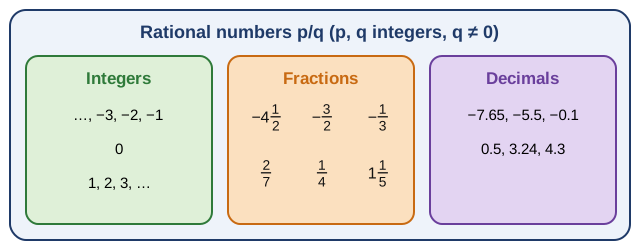
Example 15 (textbook p. 24): are 145, 34, −9 and 3.5 rational?
145 = 95 34 −9 = −91 3.5 = 3510 = 72All four can be written as pq, so they are rational numbers.
Every integer is rational: put it over 1. A decimal that ends can be written over 10, 100, 1 000, …
q cannot be 0, because dividing by zero has no answer. 50 is not a number.
Combined operations with rational numbers
Example 16 (textbook p. 24)
(a) −0.4 + 112 × (−18)= −410 + 32 × (−18) (change decimals to fractions first)
= −410 + (−316)
= −3280 − 1580
= −4780
(b) [18 × (−712) + 1.5] ÷ 0.3
= (−212 + 32) ÷ 310
= −182 ÷ 310
= −9 × 103
= −30
Evaluate −0.6 + 34 × (−135).
Show answerHide answer
34 × (−85) = −65 = −1.2
−0.6 + (−1.2) = −1.8
−0.6 + (−1.2) = −1.8
Solving problems with rational numbers
Example (textbook p. 25): Noriah's savings
Noriah has RM120. She donates 38 of it to flood victims, then buys school shoes for RM25.60. Find her balance.Amount donated = 38 × RM120 = RM45.00
Balance = RM120.00 − RM45.00 − RM25.60 = RM49.40
A ribbon ties 12 gifts, 1.85 m for each gift. This uses 23 of the ribbon. The rest is cut into 12 equal pieces. How long is each piece?
Show answerHide answer
Used = 12 × 1.85 = 22.2 m
Whole ribbon = 22.2 ÷ 23 = 33.3 m
Remaining = 33.3 − 22.2 = 11.1 m
Each piece = 11.1 ÷ 12 = 0.925 m
Whole ribbon = 22.2 ÷ 23 = 33.3 m
Remaining = 33.3 − 22.2 = 11.1 m
Each piece = 11.1 ÷ 12 = 0.925 m
Summary
| Remember | Key fact |
|---|---|
| Integers | …, −2, −1, 0, 1, 2, … (whole numbers and zero) |
| Number line | Further right = greater. −5 < −2 < 0 < 3 |
| Add / subtract | + (+) → +, + (−) → −, − (+) → −, − (−) → + |
| Multiply / divide | Same signs → positive; different signs → negative |
| Order of operations | ( ) → × or ÷ (left to right) → + or − (left to right) |
| Laws | Commutative, Associative, Distributive, Identity |
| Fractions | Same denominator to compare; ÷ a fraction = × its reciprocal |
| Rational number | pq with p, q integers and q ≠ 0 |