Mathematics questions, chapter 1
Nama / NameKelas / ClassTarikh / Date
Rational numbers
40 marks. Use Practice to check each answer as you go, or Exam to answer everything first. Show your working for Section B.
Section A: objective questions
12 marksChoose the correct answer. Each question carries 1 mark.
1
Question 1
Which of the following is not an integer?
Show answerHide answer
C
Integers are positive and negative whole numbers and zero. −3.4 is not a whole number. Zero is an integer.
2
Question 2
If +20 represents 20 m above sea level, which number represents 35 m below sea level?
Show answerHide answer
B
Above sea level is positive, so below sea level is negative: −35. +35 and 35 are the same number (35 m above).
3
Question 3
Diagram 1 shows a number line. What are the integers represented by P and Q?

Show answerHide answer
A
From −4 to 4 is 8 units in 4 steps, so each step is 2. P = −4 − 2 × 2 = −8. Q = −4 + 3 × 2 = 2. −6 and −1 come from counting each step as 1.
4
Question 4
Which list shows −7, 5, −2, 0, −9, 3 in ascending order?
Show answerHide answer
D
Ascending means smallest first. −9 is furthest left on the number line. The first list treats −2 as smaller than −9; the third list is descending.
5
Question 5
−4 − (−9) = ______
Show answerHide answer
A
Subtracting a negative means moving right: −4 − (−9) = −4 + 9 = 5. −13 forgets to change − (−) to +.
6
Question 6
(−6) × 7 ÷ (−3) = ______
Show answerHide answer
C
(−6) × 7 = −42. −42 ÷ (−3) = 14 (same signs give a positive answer).
7
Question 7
Calculate 7 + 24 ÷ (−4) × 3.
Show answerHide answer
B
÷ and × first, from left to right: 24 ÷ (−4) = −6, −6 × 3 = −18. Then 7 + (−18) = −11. 5 comes from doing × before ÷; 3 from adding first.
8
Question 8
Which law is shown by 7 × (3 000 + 40) = 7 × 3 000 + 7 × 40?
Show answerHide answer
C
a × (b + c) = a × b + a × c is the Distributive Law: the 7 is shared to both numbers in the bracket.
9
Question 9
Diagram 2 shows a number line. Which fraction does R represent?

Show answerHide answer
D
Each step is 15. R is 3 steps left of 0, so R = −35. −25 comes from counting 2 steps from −1 instead of from 0.
10
Question 10
−23 + 34 × (−29) = ______
Show answerHide answer
A
× first: 34 × (−29) = −16. Then −23 − 16 = −46 − 16 = −56. −154 comes from adding first.
11
Question 11
Which of these decimals has the smallest value?
Show answerHide answer
B
Write with 3 decimal places: −1.250, −1.520, −1.205, −1.052. −1.520 is furthest left on the number line, so it is the smallest.
12
Question 12
−1.25 is a rational number. Which fraction is equal to −1.25?
Show answerHide answer
D
−1.25 = −125100 = −54. −12510 = −12.5, and 54 has lost the negative sign.
Section B: structured questions
28 marksAnswer all questions. Show your working.
13
Question 13
Calculate.
[1 mark]
(a)−8 + (−5)
Show answerHide answer
Tick each point you got.
[1 mark]
(b)6 − (−9)
Show answerHide answer
Tick each point you got.
[1 mark]
(c)54 ÷ (−9)
Show answerHide answer
Different signs give a negative quotient.
Tick each point you got.
14
Question 14
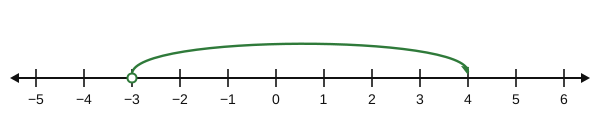
Diagram 3 shows a move on a number line.
[1 mark]
(a)Write an addition that is shown by the move.
Show answerHide answer
Tick each point you got.
[1 mark]
(b)Write the same move as a subtraction of a negative integer.
Show answerHide answer
Adding 7 and subtracting −7 both move 7 units to the right.
Tick each point you got.
[1 mark]
(c)Subtracting a negative integer is represented by moving towards the
Show answerHide answer
right
− (−) becomes +, so we move right.
15
Question 15
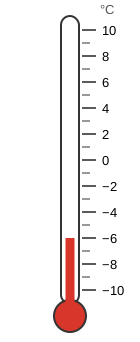
Diagram 4 shows the temperature in a town in Japan at 7:00 a.m.
[1 mark]
(a)State the temperature at 7:00 a.m.
Show answerHide answer
Tick each point you got.
[3 marks]
(b)By 1:00 p.m. the temperature rose by 11°C. It then dropped by 3°C every hour for 4 hours. Calculate the temperature at 5:00 p.m.
Show answerHide answer
Tick each point you got.
16
Question 16
Diagram 5 shows a number line from −1 to 1 divided into equal parts.

[2 marks]
(a)State the fractions represented by P and Q in their simplest form.
Show answerHide answer
Tick each point you got.
[2 marks]
(b)Arrange −56, 13, −14, 38, −23 in ascending order.
Show answerHide answer
Tick each point you got.
17
Question 17
Siti has savings of RM150. She donates 25 of her savings to flood victims. She then buys a school bag for RM36.75.
[1 mark]
(a)Calculate the amount she donates.
Show answerHide answer
Tick each point you got.
[2 marks]
(b)Calculate the balance she still has.
Show answerHide answer
Tick each point you got.
18
Question 18
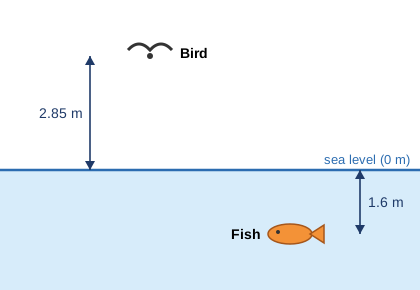
Diagram 6 shows a bird 2.85 m above sea level and a fish 1.6 m below sea level.
[2 marks]
(a)Calculate the vertical distance between the bird and the fish.
Show answerHide answer
Tick each point you got.
[2 marks]
(b)A crab is 2.35 m below the fish. Calculate the vertical distance between the bird and the crab.
Show answerHide answer
Check: 4.45 + 2.35 = 6.8 m.
Tick each point you got.
19
Question 19
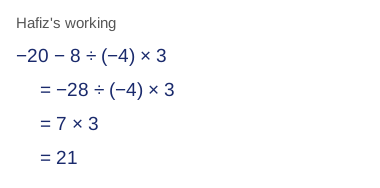
Hafiz calculated −20 − 8 ÷ (−4) × 3. Diagram 7 shows his working.
[1 mark]
(a)Is Hafiz's answer correct? Explain his mistake.
Show answerHide answer
Tick each point you got.
[2 marks]
(b)Write the correct working and answer.
Show answerHide answer
Tick each point you got.
20
Question 20
Look at these numbers:
−12, 6, 2, −3, −2, 8, 11, 5, 15
−12, 6, 2, −3, −2, 8, 11, 5, 15
[2 marks]
(a)Use three of the numbers and two different operations (+, −, ×, ÷) to write two different calculations that give an answer of −14.
Show answerHide answer
−12 + 6 ÷ (−3) = −12 + (−2) = −14 and −2 × 8 + 2 = −16 + 2 = −14
Tick each point you got.
21
Question 21
Diagram 8 shows part of a multiplication table of integers. Each box is the row number × the column number.
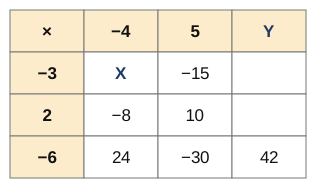
[1 mark]
(a)Find the value of X.
Show answerHide answer
Tick each point you got.
[1 mark]
(b)Find the value of Y.
Show answerHide answer
Tick each point you got.