Mathematics questions, chapter 2
Nama / NameKelas / ClassTarikh / Date
Factors and multiples
40 marks. Use Practice to check each answer as you go, or Exam to answer everything first. Show your working for Section B.
Section A: objective questions
12 marksChoose the correct answer. Each question carries 1 mark.
1
Question 1
Which of the following is a factor of 54?
Show answerHide answer
C
54 ÷ 9 = 6 exactly, so 9 is a factor of 54. 54 ÷ 7, 54 ÷ 8 and 54 ÷ 12 all leave a remainder.
2
Question 2
Diagram 1 shows all the ways to arrange 20 counters in equal rows. Which list gives all the factors of 20?

Show answerHide answer
A
Each arrangement gives a factor pair: 1 × 20, 2 × 10, 4 × 5. So the factors are 1, 2, 4, 5, 10 and 20. Do not forget 1 and the number itself. 3 is not a factor because 20 ÷ 3 leaves a remainder of 2.
3
Question 3
Which list contains prime numbers only?
Show answerHide answer
D
2, 3, 11 and 23 each have exactly two factors. 9 = 3 × 3 and 15 = 3 × 5 are not prime, and 1 is not a prime number.
4
Question 4
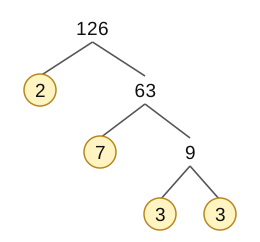
Diagram 2 shows a factor tree of 126. Which of the following is the prime factorisation of 126?
Show answerHide answer
B
The prime factorisation uses all the numbers at the ends of the branches: 2, 7, 3 and 3. So 126 = 2 × 3 × 3 × 7. 63 and 9 are not prime, and 2 × 3 × 7 = 42 has lost one 3.
5
Question 5
List all the prime factors of 84.
Show answerHide answer
A
Factors of 84: 1, 2, 3, 4, 6, 7, 12, 14, 21, 28, 42, 84. The prime numbers among them are 2, 3 and 7. 1, 4 and 6 are factors but not prime.
6
Question 6
Which number is a common factor of 24, 40 and 56?
Show answerHide answer
C
24 ÷ 8 = 3, 40 ÷ 8 = 5, 56 ÷ 8 = 7, so 8 divides all three completely. 3, 6 and 12 do not divide 40 completely.
7
Question 7
Find the highest common factor (HCF) of 42 and 70.
Show answerHide answer
B
42 = 2 × 3 × 7 and 70 = 2 × 5 × 7. HCF = 2 × 7 = 14. 2 and 7 are common factors but not the highest; 210 is the LCM.
8
Question 8
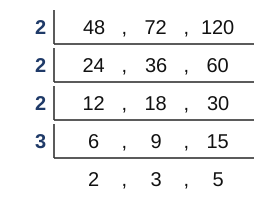
Diagram 3 shows the repeated division of 48, 72 and 120 to find their HCF. What is the HCF?
Show answerHide answer
D
For the HCF multiply only the divisors on the left: 2 × 2 × 2 × 3 = 24. 2, 3 and 5 have no common factor, so the division stops. 30 multiplies only the bottom row (2 × 3 × 5); 720 multiplies the divisors and the bottom row (that is the LCM); 12 misses one 2.
9
Question 9
Which of the following is a common multiple of 4 and 6?
Show answerHide answer
D
36 ÷ 4 = 9 and 36 ÷ 6 = 6, so 36 is a multiple of both. 16 is a multiple of 4 only, 18 is a multiple of 6 only, and 10 = 4 + 6 is not a multiple of either.
10
Question 10
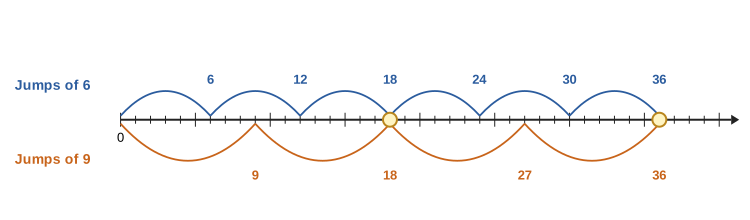
Diagram 4 shows jumps of 6 and jumps of 9 on a number line. Which list gives the first four common multiples of 6 and 9?
Show answerHide answer
A
Both jumps first meet at 18, the first common multiple. Every other common multiple is a multiple of 18: 18, 36, 54, 72. 18, 24, 30, 36 are multiples of 6 only; 18, 27, 36, 45 are multiples of 9 only.
11
Question 11
Find the lowest common multiple (LCM) of 8, 12 and 18.
Show answerHide answer
B
8 = 2 × 2 × 2, 12 = 2 × 2 × 3, 18 = 2 × 3 × 3. LCM = 2 × 2 × 2 × 3 × 3 = 72. 2 is the HCF, 144 is a common multiple but not the lowest, and 1 728 = 8 × 12 × 18.
12
Question 12
Bus A leaves the station every 15 minutes and bus B every 20 minutes. Both buses leave together at 7:00 a.m. At what time will they next leave together?
Show answerHide answer
C
LCM of 15 and 20 = 60 minutes. 7:00 a.m. + 60 minutes = 8:00 a.m. 7:35 adds 15 + 20; 12:00 noon adds 15 × 20 = 300 minutes; 7:05 uses the HCF, 5.
Section B: structured questions
28 marksAnswer all questions. Show your working.
13
Question 13
Answer the questions about the number 45.
[1 mark]
(a)List all the factors of 45.
Show answerHide answer
45 = 1 × 45 = 3 × 15 = 5 × 9.
Tick each point you got.
[1 mark]
(b)1 is a prime factor of 45.
Show answerHide answer
False
1 is a factor of 45 but 1 is not a prime number, because it has only one factor.
[1 mark]
(c)List all the prime factors of 45.
Show answerHide answer
Tick each point you got.
14
Question 14
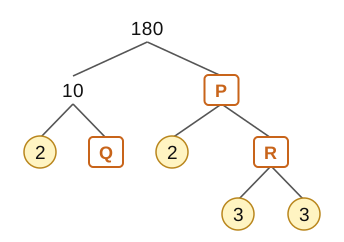
Diagram 5 shows an incomplete factor tree of 180.
[2 marks]
(a)Find the values of P, Q and R.
Show answerHide answer
Tick each point you got.
[1 mark]
(b)Express 180 in the form of prime factorisation.
Show answerHide answer
Use every prime at the end of a branch: 2, 5, 2, 3, 3. Check: 2 × 2 × 3 × 3 × 5 = 180.
Tick each point you got.
15
Question 15
Diagram 6 shows the factors of 24 and the factors of 36 in a Venn diagram.
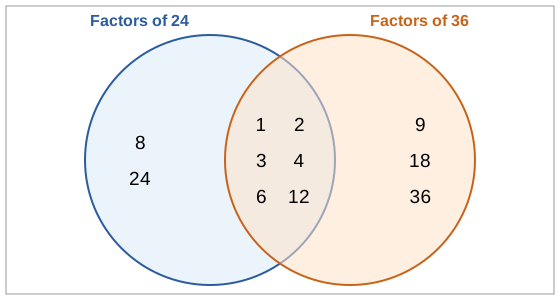
[1 mark]
(a)List the common factors of 24 and 36.
Show answerHide answer
Tick each point you got.
[1 mark]
(b)State the HCF of 24 and 36.
Show answerHide answer
Tick each point you got.
[1 mark]
(c)Explain why 8 is placed only in the circle Factors of 24.
Show answerHide answer
Tick each point you got.
16
Question 16
Find the HCF of 84, 126 and 210 by using prime factorisation.
[3 marks]
(a)Show your working.
Show answerHide answer
Check: 84 ÷ 42 = 2, 126 ÷ 42 = 3, 210 ÷ 42 = 5, and 2, 3, 5 have no common factor other than 1.
Tick each point you got.
17
Question 17
Encik Zaki wants to cover the floor in Diagram 7 with square tiles of the same size. No tile may be cut.
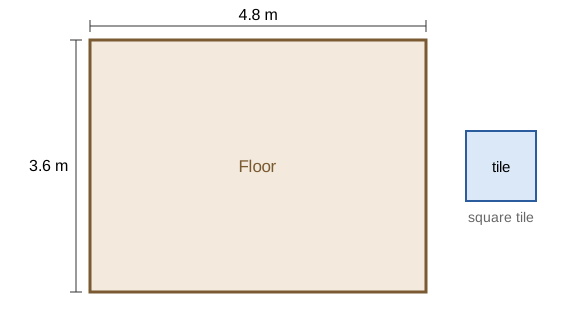
[2 marks]
(a)Find the biggest side length, in cm, of the square tiles.
Show answerHide answer
480 = 2 × 2 × 2 × 2 × 2 × 3 × 5 and 360 = 2 × 2 × 2 × 3 × 3 × 5, so HCF = 2 × 2 × 2 × 3 × 5 = 120.
Tick each point you got.
[2 marks]
(b)How many of these tiles are needed to cover the floor?
Show answerHide answer
Tick each point you got.
18
Question 18
Puan Lim makes hot dogs for a school carnival. Diagram 8 shows how sausages and buns are sold. She wants the same number of sausages and buns, with nothing left over.
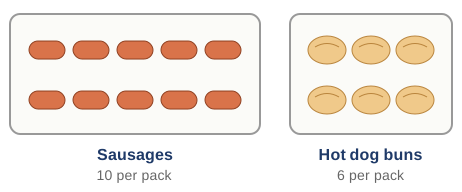
[2 marks]
(a)What is the smallest number of hot dogs she can make?
Show answerHide answer
Tick each point you got.
[2 marks]
(b)How many packs of sausages and how many packs of buns does she buy?
Show answerHide answer
Check: 3 × 10 = 30 sausages and 5 × 6 = 30 buns.
Tick each point you got.
19
Question 19
Hafiz wants the LCM of 12, 18 and 30. Diagram 9 shows his working.
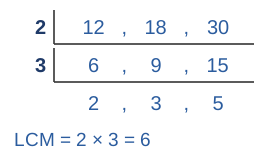
[1 mark]
(a)Is Hafiz correct? Explain his mistake.
Show answerHide answer
Tick each point you got.
[2 marks]
(b)Find the correct LCM of 12, 18 and 30.
Show answerHide answer
Prime factorisation: 12 = 2 × 2 × 3, 18 = 2 × 3 × 3, 30 = 2 × 3 × 5. LCM = 2 × 2 × 3 × 3 × 5 = 180. Check: 180 ÷ 12 = 15, 180 ÷ 18 = 10, 180 ÷ 30 = 6.
Tick each point you got.
20
Question 20
Suggest two numbers whose HCF is 6 and whose LCM is 60. Show working to prove that your numbers work.
[3 marks]
(a)Write your two numbers and your working.
Show answerHide answer
12 and 30. 12 = 2 × 2 × 3 and 30 = 2 × 3 × 5. HCF = 2 × 3 = 6. LCM = 2 × 2 × 3 × 5 = 60.
Only two pairs work: 12 and 30, or 6 and 60. Check: HCF × LCM = 6 × 60 = 360 = 12 × 30.
Tick each point you got.
21
Question 21
The HCF of m and 54 is 6. Given that m is less than 54, find the largest possible value of m.
[2 marks]
(a)Show your working.
Show answerHide answer
Check: 48 = 2 × 2 × 2 × 2 × 3, so HCF(48, 54) = 2 × 3 = 6. 54 itself is not allowed, and HCF(36, 54) = 18, not 6.
Tick each point you got.