Factors and multiples
What this chapter covers
- List the factors of a whole number and make generalisations about factors (2.1.1)
- List the prime factors of a whole number and write it in prime factorisation form (2.1.2)
- Explain and find the common factors of whole numbers (2.1.3)
- Find the HCF of two or three whole numbers by listing, repeated division and prime factorisation (2.1.4)
- Solve problems involving HCF (2.1.5)
- Explain and find the common multiples of whole numbers (2.2.1)
- Find the LCM of two or three whole numbers by listing, repeated division and prime factorisation (2.2.2)
- Solve problems involving LCM (2.2.3)
2.1Factors, prime factors and highest common factor (HCF)
What are factors?
12 ÷ 1 = 12, 12 ÷ 2 = 6, 12 ÷ 3 = 4, 12 ÷ 4 = 3, 12 ÷ 6 = 2 and 12 ÷ 12 = 1. So the factors of 12 are 1, 2, 3, 4, 6 and 12. You can see the factors by arranging 12 counters in equal rows: every rectangle gives a factor pair.
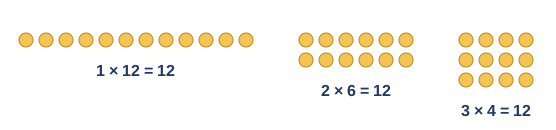
Example 1: is it a factor? (textbook p. 32)
Determine whether (a) 12 is a factor of 36, (b) 9 is a factor of 30.
- (a) 36 ÷ 12 = 3, no remainder. So 12 is a factor of 36.
- (b) 30 ÷ 9 = 3 remainder 3. So 9 is not a factor of 30.
Example 2: list all the factors of 18 (textbook p. 32)
- Write 18 as a product of two numbers, starting from 1: 18 = 1 × 18, 18 = 2 × 9, 18 = 3 × 6.
- Try 4 and 5: they do not divide 18 completely. The next number, 6, is already in the list, so stop.
Factors of 18: 1, 2, 3, 6, 9, 18.
Show answerHide answer
(b) 56 ÷ 14 = 4, so yes. 98 ÷ 18 = 5 remainder 8, so no.
What are prime factors?
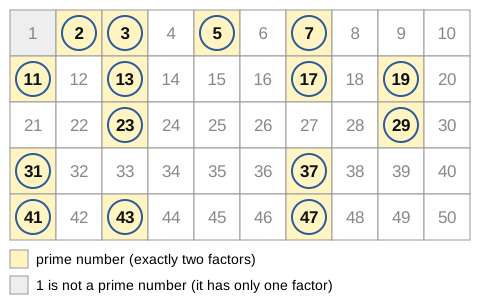
Factors of 18 are 1, 2, 3, 6, 9 and 18. Only 2 and 3 are prime, so the prime factors of 18 are 2 and 3.
Example 3: prime factors of 84 (textbook p. 33)
Is (a) 2, (b) 3, (c) 5 a prime factor of 84?
- (a) 84 ÷ 2 = 42 and 2 is prime: yes.
- (b) 84 ÷ 3 = 28 and 3 is prime: yes.
- (c) 84 ÷ 5 = 16 remainder 4. 5 is prime but does not divide 84 completely: no.
Example 4: list all the prime factors of 72 (textbook p. 34)
- List all the factors of 72: 1, 2, 3, 4, 6, 8, 9, 12, 18, 24, 36, 72.
- Pick out the prime numbers in the list: 2 and 3.
The prime factors of 72 are 2 and 3.
Prime factorisation
Example 5: express 60 in prime factorisation (textbook p. 34)
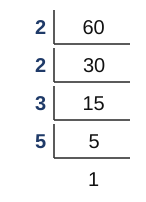
Method 1: repeated division. Divide by the smallest prime that works. Keep dividing until the quotient is 1.
Method 2: factor tree. Split the number into two factors again and again until every branch ends in a prime (circled).
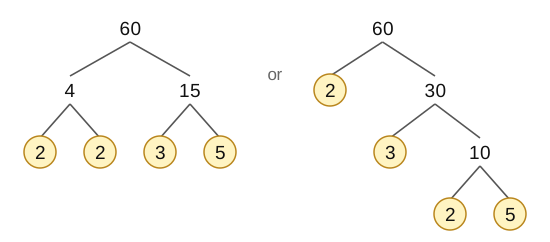
Both ways give 60 = 2 × 2 × 3 × 5. A different first split still gives the same primes.
Show answerHide answer
(b) 120 = 2 × 2 × 2 × 3 × 5
Common factors
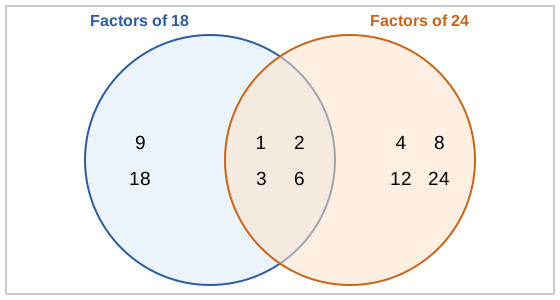
Example 6: is it a common factor? (textbook p. 35)
- Is 6 a common factor of 24 and 36? 24 ÷ 6 = 4 and 36 ÷ 6 = 6. Yes.
- Is 4 a common factor of 30, 40 and 60? 30 ÷ 4 = 7 remainder 2. No — one number is enough to fail.
Example 7: common factors of 20, 44, 56 and 64 (textbook p. 35)
| Number | Factors |
|---|---|
| 20 | 1, 2, 4, 5, 10, 20 |
| 44 | 1, 2, 4, 11, 22, 44 |
| 56 | 1, 2, 4, 7, 8, 14, 28, 56 |
| 64 | 1, 2, 4, 8, 16, 32, 64 |
Common factors: 1, 2 and 4.
Highest common factor (HCF)
The common factors of 20, 44, 56 and 64 are 1, 2 and 4, so their HCF is 4. There are three methods.
Example 8: three methods for the HCF (textbook p. 36)
(a) Listing the common factors — HCF of 18 and 24.
Factors of 18: 1, 2, 3, 6, 9, 18. Factors of 24: 1, 2, 3, 4, 6, 8, 12, 24.
Common factors: 1, 2, 3, 6. HCF = 6.
(b) Repeated division — HCF of 36, 60 and 72. Divide by a prime that divides all the numbers. Stop when no prime divides them all. Multiply the divisors only.
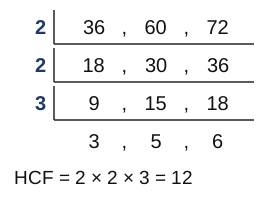
(c) Prime factorisation — HCF of 48, 64 and 80.
| 48 | = 2 × 2 × 2 × 2 × 3 |
| 64 | = 2 × 2 × 2 × 2 × 2 × 2 |
| 80 | = 2 × 2 × 2 × 2 × 5 |
Multiply the prime factors common to all three: HCF = 2 × 2 × 2 × 2 = 16.
Show answerHide answer
(b) 27 = 3 × 3 × 3, 45 = 3 × 3 × 5, 60 = 2 × 2 × 3 × 5. HCF = 3
Solving problems involving HCF
Example (textbook p. 37): Boy Scouts' charity packs
252 shirts, 180 pairs of trousers and 108 pairs of socks are divided equally into packs. What is the maximum number of packs?
- Understand: every pack gets the same of each item; find the most packs.
- Plan: find the HCF of 252, 180 and 108.
- Solve: 252 = 2 × 2 × 3 × 3 × 7, 180 = 2 × 2 × 3 × 3 × 5, 108 = 2 × 2 × 3 × 3 × 3. HCF = 2 × 2 × 3 × 3 = 36 packs.
- Check: 252 ÷ 36 = 7 shirts, 180 ÷ 36 = 5 trousers, 108 ÷ 36 = 3 pairs of socks in each pack.
Worked problem (Mastery Q 2.1, textbook p. 38): cutting paper into squares
Anita cuts paper 260 cm long and 20 cm wide into equal squares with no paper left. What is the biggest possible size of the squares?
- The side of the square must divide both 260 and 20 completely.
- HCF of 260 and 20 = 20. So the squares are 20 cm × 20 cm.
- Check: 260 ÷ 20 = 13 squares in one row.

Show answerHide answer
HCF = 2 × 3 = 6, so 6 boxes (each with 10 sacks of rice, 13 bottles of oil, 15 bottles of water).
2.2Multiples, common multiples and lowest common multiple (LCM)
Multiples and common multiples
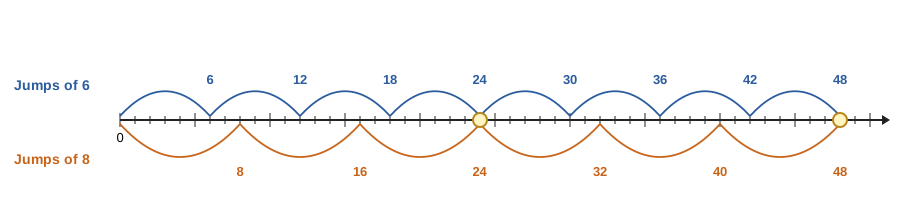
Multiples of 6: 6, 12, 18, 24, 30, … Multiples of 8: 8, 16, 24, 32, 40, … So 24 is a common multiple of 6 and 8, and 24 can be divided completely by both 6 and 8.
Example 9: is it a common multiple? (textbook pp. 38–39)
- Is 32 a common multiple of 2 and 8? 32 ÷ 2 = 16 and 32 ÷ 8 = 4. Yes.
- Is 60 a common multiple of 5, 15 and 24? 60 ÷ 24 = 2 remainder 12. No.
- Is 72 a common multiple of 8, 9, 18 and 24? 72 ÷ 8 = 9, 72 ÷ 9 = 8, 72 ÷ 18 = 4, 72 ÷ 24 = 3. Yes.
Example 10: first five common multiples of 2, 3 and 4 (textbook p. 40)
- Multiples of 2: 2, 4, 6, 8, 10, 12 … Multiples of 3: 3, 6, 9, 12 … Multiples of 4: 4, 8, 12 …
- The first common multiple is 12. Now list multiples of 12.
First five common multiples: 12, 24, 36, 48, 60.
Lowest common multiple (LCM)
Example 11: three methods for the LCM (textbook pp. 40–41)
(a) Listing multiples — LCM of 2 and 3. Multiples of 2: 2, 4, 6, 8 … Multiples of 3: 3, 6, 9 … LCM = 6.
(b) Repeated division — LCM of 3, 6 and 9. Divide by a prime that divides at least one number. Bring down any number that cannot be divided. Continue until every quotient is 1, then multiply all the divisors.
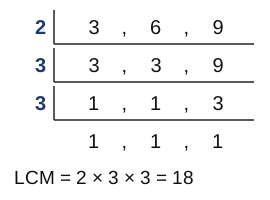
(c) Prime factorisation — LCM of 3, 8 and 12. 3 = 3, 8 = 2 × 2 × 2, 12 = 2 × 2 × 3. Take each prime the greatest number of times it appears in any one number: three 2s (from 8) and one 3. LCM = 2 × 2 × 2 × 3 = 24.
Shortcut: list multiples of the greatest number (12, 24, 36 …) and stop at the first one that 3 and 8 divide completely: 24.
Show answerHide answer
(b) 9 = 3 × 3, 12 = 2 × 2 × 3, 21 = 3 × 7. LCM = 2 × 2 × 3 × 3 × 7 = 252
Solving problems involving LCM
Example (textbook pp. 41–42): canned coffee and tea
Coffee is sold 6 cans per box and tea 9 cans per box. Ainun wants the same number of cans of each. What is the minimum number of boxes of each?
- Plan: find the LCM of 6 and 9 for the same number of cans.
- Multiples of 6: 6, 12, 18 … Multiples of 9: 9, 18 … LCM = 18 cans.
- Coffee: 18 ÷ 6 = 3 boxes. Tea: 18 ÷ 9 = 2 boxes.
- Check: 3 × 6 = 18 and 2 × 9 = 18.
| Clue in the question | Use | Answer is |
|---|---|---|
| Share equally, maximum number of groups, biggest size, cut with nothing left | HCF | smaller than or equal to the numbers |
| Together again, same time, same number, smallest / minimum amount | LCM | bigger than or equal to the numbers |
(b) Nurul, Hui Ling and Gopal cut equal ribbons into pieces of 15 cm, 25 cm and 30 cm with nothing left. What is the shortest possible length of each ribbon?
Show answerHide answer
(b) 15 = 3 × 5, 25 = 5 × 5, 30 = 2 × 3 × 5. LCM = 2 × 3 × 5 × 5 = 150 cm
Summary
| Remember | Factors | Multiples |
|---|---|---|
| Example | Factors of 12: 1, 2, 3, 4, 6, 12 Factors of 18: 1, 2, 3, 6, 9, 18 | Multiples of 6: 6, 12, 18, 24, 30, … Multiples of 8: 8, 16, 24, 32, 40, … |
| Common | Common factors of 12 and 18: 1, 2, 3, 6 | Common multiples of 6 and 8: 24, 48, 72, 96, … |
| Highest / lowest | HCF of 12 and 18 = 6 | LCM of 6 and 8 = 24 |
| Prime factorisation | HCF = primes common to all numbers | LCM = every prime, the most times it appears in one number |
| Problems | Share equally / biggest size | Together again / same number |
Content and examples follow Mathematics Form 1 (DLP) textbook, Chapter 2, pp. 30–44.