Squares, Square Roots, Cubes and Cube Roots
What this chapter covers
- Explain the meaning of squares and perfect squares, and decide whether a number is a perfect square by prime factorisation (3.1)
- State the relationship between squares and square roots, and find squares and square roots with and without a calculator (3.1)
- Estimate squares and square roots, and multiply square roots (√a × √a = a, √a × √b = √ab) (3.1)
- Solve problems involving squares and square roots (3.1)
- Explain the meaning of cubes and perfect cubes, and decide whether a number is a perfect cube by prime factorisation (3.2)
- State the relationship between cubes and cube roots, and find cubes and cube roots with and without a calculator (3.2)
- Estimate cubes and cube roots, and solve problems involving cubes and cube roots (3.2)
- Work out combined operations involving squares, square roots, cubes and cube roots (3.2)
At the 2015 SEA Games our silat team competed on a square court with an area of 100 m². How long is each side? We need a number that, multiplied by itself, gives 100. That number is 10, so each side is 10 m. In this chapter you will learn about squares and square roots (for areas of squares) and cubes and cube roots (for volumes of cubes).
| English | Bahasa Melayu |
|---|---|
| square, perfect square | kuasa dua, kuasa dua sempurna |
| square root | punca kuasa dua |
| cube, perfect cube | kuasa tiga, kuasa tiga sempurna |
| cube root | punca kuasa tiga |
| estimation | anggaran |
3.1Squares and square roots
Squares and perfect squares
A square with sides of 4 units has an area of 4 × 4 = 16 unit². That is why we call it "squaring".
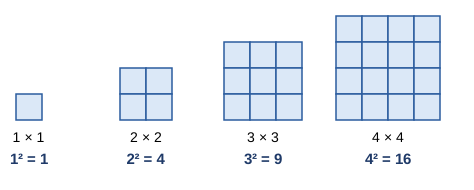
| Number | 1 | 2 | 3 | 4 | 5 | 6 | 7 | 8 | 9 | 10 | 11 | 12 | 13 | 14 | 15 |
|---|---|---|---|---|---|---|---|---|---|---|---|---|---|---|---|
| Square | 1 | 4 | 9 | 16 | 25 | 36 | 49 | 64 | 81 | 100 | 121 | 144 | 169 | 196 | 225 |
Is the number a perfect square?
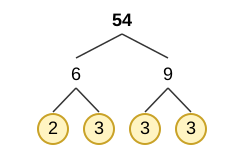
Use prime factorisation. If the prime factors can be split into two identical groups, the number is a perfect square.
Example 1: 36 and 54 (textbook p. 50)
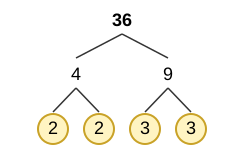
- 36 = 2 × 2 × 3 × 3 = (2 × 3) × (2 × 3) = 6 × 6. Two identical groups, so 36 is a perfect square.
- 54 = 2 × 3 × 3 × 3. There is only one 2, so the factors cannot be split into two identical groups. 54 is not a perfect square.
Show answerHide answer
b) 100 = 2 × 2 × 5 × 5 = (2 × 5) × (2 × 5) = 10 × 10. Perfect square.
c) 324 = 2 × 2 × 3 × 3 × 3 × 3 = (2 × 3 × 3) × (2 × 3 × 3) = 18 × 18. Perfect square.
Squares and square roots are inverse operations
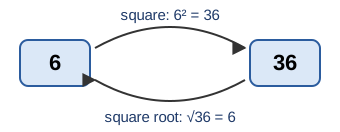
Finding the square root of the area of a square gives the length of its side. A square with an area of 36 unit² has sides of √36 = 6 units.
Finding the square of a number
Multiply the number by itself. This works for whole numbers, fractions, decimals and negative numbers.
Example 2: without a calculator (textbook p. 52)
- 6² = 6 × 6 = 36
- (34)² = 34 × 34 = 916
- (−0.5)² = (−0.5) × (−0.5) = 0.25 (negative × negative = positive)
Example 3: with a calculator (textbook p. 52)
| Question | Press | Answer |
|---|---|---|
| 43² | 4 3 x² = | 1 849 |
| (−713)² | ( (−) 7 a b/c 1 3 ) x² = | 49169 |
| 2.96² | 2 . 9 6 x² = | 8.7616 |
Show answerHide answer
b) 0.3 × 0.3 = 0.09
c) (−32) × (−32) = 94 = 214
Finding square roots without a calculator
For a small perfect square, recall the times table. For a bigger number, use prime factorisation and split the factors into two identical groups. One group is the square root.
Example 4: √441 (textbook p. 53)
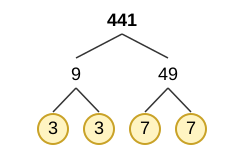
- 441 = 3 × 3 × 7 × 7
- = (3 × 7) × (3 × 7) = 21 × 21
- √441 = 21
Example 5: fractions and decimals (textbook pp. 53–54)
- √425 = √4√25 = 25
- √279 = √259 = 53 = 123 (change to an improper fraction first)
- √2748 = √916 = 34 (simplify the fraction first)
- √0.36 = √36100 = 610 = 0.6
Show answerHide answer
b) √2516 = 54 = 114
c) 576 = 2 × 2 × 2 × 2 × 2 × 2 × 3 × 3 = (2 × 2 × 2 × 3) × (2 × 2 × 2 × 3) = 24 × 24, so √576 = 24
Square roots with a calculator
Most numbers are not perfect squares, so their square roots are long decimals. Round them as asked.
| Question | Press | Answer (2 d.p.) |
|---|---|---|
| √89 | √ 8 9 = | 9.43 |
| √154.7 | √ 1 5 4 . 7 = | 12.44 |
| √627 | √ 6 a b/c 2 a b/c 7 = | 2.51 |
Estimating squares and square roots
Find the two perfect squares on either side of the number, then choose the nearer one.
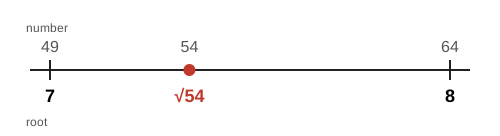
Example 6: estimate 27.5² and √54 (textbook p. 55)
- 27.5 is between 20 and 30, so 27.5² is between 20² = 400 and 30² = 900. 27.5 is nearer 30, so 27.5² ≈ 900.
- 54 is between the perfect squares 49 and 64, so √54 is between 7 and 8. 54 is nearer 49, so √54 ≈ 7.
Show answerHide answer
b) 34 is between 25 and 36, nearer 36, so √34 ≈ 6
Multiplying square roots
Example 7
- √7 × √7 = 7
- √2 × √18 = √2 × 18 = √36 = 6
Solving problems
Example 8: Maslina's photo (textbook p. 56)
A square cardboard has sides of 12 cm. A square photo has an area of 90.25 cm². Where should Maslina paste the photo so that it is in the middle of the cardboard?
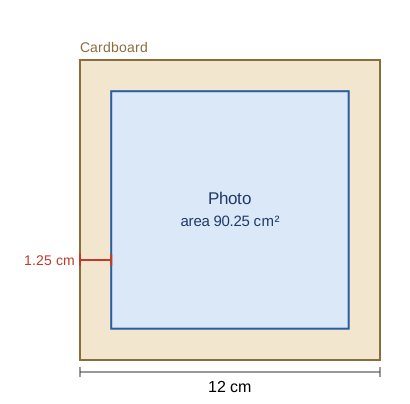
- Side of photo = √90.25 = √9.5 × 9.5 = 9.5 cm
- Length left over = 12 − 9.5 = 2.5 cm
- Gap on each side = 2.5 ÷ 2 = 1.25 cm
Paste the photo 1.25 cm from each side. The area not covered is 12² − 90.25 = 144 − 90.25 = 53.75 cm².
3.2Cubes and cube roots
Cubes and perfect cubes
A cube with sides of 2 units is made of 2 × 2 × 2 = 8 unit cubes. Its volume is 8 unit³.
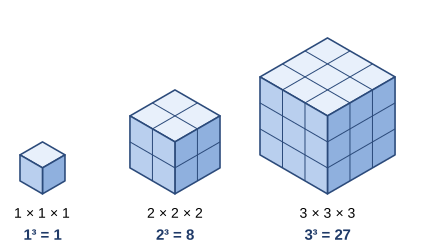
| Number | 1 | 2 | 3 | 4 | 5 | 6 | 7 | 8 | 9 | 10 |
|---|---|---|---|---|---|---|---|---|---|---|
| Cube | 1 | 8 | 27 | 64 | 125 | 216 | 343 | 512 | 729 | 1 000 |
Is the number a perfect cube?
Use prime factorisation. If the prime factors can be split into three identical groups, the number is a perfect cube.
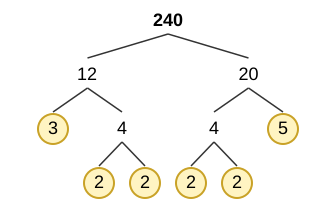
Example 9: 64 and 240 (textbook p. 60)
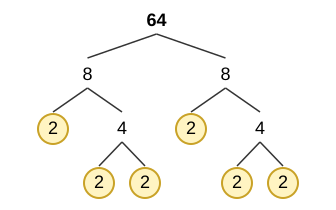
- 64 = 2 × 2 × 2 × 2 × 2 × 2 = (2 × 2) × (2 × 2) × (2 × 2) = 4 × 4 × 4. 64 is a perfect cube.
- 240 = 2 × 2 × 2 × 2 × 3 × 5. There is only one 3 and one 5, so 240 is not a perfect cube.
Show answerHide answer
Cubes and cube roots are inverse operations
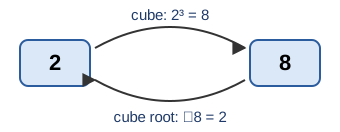
Finding the cube root of the volume of a cube gives the length of its side.
Finding the cube of a number
Example 10: without a calculator (textbook p. 63)
- 4³ = 4 × 4 × 4 = 64
- 0.2³ = 0.2 × 0.2 × 0.2 = 0.008 (3 decimal places)
- (−35)³ = (−35) × (−35) × (−35) = −27125
Example 11: with a calculator (textbook p. 63)
| Question | Press | Answer |
|---|---|---|
| 18³ | 1 8 x³ = | 5 832 |
| (−412)³ | ( (−) 4 a b/c 1 a b/c 2 ) x³ = | −9118 |
| (−6.3)³ | ( (−) 6 . 3 ) x³ = | −250.047 |
Show answerHide answer
b) (−5)³ = −125, so 3√−125 = −5
c) 0.1³ = 0.001, so 3√0.001 = 0.1
Finding cube roots without a calculator
For a bigger number, use prime factorisation and split the factors into three identical groups. One group is the cube root.
Example 12: 3√216 (textbook p. 64)
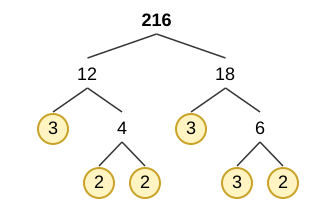
- 216 = 2 × 2 × 2 × 3 × 3 × 3
- = (2 × 3) × (2 × 3) × (2 × 3) = 6 × 6 × 6
- 3√216 = 6
Example 13: fractions and decimals (textbook pp. 64–65)
- 3√8125 = 3√83√125 = 25
- 3√−81192 = 3√−2764 = −34 (simplify first)
- 3√338 = 3√278 = 32 = 112 (improper fraction first)
- 3√0.027 = 3√0.3 × 0.3 × 0.3 = 0.3
- 3√−0.008 = 3√−81000 = −210 = −0.2
Cube roots with a calculator
| Question | Press | Answer (2 d.p.) |
|---|---|---|
| 3√24 | ∛ 2 4 = | 2.88 |
| 3√−104.8 | ∛ (−) 1 0 4 . 8 = | −4.71 |
| 3√−129 | ∛ (−) 1 a b/c 2 a b/c 9 = | −1.07 |
Estimating cubes and cube roots
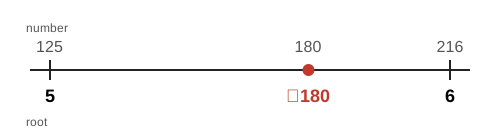
Example 14: estimate 4.2³ and 3√180 (textbook p. 66)
- 4.2 is between 4 and 5, so 4.2³ is between 4³ = 64 and 5³ = 125. 4.2 is nearer 4, so 4.2³ ≈ 64.
- 180 is between the perfect cubes 125 and 216, so 3√180 is between 5 and 6. 180 is nearer 216, so 3√180 ≈ 6.
Show answerHide answer
b) 69 is between 64 and 125, much nearer 64, so 3√69 ≈ 4
Solving problems
Example 15: the sculptor (textbook pp. 66–67)
A sculptor carves a small cube out of a wooden cube with sides of 6 cm. The remaining block has a volume of 189 cm³. Find the side of the small cube.
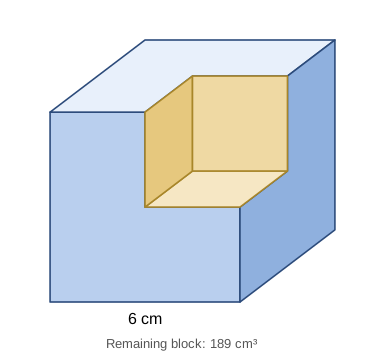
- Volume of the wooden cube = 6³ = 216 cm³
- Volume of the small cube = 216 − 189 = 27 cm³
- Side of the small cube = 3√27 = 3 cm
Check: 3³ + 189 = 27 + 189 = 216 = 6³ ✓
Show answerHide answer
Combined operations
Work in this order:
- Find the squares, square roots, cubes and cube roots.
- Work out the brackets.
- × and ÷ from left to right.
- + and − from left to right.
Example 16 (textbook p. 68)
- 0.5² + 3√1 000 = 0.25 + 10 = 10.25
- (−3)³ − √64 = −27 − 8 = −35
- √25 + (−0.2)² ÷ 3√0.008 = 5 + 0.04 ÷ 0.2 = 5 + 0.2 = 5.2 (÷ before +)
- 3√−278 × (√36 − 2³)² = −32 × (6 − 8)² = −32 × 4 = −6
Show answerHide answer
b) 3 − 2.25 = 0.75
Summary
| Meaning | Example | Perfect ones | |
|---|---|---|---|
| Square | a × a = a² | 7² = 49 | 1, 4, 9, 16, 25, 36, … |
| Square root | √a × a = a | √49 = 7 | Prime factors split into 2 identical groups |
| Cube | a × a × a = a³ | 5³ = 125 | 1, 8, 27, 64, 125, … |
| Cube root | 3√a × a × a = a | 3√125 = 5 | Prime factors split into 3 identical groups |
| Remember | Key fact |
|---|---|
| Signs | (negative)² is positive; (negative)³ is negative; 3√negative is negative |
| Fractions | Simplify, or change a mixed number to an improper fraction, before finding the root |
| Decimals | 0.3² = 0.09; 0.2³ = 0.008; √0.36 = 0.6; 3√0.027 = 0.3 |
| Estimating | Find the perfect squares (or cubes) on either side and choose the nearer one |
| Multiplying roots | √a × √a = a; √a × √b = √ab |
| Order | Powers and roots, then brackets, then × ÷, then + − |
| Area and volume | Side of a square = √area; side of a cube = 3√volume |