Ratios, Rates and Proportions
What this chapter covers
- Represent the relationship between three quantities in the form a : b : c (4.1)
- Identify and find equivalent ratios in numbers, diagrams and daily situations (4.1)
- Express ratios of two and three quantities in their simplest form (4.1)
- Explain how a rate is related to a ratio, and convert the units of a rate (4.2)
- Explain how a proportion is related to ratios, and find an unknown value in a proportion (4.3)
- Find the ratio of three quantities from two ratios of two quantities (4.4)
- Find a value from a ratio of two or three quantities and the value of one quantity, and find a value related to a rate (4.4)
- Solve problems involving ratios, rates and proportions, including making estimations (4.4)
- Link percentages with ratios, and find the percentage of a quantity using proportions (4.5)
- Solve problems that combine ratios, rates and proportions with percentages, fractions and decimals (4.5)
Marine biologists want to know how many seahorses (Hippocampus kuda) live in a river estuary, but they cannot catch every one. Instead, they tag a first sample, release it, and later count how many tagged seahorses turn up in a second sample. By comparing these numbers they can estimate the whole population. Comparing quantities like this is what ratios, rates and proportions are about.
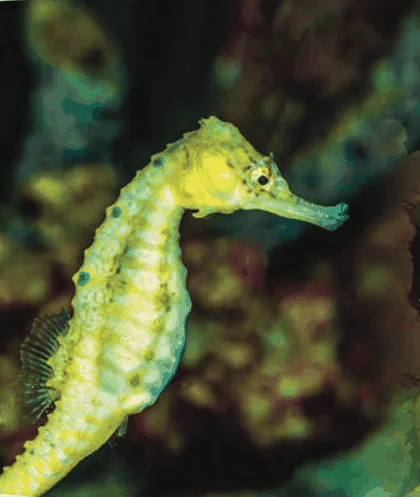
Photo: Mathematics Form 1 (DLP) textbook, p. 74.
| English | Bahasa Melayu |
|---|---|
| ratio | nisbah |
| equivalent ratio | nisbah setara |
| rate | kadar |
| proportion | kadaran |
| percentage | peratusan |
4.1Ratios
Example: 5 000 g to 9 kg = 5 kg : 9 kg = 5 : 9. Change both quantities to the same unit first, then drop the unit.
Ratios of three quantities, a : b : c
Example 1: 0.02 m to 3 cm to 4.6 cm (textbook p. 76)
- Same unit (cm): 0.02 m : 3 cm : 4.6 cm = 2 cm : 3 cm : 4.6 cm
- Drop the units: = 2 : 3 : 4.6
- Remove the decimal (× 10): = 20 : 30 : 46
- Divide by 2: = 10 : 15 : 23
Show answerHide answer
b) In grams: 100 : 50 : 250 = 2 : 1 : 5 (divide by 50)
Equivalent ratios
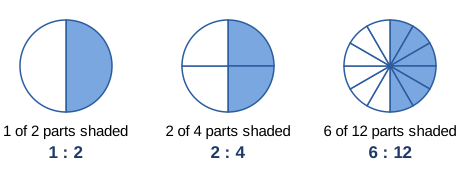
| Ratio (shaded : whole) | As a fraction | How we get it |
|---|---|---|
| 1 : 2 | 12 | Start |
| 2 : 4 | 24 | 1 × 2 : 2 × 2 |
| 6 : 12 | 612 | 2 × 3 : 4 × 3 |
Example 2: which ratios are equivalent to 27 : 45? (textbook p. 77)
Choices: 9 : 15 5 : 3 54 : 90 12 : 56
- 27 : 45 = 27 ÷ 3 : 45 ÷ 3 = 9 : 15 (equivalent)
- 27 : 45 = 27 × 2 : 45 × 2 = 54 : 90 (equivalent)
- 27 : 45 = 27 × 154 : 45 × 154 = 12 : 56 (equivalent)
- 27 : 45 = 27 ÷ 9 : 45 ÷ 9 = 3 : 5, which is not 5 : 3 (not equivalent)
Example 3: a cleaning solution (textbook p. 78)
Puan Habibah mixes 4 cups of vinegar with 8 cups of water. Two equivalent ratios:
- 4 : 8 = 4 × 2 : 8 × 2 = 8 : 16 (a bigger batch)
- 4 : 8 = 4 ÷ 2 : 8 ÷ 2 = 2 : 4 (a smaller batch)
Any batch in one of these ratios cleans just as well, because the mixture has the same strength.
Ratios in their simplest form
Example 4: simplest form (textbook pp. 78–79)
| Ratio | Working | Simplest form |
|---|---|---|
| 800 g : 1.8 kg | = 800 g : 1 800 g, then ÷ 200 (the HCF) | 4 : 9 |
| 32 : 24 : 20 | ÷ 4 (HCF of 32, 24 and 20) | 8 : 6 : 5 |
| 35 : 710 | × 10 (LCM of 5 and 10): 35 × 10 : 710 × 10 = 6 : 7 | 6 : 7 |
| 0.04 : 0.12 : 0.56 | × 100 → 4 : 12 : 56, then ÷ 4 | 1 : 3 : 14 |
Show answerHide answer
b) ÷ 6 = 5 : 7 : 8
c) × 45 (LCM of 5 and 9) = 18 : 40, ÷ 2 = 9 : 20
d) × 100 = 9 : 12 : 24, ÷ 3 = 3 : 4 : 8
4.2Rates
| Situation | Rate | Quantities (units) |
|---|---|---|
| Fatin buys 2 kg of mangoes for RM10. | RM102 kg | money (RM) and mass (kg) |
| A car uses 1 litre of petrol for 12 km. | 12 km1 litre | distance (km) and volume (litre) |
| Karim's pulse is 75 beats per minute. | 75 beats1 minute | number of beats and time (minute) |
Examples from textbook pp. 81–82.
Converting the units of a rate
To compare two rates, write them in the same units first.
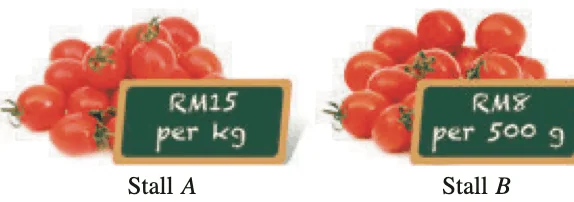
Example 5: cherry tomatoes (textbook p. 82)
- Stall B: RM8500 g = RM8 × 2500 g × 2 = RM161 000 g = RM16 per kg
- Stall A: RM15 per kg
- RM15 < RM16, so Stall A is cheaper.
Example 6: speed and density (textbook p. 82)
a) Convert 5 m/s to km/h.
- 5 m/s means 5 m in 1 s. In 1 hour (3 600 s): 5 × 3 600 = 18 000 m
- 18 000 m = 18 000 ÷ 1 000 = 18 km, so 5 m/s = 18 km/h
- In one line: 51 000 km ÷ 13 600 h = 51 000 × 3 6001 = 18 km/h
b) A metal has a density of 2 700 kg per m³. Write it in g per cm³.
- 1 kg = 1 000 g and 1 m³ = 100 cm × 100 cm × 100 cm = 1 000 000 cm³
- 2 700 kg1 m³ = 2 700 × 1 000 g1 000 000 cm³ = 2.7 g per cm³
Show answerHide answer
b) 350 × 1 000 g10 000 m² = 350 00010 000 = 35 g per m²
4.3Proportions
Example 7: writing a proportion (textbook p. 85)
If 10 beans have a mass of 17 g, then 30 beans have a mass of 51 g:
10 beans17 g = 30 beans51 g
On a map, 1 cm represents 50 km, and the 1 180 km Le Tour de Langkawi route is 23.6 cm:
1 cm50 km = 23.6 cm1 180 km
Finding an unknown value: three methods
Example 8: electricity costs 43.6 sen for 2 kWh. How much does 30 kWh cost? (textbook pp. 85–86)
| Unitary method (find 1 first) | Proportion method | Cross multiplication |
|---|---|---|
| 2 kWh: 43.6 sen 1 kWh: 43.6 ÷ 2 = 21.8 sen 30 kWh: 30 × 21.8 = 654 sen |
43.6 sen2 kWh = x sen30 kWh 2 × 15 = 30, so the top is also × 15 x = 43.6 × 15 = 654 |
43.62 = x30 2 × x = 43.6 × 30 x = 1 3082 = 654 |
So 30 kWh costs 654 sen = RM6.54.
Show answerHide answer
b) 1 minute: 60 ÷ 3 = 20 push-ups; 5 minutes: 5 × 20 = 100 push-ups
4.4Ratios, rates and proportions
The ratio of three quantities from two ratios
If p : q and q : r are given, make the common quantity q the same number in both ratios. Then join them.
Example 9: p : q = 7 : 3 and q : r = 3 : 5 (textbook p. 87)
q is already 3 in both ratios, so p : q : r = 7 : 3 : 5.
Example 10: storybooks, reference books and magazines (textbook p. 87)
Storybooks : reference books = 2 : 5 and reference books : magazines = 3 : 2. The LCM of 5 and 3 is 15.
| Storybooks | Reference books | Magazines | |
|---|---|---|---|
| First ratio (× 3) | 2 × 3 = 6 | 5 × 3 = 15 | |
| Second ratio (× 5) | 3 × 5 = 15 | 2 × 5 = 10 | |
| Joined | 6 | 15 | 10 |
Storybooks : reference books : magazines = 6 : 15 : 10
Show answerHide answer
b) LCM of 3 and 4 is 12: 2 : 3 = 8 : 12 and 4 : 1 = 12 : 3, so P : Q : R = 8 : 12 : 3
Finding a value from a ratio
Find the value of one part from the quantity you know, then multiply.
Example 11: flour to water is 5 : 3. There is 480 g of flour. (textbook p. 88)
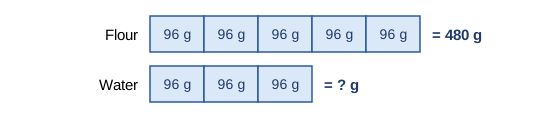
| Unitary method | Cross multiplication (m = mass of water) |
|---|---|
| 5 parts = 480 g 1 part = 480 ÷ 5 = 96 g Water = 3 × 96 = 288 g |
53 = 480m 5 × m = 3 × 480 m = 1 4405 = 288 g |
Example 12: donations in the ratio 2 : 6 : 5 (textbook p. 88)
The canteen operator, Jaya Bookstore and the PIBG donate in the ratio 2 : 6 : 5. The PIBG donates RM900.
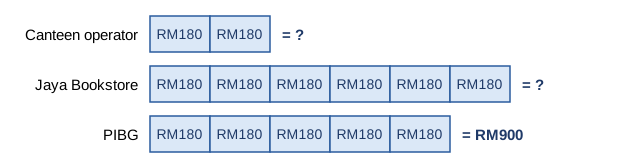
- PIBG: 5 parts = RM900, so 1 part = RM900 ÷ 5 = RM180
- Canteen operator: 2 × RM180 = RM360
- Jaya Bookstore: 6 × RM180 = RM1 080
Example 13: a 12 cm wire (textbook p. 89)
A 12 cm wire PS is cut into three parts. PQ : QR = 3 : 2 and RS = 2 cm. Find PQ : QR : RS.
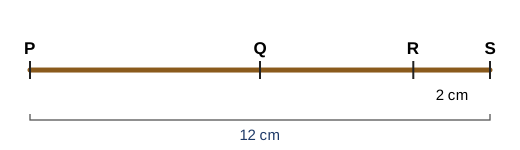
- PR = 12 − 2 = 10 cm, and PQ : QR has 3 + 2 = 5 parts
- 1 part = 10 ÷ 5 = 2 cm, so PQ = 3 × 2 = 6 cm and QR = 2 × 2 = 4 cm
- PQ : QR : RS = 6 : 4 : 2 = 3 : 2 : 1
Show answerHide answer
b) 2 parts = RM50, 1 part = RM25; Zanariah and Rusita = (5 + 3) × RM25 = RM200
Values related to a rate
Example 14: Mr Tan's heart beats 420 times in 4 minutes. How many times in 12 minutes? (textbook p. 90)
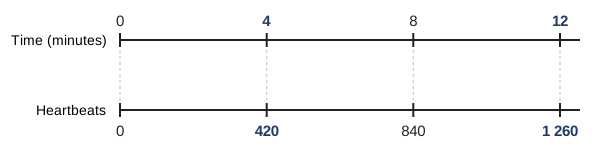
- Rate = 420 times4 minutes. Let x be the number of beats in 12 minutes.
- 4204 = x12 → 4 × x = 420 × 12
- x = 5 0404 = 1 260 times
Unitary method: 420 ÷ 4 = 105 beats per minute, and 105 × 12 = 1 260.
Show answerHide answer
b) He changes RM200 − RM5 = RM195. RM195 ÷ RM3.90 = USD50
Solving problems and making estimations
Example 15: estimating a population of snails (textbook p. 91)
A farmer catches 24 snails, marks their shells and releases them. Two weeks later he catches 30 snails, and 5 of them are marked.
- marked snails caughtsnails caught = snails marked at firstwhole population
- 530 = 24x → simplify: 16 = 24x
- x = 6 × 24 = 144 snails (an estimate)
Show answerHide answer
b) 16 : 12 = 4 : 3
c) 43 = 20x → 4x = 60 → x = 15 losses
4.5Relationship between ratios, rates and proportions, with percentages, fractions and decimals
Example 16: girls to boys is 3 : 2. What percentage are girls? (textbook p. 94)
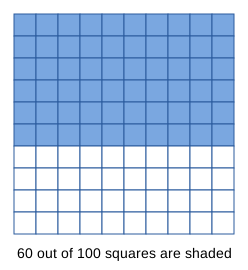
- Girls : total = 3 : (3 + 2) = 3 : 5
- 35 = 3 × 205 × 20 = 60100
- Girls = 60% (or 35 × 100% = 60%)
Example 17: Zakaria saves 30% of his pocket money (textbook p. 94)
Savings : pocket money = 30 : 100 = 3 : 10
| Red : green apples | Fraction of red apples | Decimal | Percentage |
|---|---|---|---|
| 3 : 5 (total 8 parts) | 38 | 3 ÷ 8 = 0.375 | 0.375 × 100% = 37.5% |
Show answerHide answer
b) Empty = 100% − 35% = 65%; 35 : 65 = 7 : 13
Finding a percentage using proportions
Write a proportion with the percentage over 100: partwhole = x100
Example 18: percentages by proportion (textbook pp. 95–96)
a) 2 of 8 ribbons are blue: 28 = x100 → 8x = 200 → x = 25, so 25% are blue.
b) Puan Jorana spends RM15 of her RM300: 15300 = y100 → divide 300 by 3 to get 100, so y = 15 ÷ 3 = 5, she spends 5%.
Example 19: is it really 45% off? (textbook p. 96)
A shirt is labelled "45% price reduction". The original price is RM85.00 and the scanner shows RM57.80.
- 57.8085.00 = p100 → 85p = 5 780 → p = 68. The selling price is 68% of the original price.
- Discount = 100% − 68% = 32%
- 32% is less than 45%, so the discount does not match the label.
Show answerHide answer
b) x45 = 25100 → 100x = 1 125 → x = 11.25, so the buyer saves RM11.25
Solving problems
Example 20: renting apartments (textbook pp. 97–98)
| Apartment | Rent per month | Deposit |
|---|---|---|
| Two-room (Ben) | RM450 | 1 month's rent |
| Three-room (Farid) | RM550 | 2 months' rent |
- First payment: Ben = 450 + 450 = RM900; Farid = 550 + 2 × 550 = RM1 650
- Ben : Farid = 900 : 1 650 = 6 : 11 (÷ 150)
- Ben earns RM3 750: 4503 750 × 100 = 12% of his salary goes on rent.
- Farid earns RM5 000: 5505 000 × 100 = 11% of his salary goes on rent.
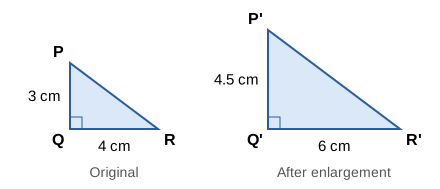
An enlargement to 150% means every length is multiplied by 150100 = 32. The ratio of a new length to the old length is always 3 : 2.
Show answerHide answer
Online: 85% of RM20 = 85100 × 20 = RM17.00
Buying online is better, because RM17.00 < RM17.50 (a bigger percentage discount does not always mean a lower price).
Summary
| Ratio | Rate | Proportion | |
|---|---|---|---|
| Meaning | Compares 2 or 3 quantities in the same unit | Compares 2 quantities with different units | Two ratios or two rates are equal |
| Written as | a : b or a : b : c (no units) | A fraction with units, e.g. km/h, RM per kg | ab = cd |
| Example | 800 g : 1.8 kg = 4 : 9 | 5 m/s = 18 km/h | 43.6 sen2 kWh = 654 sen30 kWh |
| Percentage? | Yes: part : whole as a fraction, decimal or % | No | Used to find a percentage: partwhole = x100 |
| Remember | Key fact |
|---|---|
| Units | Change to the same unit before writing a ratio; 1 m³ = 1 000 000 cm³, 1 h = 3 600 s |
| Equivalent ratios | Multiply or divide every part by the same number; order matters (3 : 5 ≠ 5 : 3) |
| Simplest form | Whole numbers with HCF 1: clear fractions (× LCM) and decimals (× 10, 100) first |
| Three quantities | Make the common middle quantity equal using the LCM, then join |
| Value from a ratio | Find 1 part from the quantity you know, then multiply |
| Unknown in a proportion | Unitary, proportion or cross multiplication: ab = cd → ad = bc |
| Percentage | Part : whole, then × 100%; discount % = 100% − (selling price as % of original) |