Mathematics notes, chapter 7
Linear inequalities
Textbook Mathematics Form 1 (DLP), pages 148–166
What this chapter covers
- Compare numbers with the symbols > and <, describe an inequality, show it on a number line and form an algebraic inequality (7.1)
- Use the converse and transitive properties, the additive and multiplicative inverses, and know when +, −, × and ÷ keep or reverse the inequality symbol (7.1)
- Form linear inequalities from daily life situations, and write a situation for a given inequality (7.2)
- Solve linear inequalities in one variable and use them to solve problems (7.2)
- Solve simultaneous linear inequalities in one variable using a number line (7.2)
7.1Inequalities
An inequality is the relationship between two quantities that do not have the same value. We compare them with the symbols <, >, ≤ and ≥.
In daily life we compare prices, masses, temperatures and heights. A phone that costs RM1 400 is cheaper than one that costs RM1 600, so 1 400 < 1 600.
| Symbol | Meaning | Example |
|---|---|---|
| < | is less than | −2 < 3 |
| > | is greater than | −2 > −7 |
| ≤ | is less than or equal to | v ≤ 110 |
| ≥ | is greater than or equal to | t ≥ 9 |
The symbol always opens towards the bigger number, like a hungry mouth: 3 > −2 and −2 < 3 say the same thing.
Comparing numbers on a number line
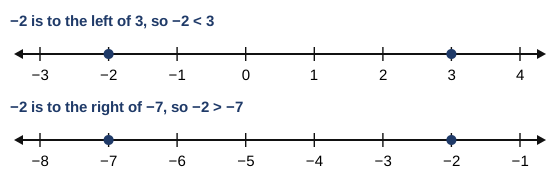
Self Practice 7.1a (textbook p. 151): fill in < or >
(a) −6 ☐ 0 (b) 10 cm ☐ 50 mm (c) 1 200 g ☐ 1.6 kg(a) −6 is to the left of 0, so −6 < 0. "−6 is less than 0."
(b) Change to the same unit first: 10 cm = 100 mm. 100 mm > 50 mm, so 10 cm > 50 mm.
(c) 1.6 kg = 1 600 g. 1 200 g < 1 600 g, so 1 200 g < 1.6 kg.
Comparing 10 cm with 50 mm by looking only at the numbers (10 < 50). Always change both quantities to the same unit first.
Describing an inequality and forming an algebraic inequality

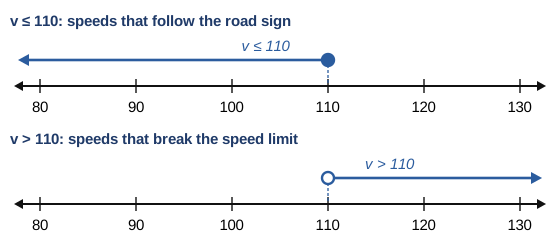
The road sign on the highway says the speed limit is 110 km/h. If v is the speed, then v = 110 or v < 110 is allowed. We join them with one symbol: v ≤ 110. The cars that break the limit have v > 110.
Example 3 (textbook p. 153): overtime pay
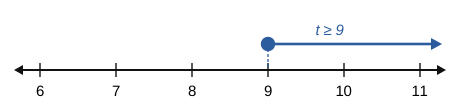
Fatimah earns overtime pay when she works at least 9 hours a day. Let t be her working hours per day.(a) t is greater than or equal to 9.
(b) Draw a solid circle at 9 (9 hours is included) and an arrow to the right.
Using an open circle for ≤ or ≥. "At least 9" includes 9, so the circle must be solid (shaded).
(a) A sign shows that a lorry's load, m tonnes, must be at most 8 tonnes. Write the inequality.
(b) Fatimah did not earn any overtime pay. Write an inequality for her working hours, t.
(b) Fatimah did not earn any overtime pay. Write an inequality for her working hours, t.
Show answerHide answer
(a) m ≤ 8 (solid circle at 8, arrow to the left)
(b) t < 9 (open circle at 9, arrow to the left)
(b) t < 9 (open circle at 9, arrow to the left)
Properties of inequalities
| Property | Rule | Example (textbook p. 154) |
|---|---|---|
| Converse | If a < b, then b > a. | 10 < 24, so 24 > 10 −4 > −13, so −13 < −4 |
| Transitive | If a < b < c, then a < c. | −5 < −1 < 9, so −5 < 9 |
The converse just reads the same inequality from the other side. Swap the two numbers and turn the symbol round.
Inequalities and the four operations
Start with 2 < 6 and do the same thing to both sides (textbook p. 156).
| Do this to both sides | Result | Symbol |
|---|---|---|
| Add 3 | 5 < 9 | stays the same |
| Subtract 3 | −1 < 3 | |
| Add (−3) | −1 < 3 | |
| Subtract (−3) | 5 < 9 | |
| Multiply by 3 | 6 < 18 | |
| Divide by 2 | 1 < 3 | |
| Multiply by (−3) | −6 > −18 | reversed |
| Divide by (−2) | −1 > −3 | |
| Multiply by (−1) (additive inverse) | −2 > −6 | |
| Take the reciprocal (multiplicative inverse) | 12 > 16 |
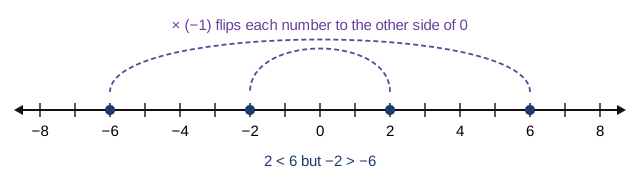
Remember: adding or subtracting any number keeps the symbol. Multiplying or dividing by a positive number keeps the symbol. Multiplying or dividing by a negative number reverses the symbol.
Thinking that subtracting a negative number reverses the symbol. Only multiplying or dividing by a negative number does. 2 − (−3) < 6 − (−3) is 5 < 9.
Given 6 < 12, fill in < or >.
(a) 6 × (−3) ☐ 12 × (−3) (b) 16 ☐ 112 (c) −6 ☐ −12 (d) Write the converse of 8 > −8 (e) Write the transitive property of −15 < −8 < 0
(a) 6 × (−3) ☐ 12 × (−3) (b) 16 ☐ 112 (c) −6 ☐ −12 (d) Write the converse of 8 > −8 (e) Write the transitive property of −15 < −8 < 0
Show answerHide answer
(a) −18 > −36, so >
(b) > (reciprocal reverses)
(c) > (× (−1) reverses)
(d) −8 < 8
(e) −15 < 0
(b) > (reciprocal reverses)
(c) > (× (−1) reverses)
(d) −8 < 8
(e) −15 < 0
7.2Linear inequalities in one variable
A linear inequality in one variable is an inequality with one variable whose power is 1, such as 3x < 7 or y − 4 > 5 + 2y.
Forming linear inequalities from situations
| Words in the question | Symbol |
|---|---|
| more than, exceeds, above | > |
| less than, below, fewer than | < |
| at least, not less than, minimum, … and above | ≥ |
| at most, not more than, maximum, cannot exceed | ≤ |
Example 5 (textbook p. 158)
(a) Pak Samad takes less than 42 days to make a gasing uri: t < 42(b) A fish must be at least 32 cm long to win a prize: l ≥ 32
(c) A cake of not more than 2 kg is cut into 10 equal slices of x kg: 10x ≤ 2
(d) Mr Mohan donates 3% of his profit p and wants the donation to exceed RM240: 3100 p > 240
Example 6 (textbook p. 159): from inequality to situation
(a) h ≥ 110, h = height in cm to ride a roller coaster: a rider must be at least 110 cm tall.(b) T < −5, T = freezer temperature in °C: the freezer is colder than −5°C.
(c) m > 4 600, m = Mr Siva's monthly salary in RM: he earns more than RM4 600.
Writing "at least 32" as l > 32. "At least" means 32 is allowed, so use ≥.
Write a linear inequality.
(a) A terrace house costs RMx, which is RM450 000 and above.
(b) The passing mark is 50. Hajar got y marks and failed.
(c) k people in 5 debating teams; each team cannot have more than 6 people.
(a) A terrace house costs RMx, which is RM450 000 and above.
(b) The passing mark is 50. Hajar got y marks and failed.
(c) k people in 5 debating teams; each team cannot have more than 6 people.
Show answerHide answer
(a) x ≥ 450 000
(b) y < 50
(c) k ≤ 5 × 6, so k ≤ 30
(b) y < 50
(c) k ≤ 5 × 6, so k ≤ 30
Solving linear inequalities
Solve an inequality the same way as a linear equation: get the variable alone. The only new rule is: when you multiply or divide by a negative number, reverse the symbol.
Example 7 (textbook p. 160)
(a) x − 2 ≤ 6x − 2 + 2 ≤ 6 + 2 (add 2)
x ≤ 8
(b) 7x ≥ 28
7x7 ≥ 287 (divide by 7, a positive number)
x ≥ 4
(c) −x3 < 9
−x3 × (−3) > 9 × (−3) (multiply by −3 and reverse)
x > −27
(d) 7 − 4x > 15
7 − 4x − 7 > 15 − 7 (subtract 7)
−4x > 8
−4x−4 < 8−4 (divide by −4 and reverse)
x < −2
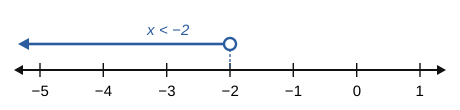
An inequality has many solutions. Check one value: in (d) try x = −3: 7 − 4(−3) = 19, and 19 > 15. ✓
Dividing −4x > 8 by −4 and writing x > −2. You must reverse the symbol: x < −2.
Solve. (a) x + 3 ≥ 10 (b) −2x < 18 (c) −7 > x3 (d) 16 − 5x ≤ −4
Show answerHide answer
(a) x ≥ 10 − 3, x ≥ 7
(b) x > 18 ÷ (−2), x > −9
(c) −21 > x, so x < −21
(d) −5x ≤ −20, x ≥ 4
(b) x > 18 ÷ (−2), x > −9
(c) −21 > x, so x < −21
(d) −5x ≤ −20, x ≥ 4
Solving problems
Example (textbook p. 161): books at RM12.50 each
Ghani spends not more than RM80 on books that cost RM12.50 each. Find the maximum number of books he can buy.Let n = number of books.
12.5n ≤ 80
n ≤ 8012.5
n ≤ 6.4
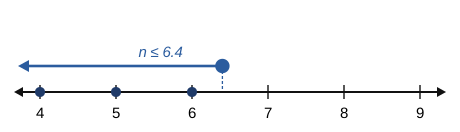
Check: 6 × RM12.50 = RM75 (≤ RM80) ✓; 7 × RM12.50 = RM87.50 (> RM80) ✗
When the answer must be a whole number (books, people, months): for a maximum, round down; for a minimum, round up to the next whole number that works.
Fatimah is paid 10 sen for each canned drink she sells. She wants to earn at least RM20 an hour. How many cans must she sell in an hour?
Show answerHide answer
0.10n ≥ 20
n ≥ 200
At least 200 cans an hour.
n ≥ 200
At least 200 cans an hour.
Simultaneous linear inequalities
The solution of simultaneous linear inequalities is the set of values that satisfy both inequalities: the common region on a number line.
Daily sugar intake should be between 25 g and 37.5 g: m > 25 and m < 37.5, or 25 < m < 37.5 (textbook p. 162).
Example 8(a) (textbook p. 162)
Solve 2x + 5 < 11 and 3x − 10 < 5.2x + 5 < 11 → 2x < 6 → x < 3
3x − 10 < 5 → 3x < 15 → x < 5
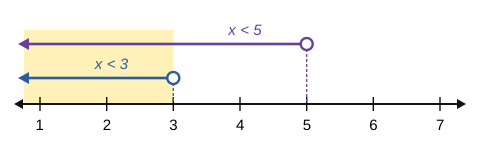
Example 8(b) (textbook p. 163)
Solve 8x + 5 ≥ 5x − 13 and 3x − 4 > 9x + 20.8x − 5x ≥ −13 − 5 → 3x ≥ −18 → x ≥ −6
3x − 9x > 20 + 4 → −6x > 24 → x < −4 (divide by −6, reverse)
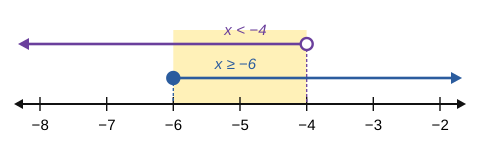
Example: listing the integer solutions
Solve x + 4 > 6 and 3x ≤ 18, then list the integers that satisfy both.x > 2 and x ≤ 6, so 2 < x ≤ 6.
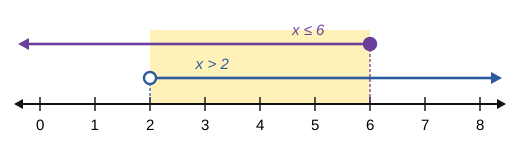
If the two arrows point away from each other and do not overlap, there is no solution. For example, x < 2 and x > 5 have no common values.
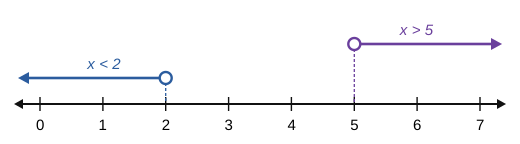
Writing the answer for x > 2 and x > 5 as 2 < x < 5. Both arrows point right, so the common region is x > 5 only. Always draw the number line.
Solve. (a) x + 2 > 4 and 4x > 20 (b) x − 3 ≤ −6 and 3x − 4 ≤ 5 (c) 5x − 3 < 2 and 4x + 6 ≥ x + 3
Show answerHide answer
(a) x > 2 and x > 5, so x > 5
(b) x ≤ −3 and x ≤ 3, so x ≤ −3
(c) x < 1 and 3x ≥ −3, x ≥ −1, so −1 ≤ x < 1
(b) x ≤ −3 and x ≤ 3, so x ≤ −3
(c) x < 1 and 3x ≥ −3, x ≥ −1, so −1 ≤ x < 1
Summary
| Remember | Key fact |
|---|---|
| Symbols | < less than, > greater than, ≤ less than or equal to, ≥ greater than or equal to |
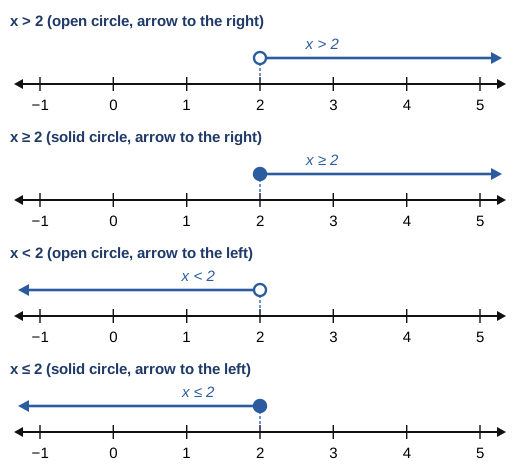
| Number line | Open circle for < and >; solid circle for ≤ and ≥ |
| Converse | If a < b, then b > a |
| Transitive | If a < b < c, then a < c |
| + and − | If a < b, then a + c < b + c and a − c < b − c (symbol stays) |
| × and ÷ by positive c | a × c < b × c and ac < bc (symbol stays) |
| × and ÷ by negative (−c) | a × (−c) > b × (−c) and a−c > b−c (symbol reverses) |
| Inverses | If a < b, then −a > −b; for positive a and b, 1a > 1b |
| Word clues | at least, minimum → ≥; at most, maximum, not more than → ≤ |
| Simultaneous | Solve each one, draw both on one number line, take the common region |