Mathematics questions, chapter 10
Nama / NameKelas / ClassTarikh / Date
Perimeter and area
40 marks. Use Practice to check each answer as you go, or Exam to answer everything first. You may use a calculator. Show your working for Section B.
Section A: objective questions
12 marksChoose the correct answer.
1
Question 1
What is the perimeter of a shape?
Show answerHide answer
A
Perimeter is the distance all the way round, so we add all the sides. The surface covered is the area, and length × width is the area of a rectangle.
2
Question 2
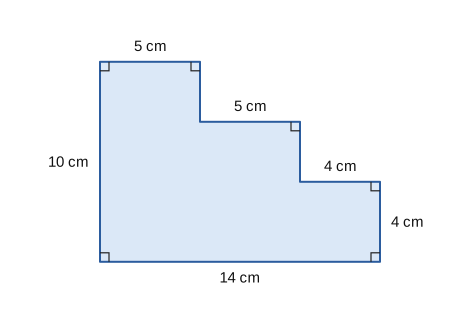
Diagram 1 shows a shape with right-angled corners. Find its perimeter.
Show answerHide answer
C
The right-hand vertical pieces must add up to the left side, so the two unlabelled vertical sides add up to 10 − 4 = 6 cm. Perimeter = 5 + 5 + 4 + 4 + 14 + 10 + 6 = 48 cm. 42 cm adds only the labelled sides and 45 cm counts only one of the two short sides (3 cm). 140 is 14 × 10, an area idea.
3
Question 3
Aina estimates the perimeter of a leaf as 30 cm. She measures it with a thread and gets 32 cm. What is the percentage error of her estimate?
Show answerHide answer
B
Percentage error = (32 − 30) ÷ 32 × 100% = 6.25%. 6.67% divides by the estimate (30) instead of the actual value. 2% is only the difference, and 93.75% is 30 ÷ 32 × 100%.
4
Question 4
A rectangular field is 45 m long and 30 m wide. The whole field is fenced except for a gate 5 m wide. Fencing costs RM12 per metre. What is the cost of the fencing?
Show answerHide answer
D
Perimeter = 2 × (45 + 30) = 150 m. Fence = 150 − 5 = 145 m. Cost = 145 × RM12 = RM1 740. RM1 800 forgets the gate, RM1 680 subtracts the gate twice, and RM16 200 uses the area (1 350 m²).
5
Question 5
A trapezium has parallel sides of lengths a and b, and height t. Which formula gives its area?
Show answerHide answer
A
Two identical trapeziums make a parallelogram with base (a + b) and height t, so one trapezium is ½(a + b)t. (a + b)t is the area of the whole parallelogram.
6
Question 6
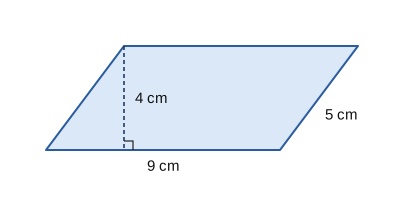
Find the area of the parallelogram in Diagram 2.
Show answerHide answer
B
Area = base × height = 9 × 4 = 36 cm². 45 cm² uses the slanted side (9 × 5), 18 cm² wrongly halves it like a triangle, and 28 is the perimeter.
7
Question 7
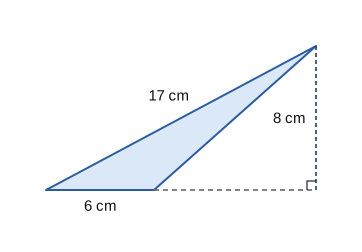
Diagram 3 shows a triangle with a base of 6 cm. Its height, 8 cm, is drawn outside the triangle. Find the area of the triangle.
Show answerHide answer
D
Area = ½ × base × height = ½ × 6 × 8 = 24 cm². The height is still perpendicular to the base line, even when it is outside. 48 cm² forgets the ½; 51 cm² and 68 cm² use the 17 cm side, which is not perpendicular to the base or the height.
8
Question 8
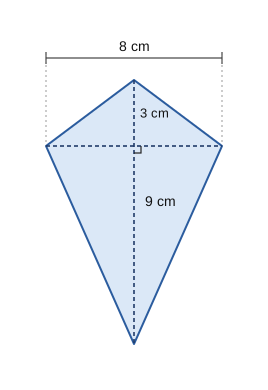
Diagram 4 shows a kite. Find its area.
Show answerHide answer
C
The diagonals are 3 + 9 = 12 cm and 8 cm. Area = ½ × 12 × 8 = 48 cm². 96 cm² forgets the ½, 24 cm² uses half of the 8 cm diagonal, and 36 cm² uses only the 9 cm part.
9
Question 9
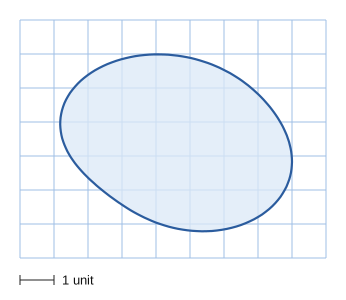
Diagram 5 shows a shape on a grid of 1 unit squares. 15 squares are full, 12 squares are half full or more, and 9 squares are less than half full. Estimate the area of the shape.
Show answerHide answer
B
Count full squares plus squares that are half full or more: 15 + 12 = 27 unit². Squares less than half full are ignored, so 36 (15 + 12 + 9) is too big, and 15 leaves out the half-full squares.
10
Question 10
Kassim has 20 m of fencing to make a rectangular plot. Which length and width give the largest area?
Show answerHide answer
D
All four have a perimeter of 20 m. The areas are 9, 21, 24 and 25 m². With a fixed perimeter, the area is largest when the rectangle is a square.
11
Question 11
The length of a rectangle is 3 cm more than its width. Its perimeter is 26 cm. Find the area of the rectangle.
Show answerHide answer
A
2w + 2(w + 3) = 26, so 4w + 6 = 26 and w = 5 cm; length = 8 cm. Area = 8 × 5 = 40 cm². 42.25 cm² treats it as a square of side 6.5 cm; 166.75 cm² uses w + (w + 3) = 26; 65 cm² multiplies 5 by half the perimeter (13).
12
Question 12
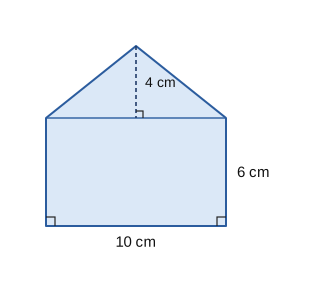
Diagram 6 shows a rectangle 10 cm by 6 cm with a triangle on top. The height of the triangle is 4 cm. Find the area of the whole shape.
Show answerHide answer
C
Rectangle = 10 × 6 = 60 cm². Triangle = ½ × 10 × 4 = 20 cm². Total = 80 cm². 100 cm² forgets the ½ for the triangle, 60 cm² leaves the triangle out, and 90 cm² uses 6 cm as the height of the triangle.
Section B: structured questions
28 marksAnswer all questions. Show your working.
13
Question 13
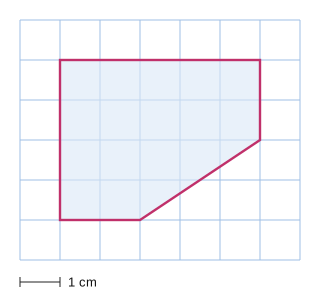
Diagram 7 shows a shape drawn on a grid of 1 cm squares.
[1 mark]
(a)Estimate the perimeter of the shape.
Show answerHide answer
The slanted side crosses 3 squares across and 2 squares down, so it is a little more than 3.5 cm.
Tick each point you got.
[2 marks]
(b)Ali estimated the perimeter as 16 cm. He measured it with a ruler and got 16.6 cm. Calculate the percentage error of Ali's estimate.
Show answerHide answer
Tick each point you got.
14
Question 14
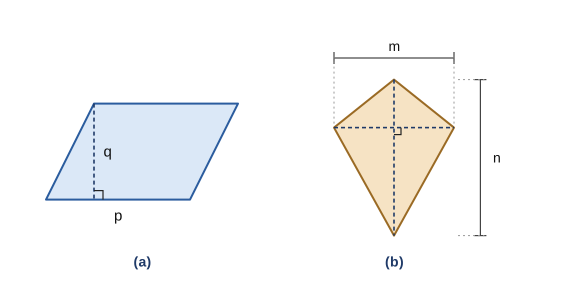
Diagram 8 shows (a) a parallelogram with base p and height q, and (b) a kite with diagonals m and n.
[1 mark]
(a)Write an expression for the area of the parallelogram.
Show answerHide answer
Tick each point you got.
[1 mark]
(b)Write an expression for the area of the kite.
Show answerHide answer
Tick each point you got.
15
Question 15
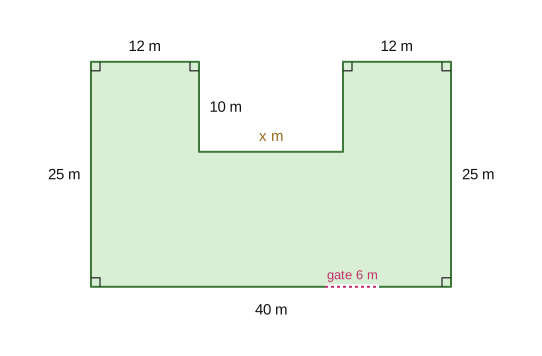
Diagram 9 shows the plan of a school garden. All corners are right angles. The garden is fenced all round except for a gate 6 m wide. Fencing costs RM25 per metre.
[1 mark]
(a)Find the value of x.
Show answerHide answer
Tick each point you got.
[1 mark]
(b)Find the perimeter of the garden.
Show answerHide answer
Tick each point you got.
[2 marks]
(c)Calculate the cost of the fencing.
Show answerHide answer
Tick each point you got.
16
Question 16
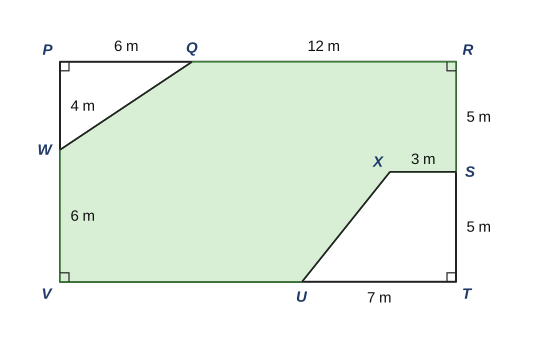
Diagram 10 shows a rectangular plot of land PRTV. Triangle PQW is planted with pandan and trapezium UTSX is a fish pond. The shaded region is planted with vegetables.
[1 mark]
(a)Find the area of the rectangle PRTV.
Show answerHide answer
Tick each point you got.
[3 marks]
(b)Find the area of the shaded region.
Show answerHide answer
Tick each point you got.
17
Question 17
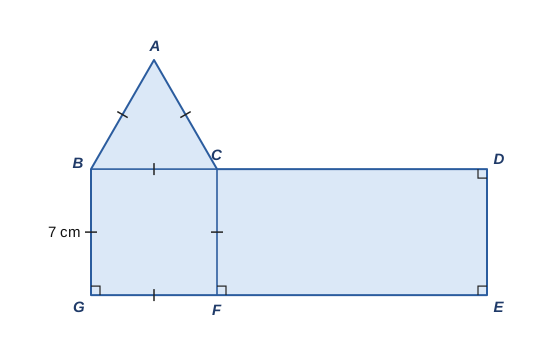
In Diagram 11, ABC is an equilateral triangle, BCFG is a square with sides of 7 cm and CDEF is a rectangle. GFE is a straight line. The perimeter of the whole diagram is 65 cm.
[2 marks]
(a)Find the length of CD.
Show answerHide answer
Tick each point you got.
[1 mark]
(b)Hence, find the length of GE.
Show answerHide answer
Tick each point you got.
18
Question 18
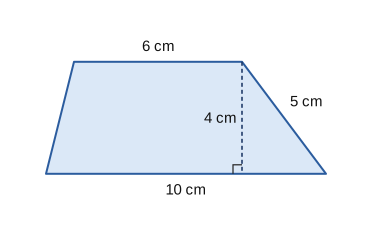
Diagram 12 shows a trapezium. Siti calculated its area like this:
Area = ½ × (6 + 10) × 5
= ½ × 16 × 5
= 40 cm²
Area = ½ × (6 + 10) × 5
= ½ × 16 × 5
= 40 cm²
[2 marks]
(a)Siti's answer is wrong. Explain her mistake.
Show answerHide answer
Tick each point you got.
[2 marks]
(b)Calculate the correct area.
Show answerHide answer
Tick each point you got.
19
Question 19
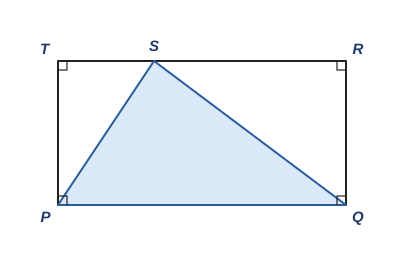
Diagram 13 shows triangle PQS inside rectangle PQRT. S lies on TR. The perimeter of the rectangle is 60 cm and its length PQ is twice its width.
[2 marks]
(a)Find the width and the length of the rectangle.
Show answerHide answer
Tick each point you got.
[2 marks]
(b)Find the area of triangle PQS.
Show answerHide answer
The height of the triangle is the width of the rectangle, wherever S is on TR.
Tick each point you got.
20
Question 20
Puan Lim has 24 m of fencing. She wants to fence a rectangular herb garden using all the fencing. The side lengths must be whole numbers of metres.
[2 marks]
(a)List every possible length and width, with the area of each garden.
Show answerHide answer
Tick each point you got.
[1 mark]
(b)Puan Lim wants a garden that is not a square and has an area of at least 32 m². Design one such garden. State its length and width and show that it meets both conditions.
Show answerHide answer
Tick each point you got.
[1 mark]
(c)Which garden from (a) has the largest area? Explain why, using the pattern in your list.
Show answerHide answer
Tick each point you got.