Perimeter and area
What this chapter covers
- Determine the perimeter of shapes when the side lengths are given or need to be measured, including finding missing sides (10.1)
- Estimate the perimeter of a shape on a grid and judge the accuracy with the percentage error (10.1)
- Solve problems involving perimeter, such as fencing and its cost (10.1)
- Estimate the area of irregular shapes by counting squares on a grid (10.2)
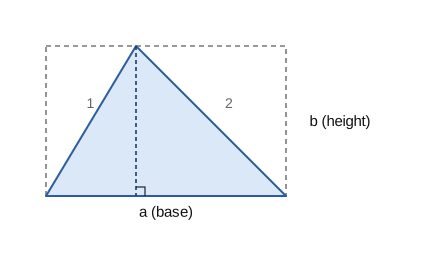
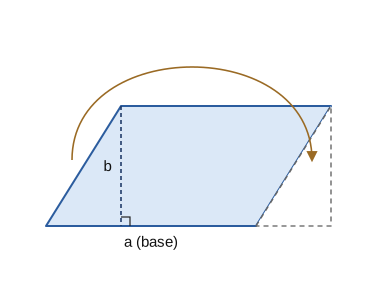
- Explain how the area formulae of triangles, parallelograms, kites and trapeziums come from the area of a rectangle (10.2)
- Calculate the areas of triangles, parallelograms, kites, trapeziums and combined shapes, including shaded regions (10.2)
- Make and verify conjectures about the relationship between perimeter and area of rectangles (10.3)
- Solve problems involving both perimeter and area (10.3)
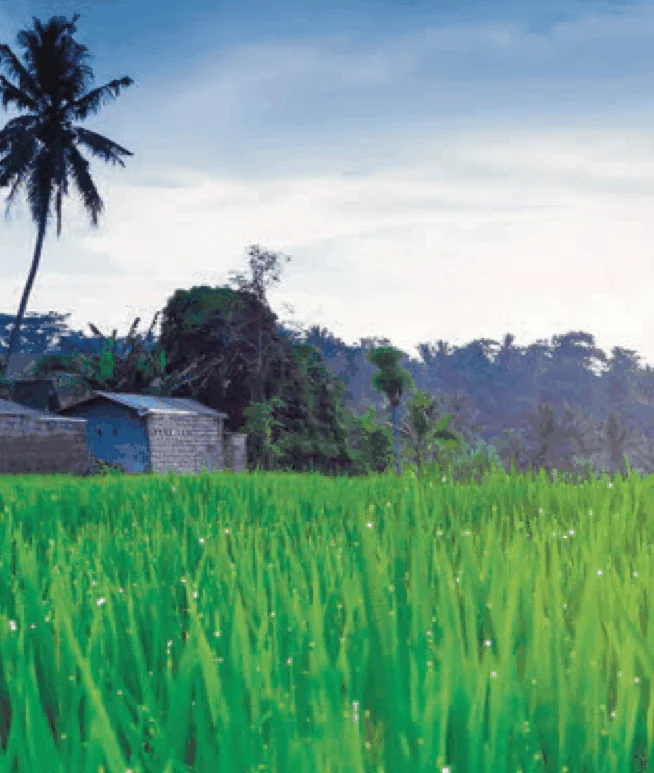
A farmer who wants to fence a paddy field needs to know the perimeter: the distance all the way round. A farmer who wants to know how much rice he can plant needs the area: how much surface the field covers. In this chapter you will find perimeters, use formulae for the areas of triangles, parallelograms, kites and trapeziums, and discover how perimeter and area are related.
| English | Bahasa Melayu |
|---|---|
| perimeter | perimeter |
| area | luas |
| length, width, height | panjang, lebar, tinggi |
| square, rectangle | segi empat sama, segi empat tepat |
| triangle, parallelogram | segi tiga, segi empat selari |
| kite, trapezium | lelayang, trapezium |
| square unit, formula, conjecture | unit persegi, rumus, konjektur |
10.1Perimeter
What is perimeter?

Finding missing sides
In a shape made of horizontal and vertical lines, some sides are not labelled. Use the sides that are labelled: the total of the top pieces equals the bottom, and the total of the right pieces equals the left.
Example 1 (like textbook p. 226)
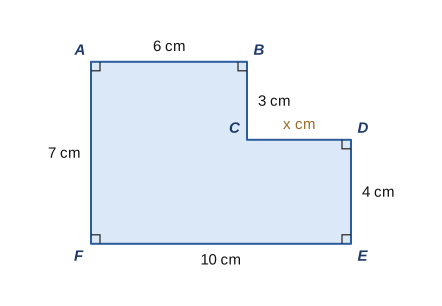
Find the perimeter of the shape ABCDEF.
- Find the missing side: AB + CD = FE, so 6 + x = 10, and x = 10 − 6 = 4 cm.
- Check the vertical sides: BC + DE = 3 + 4 = 7 cm = FA. ✓
- Perimeter = AB + BC + CD + DE + EF + FA = 6 + 3 + 4 + 4 + 10 + 7 = 34 cm
Example 2: a slanted side
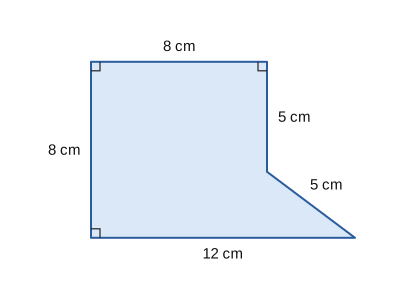
- The sides are 8 cm, 5 cm, 5 cm, 12 cm and 8 cm.
- Perimeter = 8 + 5 + 5 + 12 + 8 = 38 cm
Show answerHide answer
Estimating perimeter and percentage error
A shape drawn on a grid of 1 cm squares can be estimated: count the squares along the straight sides and estimate the slanted or curved sides. Then measure with a ruler (or a thread for curves) to see how good the estimate was.
Example 3 (like textbook pp. 227–228)
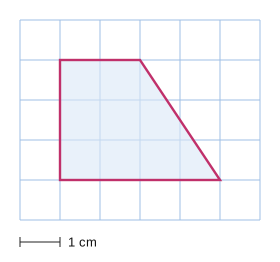
- Top = 2 cm, bottom = 4 cm, left = 3 cm. The slanted side is a little longer than 3.5 squares, so estimate 3.5 cm.
- Estimate = 2 + 3.5 + 4 + 3 = 12.5 cm
- Measured with a ruler: 12.6 cm
- Percentage error = 12.6 − 12.512.6 × 100% = 0.79% (2 decimal places)
Solving problems involving perimeter
Example 4: fencing (like textbook pp. 228–229)
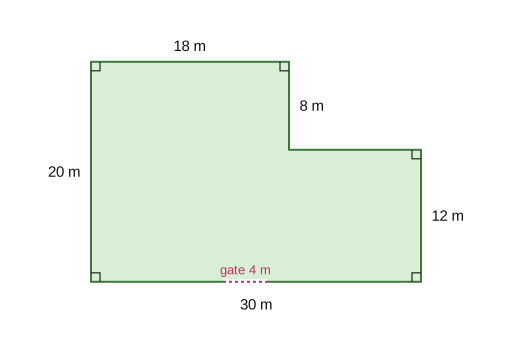
Encik Hafiz fences the whole field except a 4 m gate. Fencing costs RM15 per metre. Find the cost.
- The unlabelled horizontal side = 30 − 18 = 12 m. Check the vertical sides: 8 + 12 = 20 m ✓
- Perimeter = 18 + 8 + 12 + 12 + 30 + 20 = 100 m
- Length of fence = 100 − 4 = 96 m
- Cost = 96 × RM15 = RM1 440
Show answerHide answer
Width = 32 − 23 = 9 m
10.2Area of triangles, parallelograms, kites and trapeziums
Estimating area
For an irregular shape on a grid of 1 unit squares: count the full squares, then count the squares that are half full or more as 1 each, and ignore squares that are less than half full.
Example 5 (like textbook p. 231)
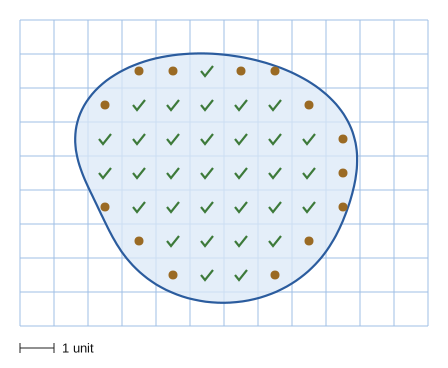
- Full squares (✓) = 32
- Squares half full or more (●) = 14
- Area ≈ 32 + 14 = 46 unit²
Another method: draw lines 1 unit apart across the shape, measure each line and add the lengths (each line stands for a strip 1 unit wide).
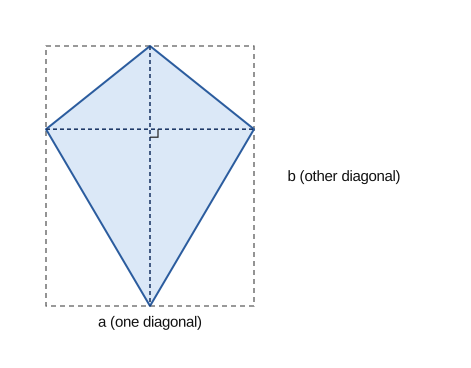
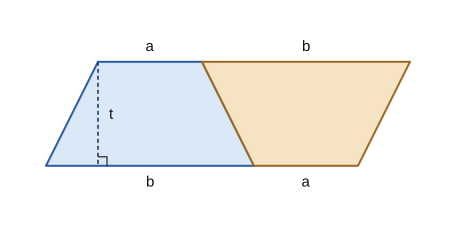
Where the formulae come from
Every formula comes from the area of a rectangle, length × width.
Calculating areas
Example 6 (like textbook pp. 236–237)
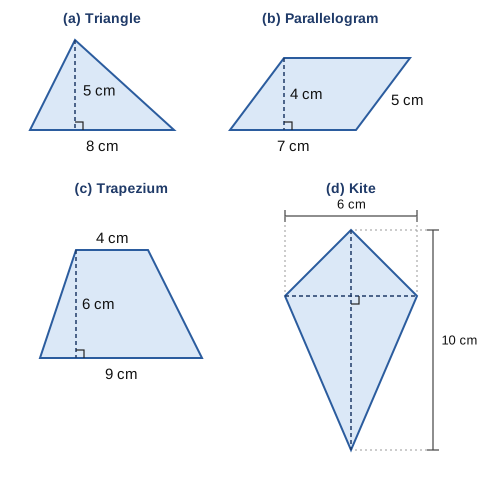
- (a) Triangle = ½ × 8 × 5 = 20 cm²
- (b) Parallelogram = 7 × 4 = 28 cm² (the 5 cm side is not the height)
- (c) Trapezium = ½ × (4 + 9) × 6 = ½ × 13 × 6 = 39 cm²
- (d) Kite = ½ × 10 × 6 = 30 cm²
Show answerHide answer
b) ½ × (5 + 11) × 4 = ½ × 16 × 4 = 32 cm²
Combined shapes and shaded regions
For a shaded region, find the area of the big shape and subtract the unshaded parts. For a combined shape, add the parts.
Example 7 (like textbook p. 237)
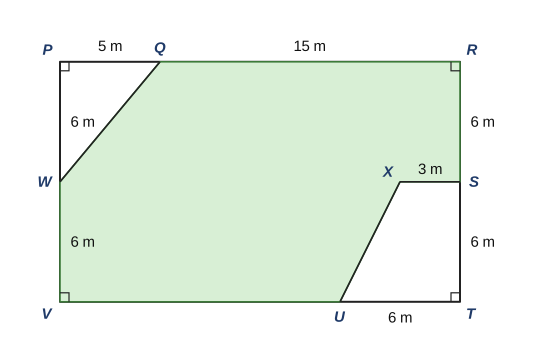
PRTV is a rectangular plot. Bananas grow in triangle PQW and rambutans in trapezium UTSX. Find the shaded area.
- Area of PRTV = (5 + 15) × (6 + 6) = 20 × 12 = 240 m²
- Area of PQW = ½ × 5 × 6 = 15 m²
- Area of UTSX = ½ × (3 + 6) × 6 = 27 m²
- Shaded area = 240 − 15 − 27 = 198 m²
10.3Relationship between perimeter and area
Kassim has a fixed length of fencing for a rectangular vegetable plot. Which rectangle gives the biggest plot? Try it with a loop of string 24 cm long: every rectangle below has a perimeter of 24 cm, but their areas are different.
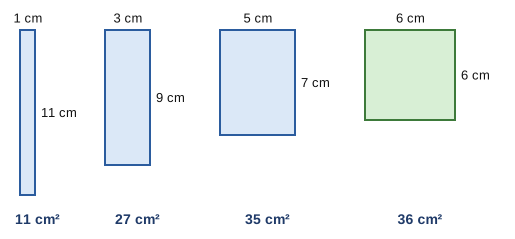
| Same perimeter (24 cm) | Same area (36 cm²) | ||||||
|---|---|---|---|---|---|---|---|
| Length | Width | Area | Difference | Length | Width | Perimeter | |
| 11 | 1 | 11 | 10 | 36 | 1 | 74 | |
| 10 | 2 | 20 | 8 | 18 | 2 | 40 | |
| 9 | 3 | 27 | 6 | 12 | 3 | 30 | |
| 8 | 4 | 32 | 4 | 9 | 4 | 26 | |
| 7 | 5 | 35 | 2 | 6 | 6 | 24 | |
| 6 | 6 | 36 | 0 | ||||
For rectangles with the same perimeter, the area gets smaller as the difference between length and width gets bigger. The area is largest when the rectangle is a square.
For rectangles with the same area, the perimeter gets bigger as the difference between length and width gets bigger. The perimeter is smallest when the rectangle is a square.
Problems with perimeter and area
Example 8 (textbook p. 241)
The area of a square garden is 500 m². Find its perimeter.
- Let the side be x m. Then x² = 500.
- x = √500 = 22.36 m (2 decimal places)
- Perimeter = 4 × 22.36 = 89.44 m
Example 9 (like textbook p. 241)
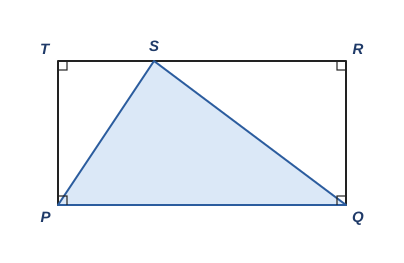
Triangle PQS is inside rectangle PQRT. The perimeter of the rectangle is 54 cm and its length is twice its width. Find the area of triangle PQS.
- Let the width be w cm. The length is 2w cm.
- 2w + 2(2w) = 54, so 6w = 54 and w = 9. Length = 2 × 9 = 18 cm.
- Check: 2(18) + 2(9) = 36 + 18 = 54 ✓
- The base of the triangle is PQ = 18 cm and its height is the width, 9 cm.
- Area of PQS = ½ × 18 × 9 = 81 cm² (half the rectangle)
Show answerHide answer
b) 2w + 2(w + 4) = 32, 4w + 8 = 32, w = 6 cm, length = 10 cm, area = 10 × 6 = 60 cm²
Summary
| Shape | Perimeter | Area |
|---|---|---|
| Rectangle (length l, width w) | 2l + 2w | l × w |
| Square (side s) | 4s | s × s |
| Triangle (sides a, b, c; base, height) | a + b + c | ½ × base × height |
| Parallelogram (sides a, b) | 2a + 2b | base × height |
| Kite (sides a, b; diagonals d₁, d₂) | 2a + 2b | ½ × d₁ × d₂ |
| Trapezium (parallel sides a, b; height t) | sum of the 4 sides | ½ × (a + b) × t |
- Perimeter = total length around a shape (cm, m). Area = surface covered (cm², m²).
- Percentage error = difference ÷ actual value × 100%. Smaller means more accurate.
- Estimate area on a grid: full squares + squares that are half full or more.
- Height is always perpendicular to the base.
- Shaded region = big shape − unshaded parts.
- Same perimeter: a square gives the largest area. Same area: a square gives the smallest perimeter.