Basic polygons
What this chapter covers
- State the relationship between the number of sides, vertices and diagonals of a polygon, and find the number of diagonals with n(n − 3) ÷ 2 (9.1)
- Draw polygons, label their vertices in order and name them, from triangle to decagon (9.1)
- Classify triangles by their sides (equilateral, isosceles, scalene) and by their angles (acute-angled, obtuse-angled, right-angled), and state their axes of symmetry (9.2)
- Use the interior and exterior angles of a triangle (the interior angles add up to 180°, an interior angle and its adjacent exterior angle add up to 180°, and an exterior angle equals the sum of the two opposite interior angles) (9.2)
- Solve problems involving triangles (9.2)
- Describe and classify the square, rectangle, parallelogram, rhombus, trapezium and kite by their geometric properties (9.3)
- Use the interior and exterior angles of a quadrilateral (sum 360°) and the equal opposite angles of a parallelogram (9.3)
- Solve problems involving quadrilaterals and combinations of triangles and quadrilaterals (9.3)
Look up inside Putra Mosque in Putrajaya and you will see triangles, squares, hexagons, octagons and more, fitted together into beautiful patterns. Each of these shapes is a polygon. Architects, tile makers and designers use the properties of polygons, and the rules for their angles, to make shapes that fit exactly. In this chapter you will name polygons, count their diagonals, learn the properties of triangles and quadrilaterals, and use angle facts to find unknown angles.

Photograph: Mathematics Form 1 (DLP) textbook, p. 200.
| English | Bahasa Melayu |
|---|---|
| polygon, side, vertex | poligon, sisi, bucu |
| diagonal | pepenjuru |
| triangle, quadrilateral | segi tiga, sisi empat |
| square, rectangle | segi empat sama, segi empat tepat |
| parallelogram, rhombus | segi empat selari, rombus |
| trapezium, kite | trapezium, lelayang |
| interior angle, exterior angle | sudut pedalaman, sudut peluaran |
| acute angle, obtuse angle, right angle | sudut tirus, sudut cakah, sudut tegak |
| conjecture | konjektur |
9.1Polygons
A circle is not a polygon (it has no straight sides), and a shape with a gap is not a polygon (it is not closed).
Naming polygons
A polygon is named by its number of sides.
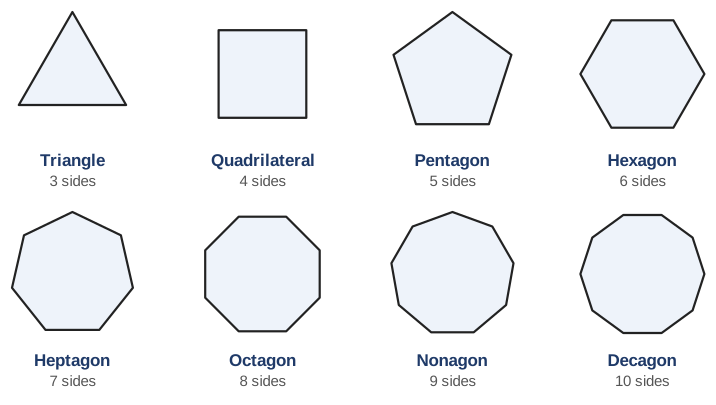
| Sides | 3 | 4 | 5 | 6 | 7 | 8 | 9 | 10 |
|---|---|---|---|---|---|---|---|---|
| Name | triangle | quadrilateral | pentagon | hexagon | heptagon | octagon | nonagon | decagon |
Sides, vertices and diagonals
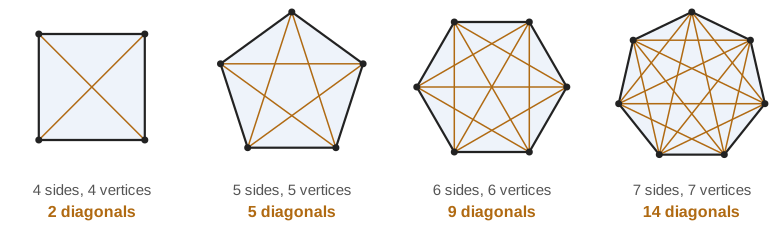
Why? From each vertex you can draw a diagonal to every other vertex except itself and its two neighbours, so n − 3 diagonals start at each vertex. That gives n(n − 3), but every diagonal has been counted twice (once from each end), so we divide by 2.
The textbook also gives a step method: let m = number of sides − 3; then number of diagonals = 2m + (m − 1) + (m − 2) + … + 1.
Example 1 (textbook p. 203)
Find the number of vertices and the number of diagonals of a polygon with 10 sides.
- Number of vertices = number of sides = 10
- Step method: m = 10 − 3 = 7, so diagonals = 2(7) + 6 + 5 + 4 + 3 + 2 + 1 = 35
- Formula: 10(10 − 3)2 = 702 = 35 diagonals
Show answerHide answer
b) 9 vertices; 9(6) ÷ 2 = 27 diagonals
c) 12 vertices; 12(9) ÷ 2 = 54 diagonals
d) 20 vertices; 20(17) ÷ 2 = 170 diagonals
Drawing, labelling and naming a polygon
- Count the number of sides needed.
- Mark that many points, with no three of them on one straight line.
- Join the points with straight lines to make a closed figure.
- Label the vertices with capital letters in order around the shape, and name the polygon.
Example 2 (textbook p. 204)
Draw a polygon with six sides. Label and name it.
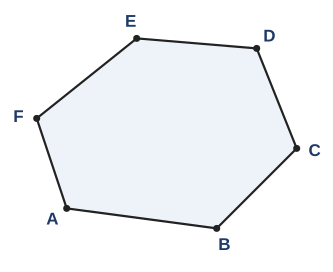
The polygon is the hexagon ABCDEF. It may also be named, for example, BCDEFA or FEDCBA, because these go round the shape in order.
Show answerHide answer
b) True: 12(9) ÷ 2 = 54.
c) False: 8(5) ÷ 2 = 20 diagonals. It has 8 sides and 8 vertices.
9.2Properties of triangles and the interior and exterior angles of triangles
Types of triangles
On diagrams, sides with the same tick marks are equal in length, angles with the same arcs are equal, and a small square marks a right angle. A dashed line shows an axis of symmetry (the fold line where the two halves match exactly).
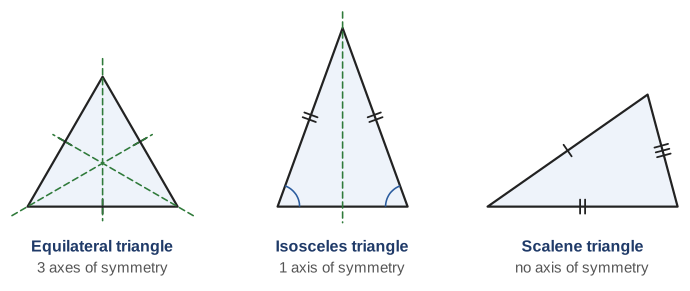
| By sides | Properties | Axes of symmetry |
|---|---|---|
| Equilateral triangle | All 3 sides are equal. Every interior angle is 60°. | 3 |
| Isosceles triangle | 2 sides are equal. The 2 base angles (opposite the equal sides) are equal. | 1 |
| Scalene triangle | All sides are different. All angles are different. | none |
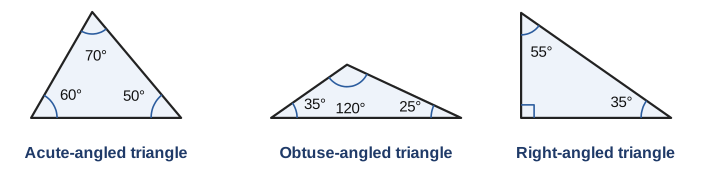
| By angles | Property |
|---|---|
| Acute-angled triangle | Every interior angle is acute (less than 90°). |
| Obtuse-angled triangle | One interior angle is obtuse (between 90° and 180°). |
| Right-angled triangle | One interior angle is a right angle (90°). |
Show answerHide answer
b) True, angles 90°, 45°, 45° with the two shorter sides equal.
c) False: a scalene triangle has no axis of symmetry.
Interior and exterior angles of a triangle
An interior angle is inside the triangle at a vertex. When a side is extended, the angle between the extended line and the next side is an exterior angle.
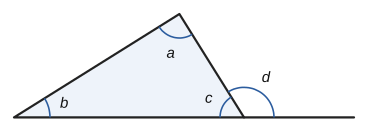
(i) the interior angles add up to 180°: a + b + c = 180°
(ii) an interior angle and its adjacent exterior angle add up to 180° (angles on a straight line): c + d = 180°
(iii) an exterior angle equals the sum of the two opposite interior angles: d = a + b
Example 3 (textbook p. 209)
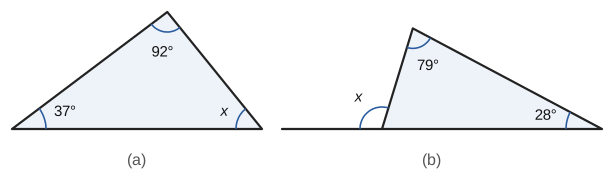
Find the value of x.
- (a) 92° + 37° + x = 180° (sum of interior angles)
- 129° + x = 180°, so x = 180° − 129° = 51°
- (b) x = 79° + 28° (exterior angle = sum of the two opposite interior angles)
- x = 107°
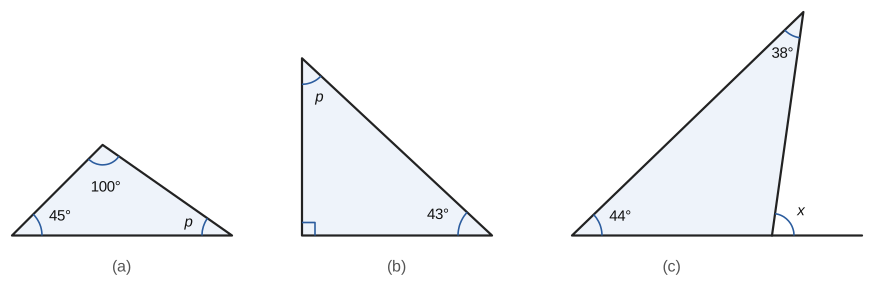
Show answerHide answer
b) p = 180° − 90° − 43° = 47°
c) x = 44° + 38° = 82°
Solving problems involving triangles
Many problems need two or three steps. Write down each angle you find with its reason, then use it in the next step.
Example 4 (textbook p. 210)
In the diagram, PQRS is a straight line and TQ = TS. Calculate the values of x and y.
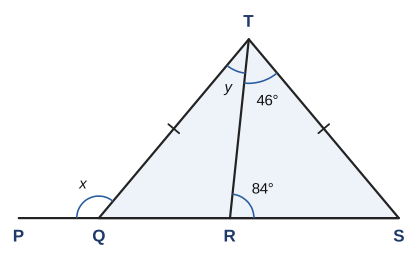
- In ΔRST: ∠RST + 84° + 46° = 180°, so ∠RST = 180° − 84° − 46° = 50°
- TQ = TS, so ΔQST is isosceles: ∠TQS = ∠RST = 50° (base angles)
- x + 50° = 180° (angles on a straight line), so x = 130°
- In ΔQST: ∠QTS = 180° − 50° − 50° = 80°
- y + 46° = 80°, so y = 34°
9.3Properties of quadrilaterals and the interior and exterior angles of quadrilaterals
Types of quadrilaterals
Arrow marks show parallel sides: sides with the same arrows are parallel.
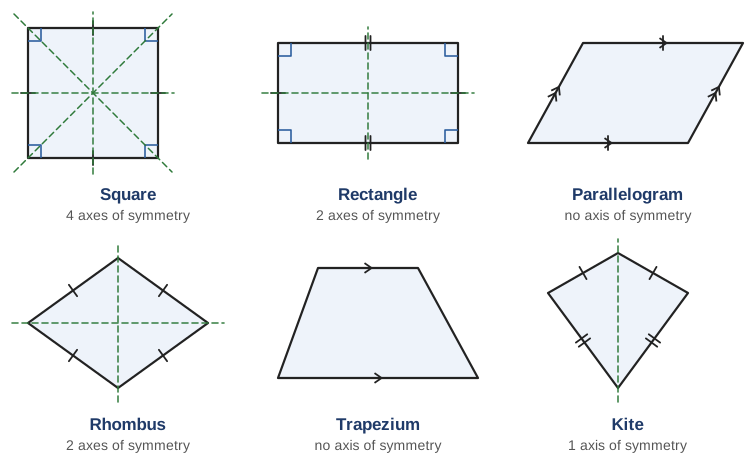
| Quadrilateral | Geometric properties | Axes of symmetry |
|---|---|---|
| Square | All sides equal; opposite sides parallel; all angles 90°; diagonals equal and are perpendicular bisectors of each other. | 4 |
| Rectangle | Opposite sides parallel and equal; all angles 90°; diagonals equal and bisect each other. | 2 |
| Parallelogram | Opposite sides parallel and equal; opposite angles equal; diagonals bisect each other. | none |
| Rhombus | All sides equal; opposite sides parallel; opposite angles equal; diagonals are perpendicular bisectors of each other. | 2 |
| Trapezium | Only one pair of opposite sides is parallel. | none |
| Kite | Two pairs of adjacent sides equal; one pair of opposite angles equal; one diagonal is the perpendicular bisector of the other and bisects the angles at its ends. | 1 |
Show answerHide answer
b) Square and rectangle
c) All four sides are equal; the diagonals are perpendicular; it has 2 axes of symmetry (any two)
Interior and exterior angles of a quadrilateral
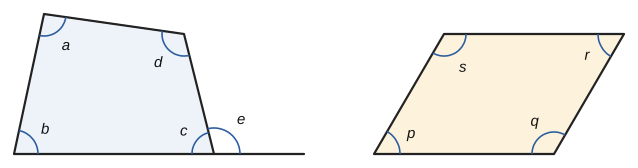
(a) the interior angles add up to 360°: a + b + c + d = 360°
(b) an interior angle and its adjacent exterior angle add up to 180°: c + e = 180°
In a parallelogram (or rhombus) the opposite angles are equal: p = r and q = s. Two angles next to each other add up to 180°: p + q = 180°.
Example 5 (textbook p. 215)
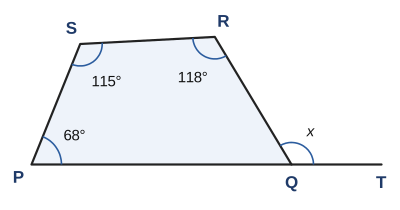
In each diagram, PST is a straight line. Calculate the values of x and y.
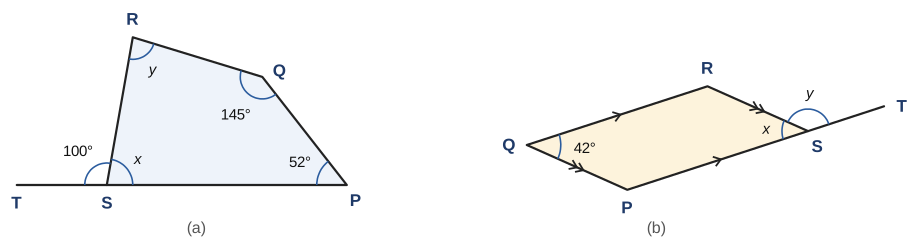
- (a) x + 100° = 180° (interior + adjacent exterior angle), so x = 80°
- y + 80° + 52° + 145° = 360° (sum of interior angles of a quadrilateral)
- y + 277° = 360°, so y = 83°
- (b) x = 42° (opposite angles of a parallelogram are equal)
- y + 42° = 180°, so y = 138°
Show answerHide answer
x = 180° − 59° = 121°
Solving problems involving quadrilaterals
Example 6 (textbook p. 216)
PQRU is a square and QRSV is a parallelogram. PVR is a straight line. Find the values of x and y.
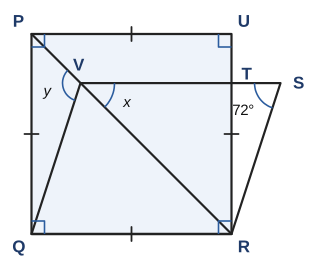
- ∠PQR = 90° and PQ = QR, so the diagonal makes ∠QRV = 90° ÷ 2 = 45°.
- VS is parallel to QR, so x = ∠QRV = 45° (alternate angles)
- ∠QVS + 72° = 180° (adjacent angles of a parallelogram), so ∠QVS = 108°
- ∠QVR = 108° − 45° = 63°
- PVR is a straight line, so y = 180° − 63° = 117°
Combinations of triangles and quadrilaterals
Example 7 (textbook p. 217)
QRTU is a parallelogram and PQRS is a straight line. Find the values of x and y.
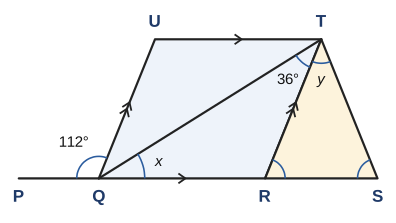
- ∠QRT = 112° (corresponding angles, QU ∥ RT)
- In ΔQRT: x + 112° + 36° = 180°, so x = 32°
- ∠TRS + 112° = 180° (angles on a straight line), so ∠TRS = 68°
- In ΔRST, ∠TSR = ∠TRS = 68°: y + 68° + 68° = 180°, so y = 44°
Show answerHide answer
One part = 360° ÷ 18 = 20°
Largest angle = 6 × 20° = 120°
Summary
| Idea | Key fact | Example |
|---|---|---|
| Polygon | Closed figure with 3 or more straight sides; named by its number of sides | 5 sides: pentagon; 8 sides: octagon |
| Vertices, diagonals | Vertices = sides; diagonals = n(n − 3) ÷ 2 | 10 sides: 10 vertices, 35 diagonals |
| Naming | Letters in order round the shape | hexagon ABCDEF |
| Triangles by sides | Equilateral (3 axes), isosceles (1 axis), scalene (none) | Isosceles: base angles equal |
| Triangles by angles | Acute-angled, obtuse-angled, right-angled | 25°, 35°, 120°: obtuse-angled |
| Triangle angles | Interior sum 180°; interior + exterior = 180°; exterior = sum of opposite interior angles | 79° + 28° = 107° |
| Quadrilaterals | Square (4 axes), rectangle (2), rhombus (2), kite (1), parallelogram and trapezium (none) | A square is also a rhombus |
| Quadrilateral angles | Interior sum 360°; interior + exterior = 180°; parallelogram: opposite angles equal | 360° − 80° − 52° − 145° = 83° |