Mathematics questions, chapter 9
Nama / NameKelas / ClassTarikh / Date
Basic polygons
40 marks. Use Practice to check each answer as you go, or Exam to answer everything first. Do not use a protractor: the diagrams are drawn to scale, but you must calculate the angles. Show your working for Section B.
Section A: objective questions
12 marksChoose the correct answer.
1
Question 1
What is the name of a polygon with 8 sides?
Show answerHide answer
C
An octagon has 8 sides (think of an octopus with 8 legs). A hexagon has 6, a heptagon 7 and a nonagon 9.
2
Question 2
How many diagonals does a polygon with 9 sides have?
Show answerHide answer
B
Number of diagonals = 9(9 − 3) ÷ 2 = 54 ÷ 2 = 27. 54 forgets to divide by 2; 6 is only the number of diagonals from one vertex; 36 counts the sides as well.
3
Question 3
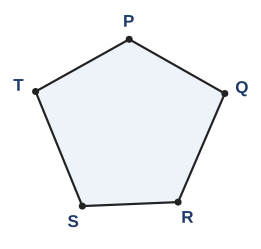
Diagram 1 shows a pentagon. Which is a correct name for the pentagon?
Show answerHide answer
D
The letters must go round the shape in order. TSRQP goes anticlockwise from T, so it is correct. The other names jump across the pentagon (for example Q to S).
4
Question 4
Which triangle has exactly one axis of symmetry?
Show answerHide answer
A
An isosceles triangle folds onto itself along the line from the apex to the middle of the base: 1 axis. An equilateral triangle has 3 axes, and a scalene triangle has none.
5
Question 5
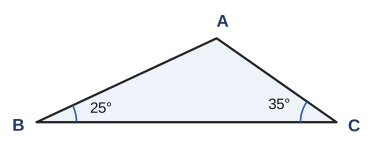
Diagram 2 shows triangle ABC. What type of triangle is ABC, based on its angles?
Show answerHide answer
B
∠BAC = 180° − 25° − 35° = 120°, which is obtuse. Choosing acute-angled comes from looking only at the two angles given.
6
Question 6
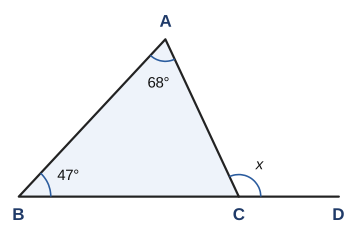
In Diagram 3, BCD is a straight line. Find the value of x.
Show answerHide answer
C
The exterior angle equals the sum of the two opposite interior angles: x = 47° + 68° = 115°. 65° is the interior angle ∠ACB, and 133° is 180° − 47°.
7
Question 7
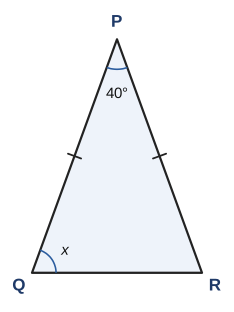
Diagram 4 shows an isosceles triangle PQR with PQ = PR. Find the value of x.
Show answerHide answer
A
The base angles are equal: 2x + 40° = 180°, so 2x = 140° and x = 70°. 140° forgets to halve, and 100° wrongly takes a base angle as 40°.
8
Question 8
The diagonals of a quadrilateral are perpendicular bisectors of each other but are not equal in length. What is the quadrilateral?
Show answerHide answer
D
A rhombus has diagonals that are perpendicular bisectors of each other. A square's diagonals are also equal; a rectangle's are not perpendicular; in a kite only one diagonal bisects the other.
9
Question 9
Which statement is TRUE?
Show answerHide answer
B
A square has all the properties of a rhombus (four equal sides, opposite sides parallel, opposite angles equal, perpendicular diagonals). A trapezium has only one pair of parallel sides, and a parallelogram has no axis of symmetry.
10
Question 10
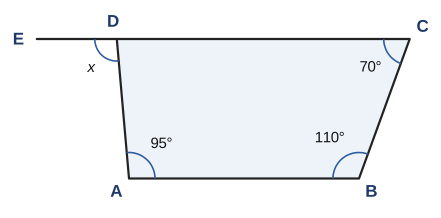
In Diagram 5, CDE is a straight line. Find the value of x.
Show answerHide answer
C
∠ADC = 360° − 95° − 110° − 70° = 85°, so x = 180° − 85° = 95°. 85° is the interior angle, not the exterior angle x.
11
Question 11
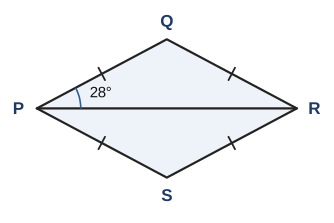
Diagram 6 shows a rhombus PQRS with diagonal PR. Find ∠PQR.
Show answerHide answer
A
PQ = QR, so ΔPQR is isosceles and ∠QRP = ∠QPR = 28°. ∠PQR = 180° − 28° − 28° = 124°. 152° uses only one 28°; 56° is ∠QPS.
12
Question 12
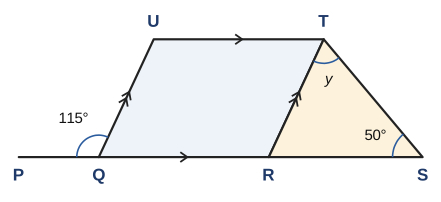
In Diagram 7, QRTU is a parallelogram and PQRS is a straight line. Find the value of y.
Show answerHide answer
D
∠UQR = 180° − 115° = 65°. RT ∥ QU, so ∠TRS = ∠UQR = 65° (corresponding angles). y = 180° − 65° − 50° = 65°. 15° comes from using ∠QRT = 115° inside ΔRST.
Section B: structured questions
28 marksAnswer all questions. Show your working.
13
Question 13
Answer these questions about polygons.
[1 mark]
(a)A polygon with 11 sides has 11 vertices.
Show answerHide answer
True
Every polygon has the same number of vertices as sides.
[2 marks]
(b)Calculate the number of diagonals of a heptagon.
Show answerHide answer
Tick each point you got.
14
Question 14
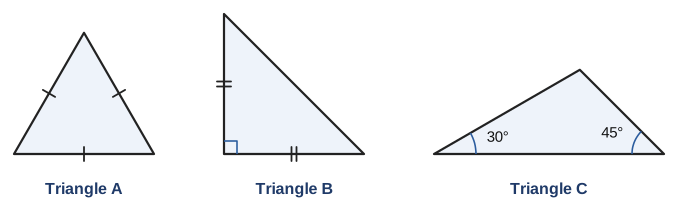
Diagram 8 shows three triangles A, B and C.
[2 marks]
(a)Name the type of triangle C based on (i) its sides, (ii) its angles.
Show answerHide answer
Tick each point you got.
[2 marks]
(b)State the number of axes of symmetry of triangle A and of triangle B.
Show answerHide answer
Tick each point you got.
15
Question 15
In Diagram 9, BCD is a straight line.
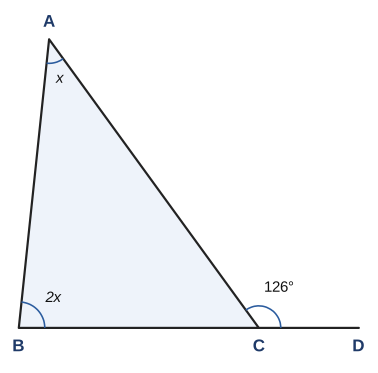
[2 marks]
(a)Find the value of x.
Show answerHide answer
Tick each point you got.
[1 mark]
(b)Find ∠ACB.
Show answerHide answer
Check: 42° + 84° + 54° = 180°.
Tick each point you got.
16
Question 16
In Diagram 10, PQRS is a straight line and TQ = TS.
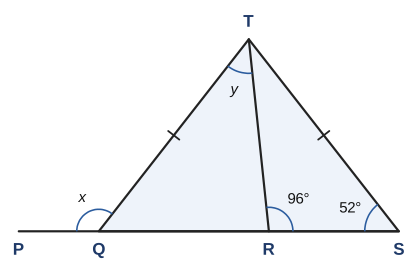
[2 marks]
(a)Calculate the value of x.
Show answerHide answer
Tick each point you got.
[2 marks]
(b)Calculate the value of y.
Show answerHide answer
Tick each point you got.
17
Question 17
Name each quadrilateral from its properties.
[1 mark]
(a)Only one pair of opposite sides is parallel.
Show answerHide answer
Tick each point you got.
[1 mark]
(b)Two pairs of adjacent sides are equal (but not all four sides are equal), and only one diagonal is the perpendicular bisector of the other.
Show answerHide answer
Tick each point you got.
[1 mark]
(c)Every rectangle is a square.
Show answerHide answer
False
A rectangle needs only its opposite sides equal; a square needs all four sides equal. (But every square is a rectangle.)
18
Question 18
In Diagram 11, PST is a straight line.
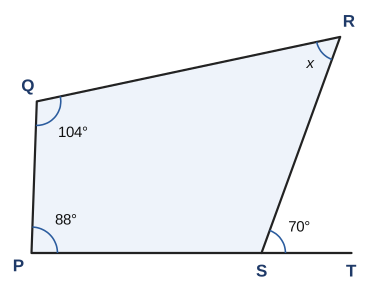
[1 mark]
(a)Find ∠PSR.
Show answerHide answer
Tick each point you got.
[2 marks]
(b)Hence, find the value of x.
Show answerHide answer
Tick each point you got.
19
Question 19
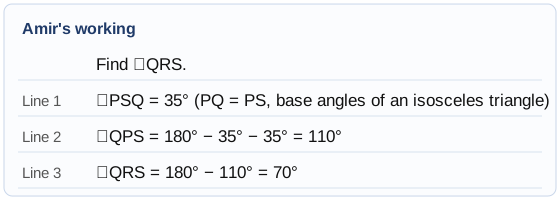
Diagram 12 shows a rhombus PQRS with diagonal QS. Diagram 13 shows Amir's working to find ∠QRS.
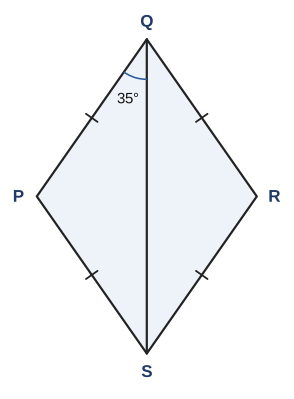
[2 marks]
(a)Amir's answer is wrong. In which line is his mistake? Explain the mistake.
Show answerHide answer
Tick each point you got.
[2 marks]
(b)Find the correct value of ∠QRS and the value of ∠PQR.
Show answerHide answer
Tick each point you got.
20
Question 20
Nadia is designing tiles shaped like quadrilaterals.
[2 marks]
(a)The four interior angles of her first tile are in the ratio 3 : 4 : 5 : 6. Find the largest angle.
Show answerHide answer
Tick each point you got.
[2 marks]
(b)Her second tile is a kite whose largest angle is 120°. Suggest the sizes of all four of its interior angles and show that they are possible.
Show answerHide answer
Other correct answers: 120°, 70°, 70°, 100° or 120°, 100°, 100°, 40°. The two equal angles must be opposite each other, and the other two angles must be different (otherwise the tile is a rhombus).
Tick each point you got.