Lines and angles
What this chapter covers
- Determine and explain the congruency of line segments and angles (8.1)
- Estimate and measure line segments and angles, and explain how the estimate was made (8.1)
- Recognise, compare and explain angles on a straight line, reflex angles and one whole turn (8.1)
- Describe complementary, supplementary and conjugate angles and solve problems involving them (8.1)
- Construct line segments, perpendicular bisectors, perpendicular lines and parallel lines, and explain the steps (8.1)
- Construct angles (60°, 30°, 90°, 45°, …) and angle bisectors, and explain the steps (8.1)
- Identify, explain and draw vertically opposite angles and adjacent angles at intersecting lines, including perpendicular lines (8.2)
- Find the values of angles and solve problems involving intersecting lines (8.2)
- Recognise parallel lines and transversals, and identify corresponding, alternate and interior angles (8.3)
- Decide whether two straight lines are parallel from the angles a transversal makes (8.3)
- Find the values of angles and solve problems involving parallel lines and transversals (8.3)
- Recognise and represent angles of elevation and angles of depression in real-life situations (8.3)
Look around you: the edges of a door, the lines on a badminton court, the frame of a bicycle. They are all made of lines that meet at angles. Builders use lines and angles to make structures strong, artists use them to make patterns, and land surveyors use them to find heights and distances. In this chapter you will measure and construct lines and angles, and learn the rules for the angles made by intersecting lines and by parallel lines.
| English | Bahasa Melayu |
|---|---|
| line segment | tembereng garis |
| congruency | kekongruenan |
| reflex angle | sudut refleks |
| complementary, supplementary, conjugate angles | sudut pelengkap, sudut penggenap, sudut konjugat |
| perpendicular bisector, angle bisector | pembahagi dua sama serenjang, pembahagi dua sama sudut |
| intersecting lines, parallel lines, transversal | garis bersilang, garis selari, garis rentas lintang |
| vertically opposite angles, adjacent angles | sudut bertentang bucu, sudut bersebelahan |
| corresponding, alternate, interior angles | sudut sepadan, sudut selang-seli, sudut pedalaman |
| angle of elevation, angle of depression | sudut dongak, sudut tunduk |
8.1Lines and angles
Naming line segments and angles
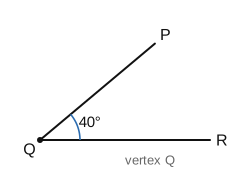
An angle is named with the symbol ∠ and three capital letters. The middle letter is always the vertex (the corner where the two arms meet).
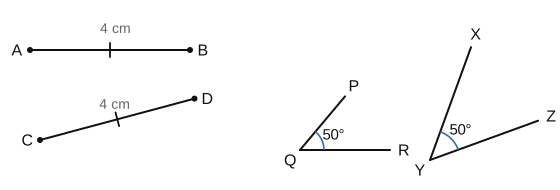
Congruent line segments and congruent angles
Show answerHide answer
Estimating and measuring
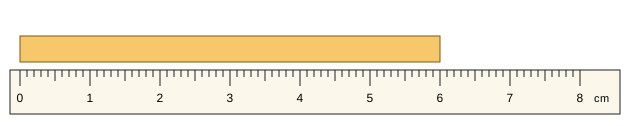
To estimate a length, compare it with an object whose length you know. If an eraser is 4 cm long and a line is about 2½ erasers long, the line is about 4 + 4 + 2 = 10 cm. To measure it exactly, use a ruler, starting at the 0 mark.
To estimate an angle, compare it with a right angle (90°). A little less than a right angle is about 80°; about half a right angle is about 45°. To measure exactly, use a protractor.
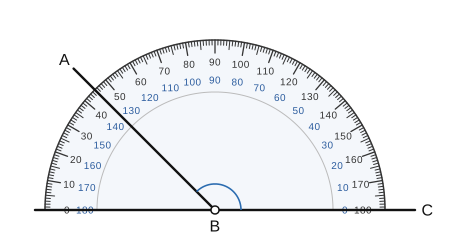
How to use a protractor (textbook p. 172)
- Put the centre of the protractor exactly on the vertex B.
- Line up the 0° line with one arm (BC).
- Start from the 0 on that arm and count round the same scale to the other arm. Here the inner scale starts at 0 on BC, so ∠ABC = 135°.
- Check with your estimate: ∠ABC is bigger than a right angle, so 135° (not 45°) makes sense.
Types of angles
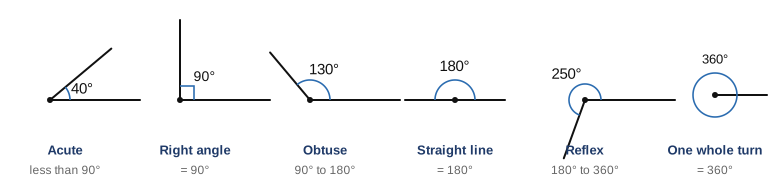
| Angle | Size | Example |
|---|---|---|
| Acute angle | more than 0°, less than 90° | 40° |
| Right angle | exactly 90° (marked with a small square) | corner of a book |
| Obtuse angle | more than 90°, less than 180° | 130° |
| Angle on a straight line | exactly 180° | angles on a straight line add up to 180° |
| Reflex angle | more than 180°, less than 360° | 250° |
| One whole turn | exactly 360° | angles at a point add up to 360° |
Complementary, supplementary and conjugate angles
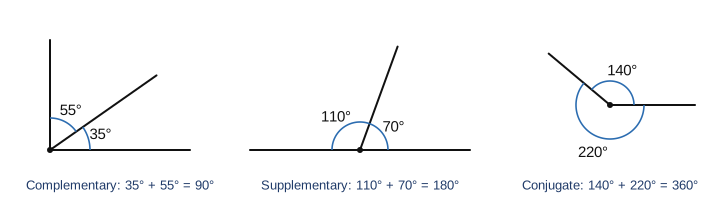
| Pair | The two angles add up to | Example |
|---|---|---|
| Complementary angles | 90° | 35° and 55° |
| Supplementary angles | 180° | 110° and 70° |
| Conjugate angles | 360° | 140° and 220° |
Example 1: angles at a point (textbook p. 175)
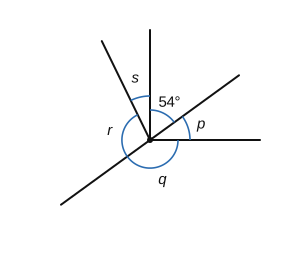
p and 54° are complementary. p and q are supplementary. The angle conjugate to r is 260°. Find p, q, r and s.
- p + 54° = 90°, so p = 90° − 54° = 36°
- p + q = 180°, so q = 180° − 36° = 144°
- r + 260° = 360°, so r = 360° − 260° = 100°
- Angles at a point: s + 100° + 144° + 36° + 54° = 360°
s + 334° = 360°, so s = 26°
Self Practice 8.1e Q2: using the difference (textbook p. 176)
p and q are supplementary and p is 52° bigger than q. Find p and q.
- p + q = 180° and p − q = 52°.
- Take away the difference and share the rest equally: 180° − 52° = 128°, 128° ÷ 2 = 64°. So q = 64°.
- p = 64° + 52° = 116°. Check: 116° + 64° = 180° ✓
Show answerHide answer
b) m + 2m = 360°, 3m = 360°, m = 120°, n = 240°
Geometrical constructions
A geometrical construction is an accurate drawing made with a pair of compasses and a straight edge (ruler). Use a sharp pencil and do not erase the construction arcs: they show your method.
Line segment AB = 8 cm
Draw a line and mark A. Open the compasses to 8 cm on a ruler. From A, mark an arc on the line: that point is B. This is more accurate than drawing along a ruler, because the compasses hold the distance.
Perpendicular bisector of PQ
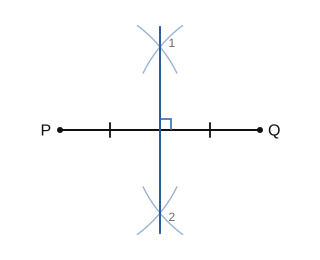
- Open the compasses to more than half of PQ.
- Draw arcs above and below PQ from P, then from Q with the same radius.
- Join the two crossing points. This line cuts PQ into two equal parts at 90°.
Perpendicular from a point M to a line PQ
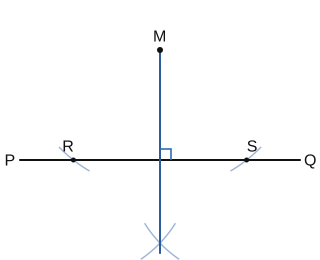
- From M, draw arcs cutting PQ at R and S.
- From R and from S (same radius), draw arcs that cross on the other side of PQ.
- Join M to the crossing point.
For a point N on the line, do the same: mark R and S on either side of N, then widen the compasses and draw crossing arcs from R and S.
Line through R parallel to PQ
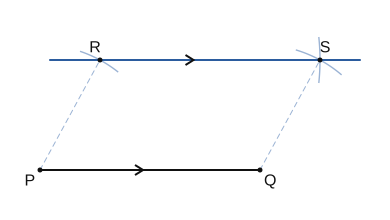
- With radius PR, draw an arc from Q.
- With radius PQ, draw an arc from R. The two arcs cross at S.
- Join R and S. PQSR is a parallelogram, so RS is parallel to PQ.
Angle of 60°
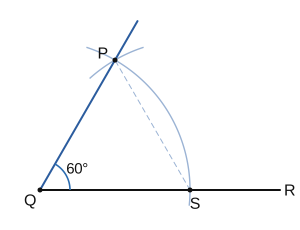
- Draw a long arc from Q cutting QR at S.
- With the same radius, draw an arc from S cutting the first arc at P.
- Join QP. QS = SP = QP, so triangle PQS is equilateral and ∠PQR = 60°.
Angle bisector
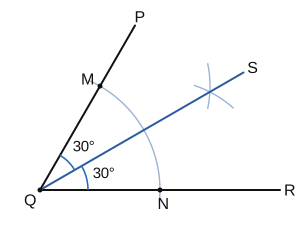
- Draw an arc from Q cutting both arms at M and N.
- With the same radius, draw arcs from M and from N that cross at S.
- Join QS. Bisecting 60° gives ∠PQS = ∠SQR = 30°.
Start with 60° and keep bisecting or adding:
| Angle | How to construct it |
|---|---|
| 30° | bisect 60° |
| 15° | bisect 30° |
| 120° | 60° + 60° (step the same arc twice) |
| 90° | 60° + 30°, or a perpendicular line |
| 45° | bisect 90° |
| 75° | 60° + 15° |
| 105° | 90° + 15° |
8.2Angles related to intersecting lines
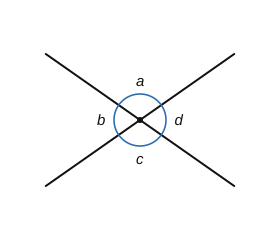
Adjacent angles at intersecting lines sit next to each other on a straight line. They add up to 180°: a + b = 180°, b + c = 180°, c + d = 180°, d + a = 180°.
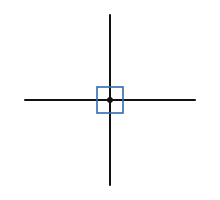
Example 10: finding x and y (textbook p. 186)
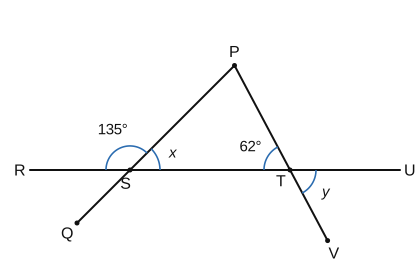
PSQ, RSTU and PTV are straight lines. Find x and y.
- x and 135° are adjacent angles on the straight line RSU: x + 135° = 180°, so x = 45°.
- y and 62° are vertically opposite angles: y = 62°.
Example 11: solving a problem (textbook p. 187)
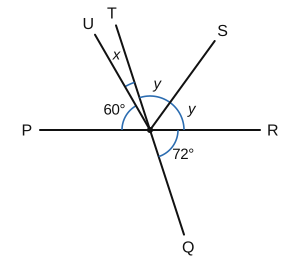
POR and TOQ are straight lines. Find x and y.
- ∠POT and ∠QOR are vertically opposite, so ∠POT = 72°.
- x + 60° = 72°, so x = 12°.
- ∠TOR and ∠QOR are adjacent: ∠TOR = 180° − 72° = 108°.
- y + y = 108°, 2y = 108°, so y = 54°.
Show answerHide answer
The fourth angle is vertically opposite 40°, so it is 40°.
8.3Angles related to parallel lines and transversals
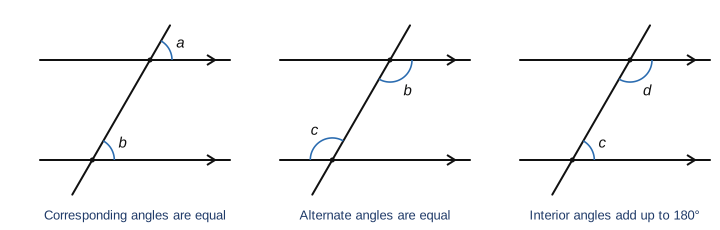
| Angle pair | Where they are | Shape to look for | Rule |
|---|---|---|---|
| Corresponding | same position at each crossing (both above-right, …) | F shape | equal |
| Alternate | between the lines, on opposite sides of the transversal | Z shape | equal |
| Interior | between the lines, on the same side of the transversal | C (or U) shape | add up to 180° |
Are the lines parallel?
Turn the rules round: if corresponding angles are equal, or alternate angles are equal, or interior angles add up to 180°, then the lines are parallel.
Example 12 (textbook p. 190)
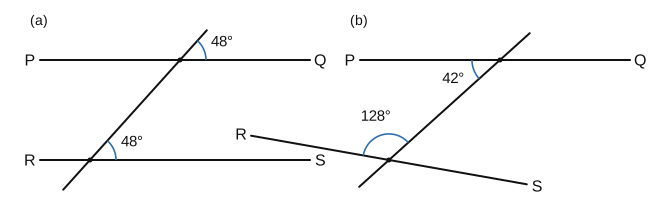
- The corresponding angles are both 48°, so PQ // RS.
- 42° and 128° are interior angles: 42° + 128° = 170° ≠ 180°. So PQ and RS are not parallel.
Finding unknown angles
Worked example: finding a, b and c (like Example 13, textbook p. 191)
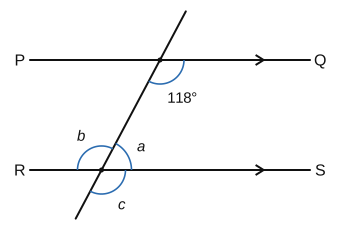
PQ // RS. Find a, b and c. Always give the reason.
- a and 118° are interior angles: a = 180° − 118° = 62°.
- b and 118° are alternate angles: b = 118°.
- c and 118° are corresponding angles: c = 118°.
Worked example: the zigzag (like Self Practice 8.3d, textbook p. 191)
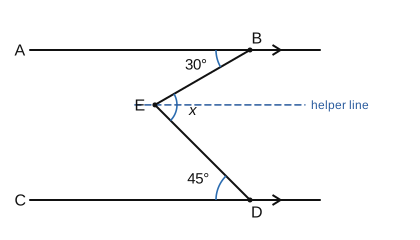
AB // CD. Find x.
- Draw a helper line through E parallel to AB (and CD).
- The top part of x and 30° are alternate angles, so it is 30°.
- The bottom part of x and 45° are alternate angles, so it is 45°.
- x = 30° + 45° = 75°.
Show answerHide answer
Angles of elevation and depression
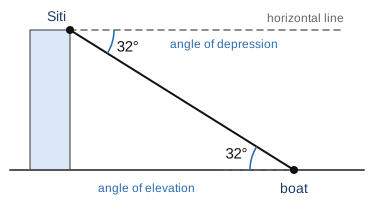
Worked example: elevation and depression (textbook p. 193)
The angle of depression of a boat from Siti is 32°. Find (a) the angle of elevation of Siti from the boat, (b) the angle between the line of sight and the wall of the building.
- Alternate angles between parallel horizontal lines: angle of elevation = 32°.
- The wall is vertical, so it makes 90° with the horizontal: 90° − 32° = 58°.
Summary
| Fact | Rule |
|---|---|
| Angles on a straight line | add up to 180° |
| Angles at a point | add up to 360° |
| Complementary / supplementary / conjugate | pair adds up to 90° / 180° / 360° |
| Reflex angle | between 180° and 360° |
| Vertically opposite angles | equal |
| Adjacent angles at intersecting lines | add up to 180° |
| Corresponding angles (parallel lines) | equal (F shape) |
| Alternate angles (parallel lines) | equal (Z shape) |
| Interior angles (parallel lines) | add up to 180° (C shape) |
| Elevation and depression | measured from the horizontal; between two points they are equal |
| Construction | Key idea |
|---|---|
| Perpendicular bisector | equal arcs from both ends, radius more than half the line |
| Perpendicular line | arcs from the point make R and S, then a bisector of RS |
| Parallel line | complete a parallelogram with two pairs of equal arcs |
| 60° | equilateral triangle: same radius from Q and then from S |
| Angle bisector | arcs from both arms cross on the bisector; 60° → 30° → 15° |