Mathematics questions, chapter 8
Nama / NameKelas / ClassTarikh / Date
Lines and angles
40 marks. Use Practice to check each answer as you go, or Exam to answer everything first. Diagrams are not drawn to scale: use the angle facts, not a protractor, unless the question says so. Show your working and give reasons in Section B.
Section A: objective questions
12 marksChoose the correct answer. Each question carries 1 mark.
1
Question 1
Which of the following is a reflex angle?
Show answerHide answer
C
A reflex angle is more than 180° and less than 360°. 90° is a right angle, 180° is the angle on a straight line and 360° is one whole turn.
2
Question 2
What is the supplement of 65°?
Show answerHide answer
B
Supplementary angles add up to 180°: 180° − 65° = 115°. 25° is the complement (90° − 65°) and 295° is the conjugate (360° − 65°).
3
Question 3
Angles m and 128° are conjugate angles. Find the value of m.
Show answerHide answer
D
Conjugate angles add up to 360°: m = 360° − 128° = 232°. 52° is 180° − 128° (supplement).
4
Question 4
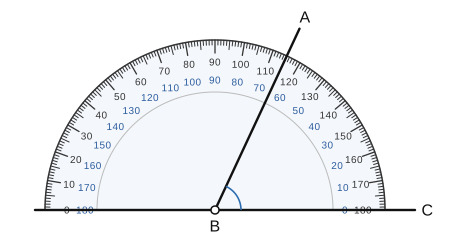
Diagram 1 shows a protractor used to measure ∠ABC. What is the size of ∠ABC?
Show answerHide answer
A
Arm BC lies on the 0° of the inner scale, so read the inner scale: 65°. ∠ABC is acute, so 115° (the outer scale) cannot be right.
5
Question 5
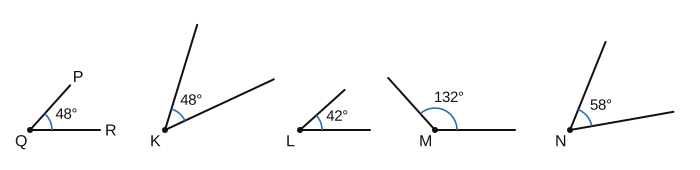
Diagram 2 shows ∠PQR and four other angles. Which angle is congruent to ∠PQR?
Show answerHide answer
B
Congruent angles have the same size. ∠K = 48° = ∠PQR. Its arms are longer, but arm length does not change the size of an angle. ∠L has arms like ∠PQR but is 42°.
6
Question 6
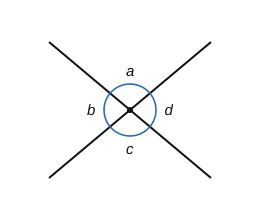
In Diagram 3, two straight lines intersect. Which statement is correct?
Show answerHide answer
C
b and d are vertically opposite angles, so they are equal. a and b are adjacent (a + b = 180°), and a = c because they are vertically opposite, so a + c is not 180° unless both are right angles.
7
Question 7
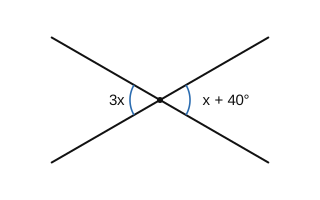
In Diagram 4, two straight lines intersect. Find the value of x.
Show answerHide answer
A
3x and x + 40° are vertically opposite, so 3x = x + 40°, 2x = 40°, x = 20°. 35° comes from wrongly using 3x + x + 40° = 180°.
8
Question 8
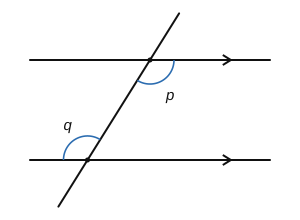
In Diagram 5, a transversal cuts two parallel lines. What type of angles are p and q?
Show answerHide answer
B
p and q are both between the parallel lines, on opposite sides of the transversal (a Z shape), so they are alternate angles.
9
Question 9
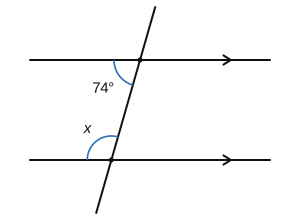
In Diagram 6, the two horizontal lines are parallel. Find the value of x.
Show answerHide answer
D
74° and x are interior angles (between the lines, same side), so x = 180° − 74° = 106°. 74° treats them as alternate angles, which they are not.
10
Question 10
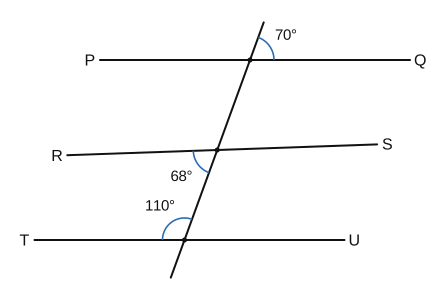
In Diagram 7, the straight lines PQ, RS and TU are cut by a transversal. Which lines are parallel?
Show answerHide answer
C
Change each angle to the 'above the line, right of the transversal' position. PQ: 70°. RS: 68° is vertically opposite that position, so 68°. TU: 180° − 110° = 70°. Only PQ and TU have equal corresponding angles.
11
Question 11
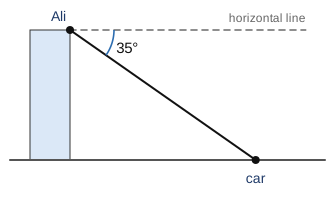
In Diagram 8, Ali is at the top of a building. The angle of depression of a car from Ali is 35°. What is the angle of elevation of Ali from the car?
Show answerHide answer
A
The horizontal line at Ali and the ground are parallel, so the angle of elevation and the angle of depression are alternate angles: 35°. 55° is the angle with the vertical wall, not with the horizontal.
12
Question 12
Which angle can be constructed using only a pair of compasses and a ruler?
Show answerHide answer
D
Start from 60° and halve or add: 75° = 60° + 15° (15° is 60° halved twice). 40°, 50° and 100° cannot be made from 60° by halving and adding.
Section B: structured questions
28 marksAnswer all questions. Show your working and give reasons.
13
Question 13
In Diagram 9, a and 38° are complementary angles. a and b are supplementary angles. The angle conjugate to c is 290°.
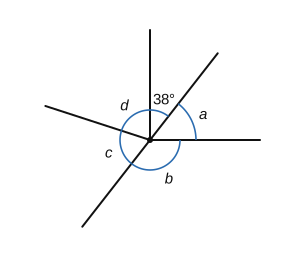
[1 mark]
(a)Find the value of a.
Show answerHide answer
Tick each point you got.
[1 mark]
(b)Find the value of b.
Show answerHide answer
Tick each point you got.
[1 mark]
(c)Find the value of c.
Show answerHide answer
Tick each point you got.
[2 marks]
(d)Find the value of d.
Show answerHide answer
Tick each point you got.
14
Question 14
In Diagram 10, POS, QOT and ROU are straight lines. ∠POQ = 2x, ∠QOR = 3x and ∠ROS = x + 30°.
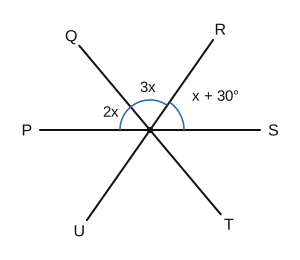
[2 marks]
(a)Find the value of x.
Show answerHide answer
Tick each point you got.
[1 mark]
(b)Find ∠TOU. Give a reason.
Show answerHide answer
Tick each point you got.
15
Question 15
In Diagram 11, AB is parallel to CD. The transversal EF cuts AB at G and CD at H. ∠EGB = 65°.
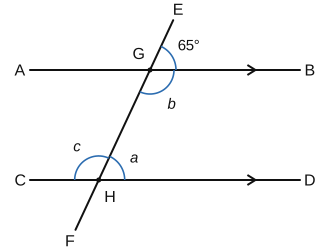
[1 mark]
(a)Find the value of a. Give a reason.
Show answerHide answer
Tick each point you got.
[1 mark]
(b)Find the value of b.
Show answerHide answer
Tick each point you got.
[1 mark]
(c)Find the value of c. Give a reason.
Show answerHide answer
Tick each point you got.
16
Question 16
In Diagram 12, AB is parallel to CD. ∠ABE = 38° and ∠CDE = 47°.
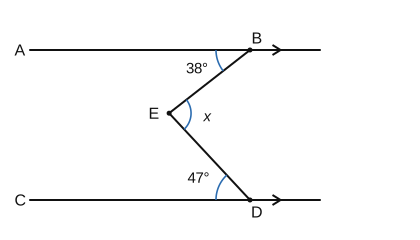
[3 marks]
(a)Find the value of x. Show your working.
Show answerHide answer
Tick each point you got.
17
Question 17
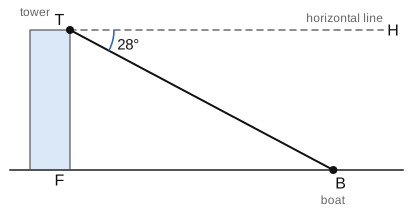
Diagram 13 shows a vertical tower TF on horizontal ground. TH is a horizontal line. The angle of depression of boat B from T is 28°.
[1 mark]
(a)Name the angle of depression of B from T.
Show answerHide answer
Tick each point you got.
[1 mark]
(b)State the angle of elevation of T from B.
Show answerHide answer
Tick each point you got.
[1 mark]
(c)Find ∠FTB.
Show answerHide answer
Tick each point you got.
18
Question 18
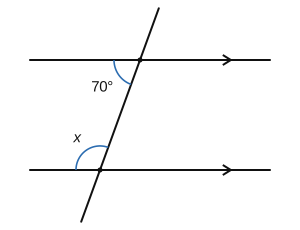
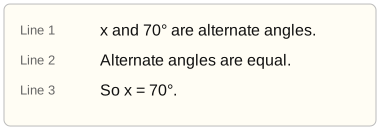
Diagram 14 shows two parallel lines cut by a transversal. Nadia wants to find x. Diagram 15 shows her working.
[2 marks]
(a)Nadia's answer is wrong. Which line is wrong? Explain her mistake.
Show answerHide answer
Tick each point you got.
[1 mark]
(b)Find the correct value of x.
Show answerHide answer
Tick each point you got.
19
Question 19
Mei Ling is designing a logo made of two parallel lines cut by a transversal. She wants one interior angle to be exactly twice the other interior angle on the same side, and she must draw the logo using only a pair of compasses and a ruler.
[2 marks]
(a)Find the sizes of the two interior angles in her design.
Show answerHide answer
Tick each point you got.
[2 marks]
(b)Describe how she can construct the 60° angle between the transversal and one parallel line using only a pair of compasses and a ruler.
Show answerHide answer
QS = SP = QP, so triangle PQS is equilateral and each of its angles is 60°. The 120° angle is then on the other side of the line (180° − 60°).
Tick each point you got.
20
Question 20
Solve each of the following.
[2 marks]
(a)x and y are supplementary angles and x : y = 2 : 3. Find x and y.
Show answerHide answer
Tick each point you got.
[2 marks]
(b)p and q are conjugate angles and q is four times p. Find p and q.
Show answerHide answer
Tick each point you got.