Introduction of set
What this chapter covers
- Explain the meaning of a set by grouping objects that share a common characteristic (11.1)
- Describe a set by description, by listing and by set builder notation (11.1)
- Recognise an empty set and write it as φ or { } (11.1)
- Say whether an object is an element of a set and write the relation with ∈ or ∉ (11.1)
- Find the number of elements of a set and write it as n(A) (11.1)
- Decide whether two or more sets are equal and explain why (11.1)
- Identify and describe the universal set ξ and the complement A′ of a set (11.2)
- Represent a set, the universal set and the complement of a set with Venn diagrams (11.2)
- Identify subsets (⊂, ⊄) and list all the possible subsets of a set, using 2ⁿ to count them (11.2)
- Represent subsets and the relations between sets, subsets, universal sets and complements with Venn diagrams (11.2)
At home we sort rubbish for recycling into paper, plastic, glass and aluminium. Each group holds objects that share one characteristic. In Mathematics such a group is called a set. In this chapter you will learn to write sets in three ways, count their elements, compare them, and draw them as Venn diagrams.
| English | Bahasa Melayu |
|---|---|
| set | set |
| element | unsur |
| description, set notation, set builder notation | perihalan, tatatanda set, tatatanda pembina set |
| empty set | set kosong |
| equal sets | set sama |
| universal set | set semesta |
| complement of a set | pelengkap bagi suatu set |
| subset | subset |
| Venn diagram | gambar rajah Venn |
11.1Set
What is a set?
When we sort objects, the objects with a common characteristic go into the same group. For example, car, lorry, van and bus all travel on land.
Show answerHide answer
Water: sampan, boat, ship, ferry
Air: rocket, aeroplane, helicopter, hot-air balloon
Three ways to describe a set
| Method | How | The colours of the Jalur Gemilang |
|---|---|---|
| Description | A sentence in words | A is the set of colours of the Jalur Gemilang. |
| Listing (set notation) | Write the elements inside { }, separated by commas | A = {red, white, blue, yellow} |
| Set builder notation | {x : the condition x must satisfy} | A = {x : x is a colour of the Jalur Gemilang} |
Example 1 (textbook p. 249)
Describe each set by description, listing and set builder notation. (a) Letters in the word 'MALAYSIA' (b) Odd numbers which are less than 20
- (a) Description: P is the set of letters in the word 'MALAYSIA'.
- Listing: P = {M, A, L, Y, S, I}. The letter A appears three times in the word, but it is written only once.
- Set builder notation: P = {x : x is a letter in the word 'MALAYSIA'}
- (b) Description: Q is the set of odd numbers which are less than 20.
- Listing: Q = {1, 3, 5, 7, 9, 11, 13, 15, 17, 19}
- Set builder notation: Q = {x : x is an odd number and x < 20}
The empty set
Which month has 32 days? None! The set M of months with 32 days has no elements.
Show answerHide answer
b) FALSE: 2 is a prime number and an even number, so Q = {2}.
c) TRUE: no odd number is divisible by 2.
Elements: ∈ and ∉
Let A = {local fruits in Malaysia}. Durian is a local fruit, so durian is an element of A. Apple is not.
| Symbol | Meaning | Example |
|---|---|---|
| ∈ (epsilon) | is an element of | durian ∈ A |
| ∉ | is not an element of | apple ∉ A |
Example 2 (textbook p. 251)
Given P = {x : x is a prime number and 0 ≤ x ≤ 20}, complete with ∈ or ∉: (a) 5 __ P (b) 8 __ P (c) 19 __ P (d) 1 __ P
- First list all the elements: P = {2, 3, 5, 7, 11, 13, 17, 19}
- (a) 5 ∈ P (b) 8 ∉ P (c) 19 ∈ P (d) 1 ∉ P (1 is not a prime number)
Show answerHide answer
a) 8 ∉ P (even) b) 17 ∈ P c) 63 ∉ P (63 is odd but not less than 50)
d) 84 ∈ Q e) 60 ∈ Q f) 46 ∉ Q
The number of elements, n(A)
Example 3 (textbook p. 252)
P = {letters in the word 'WAWASAN'}, Q = {x : x is a two-digit number such that the sum of its digits is 7}. Find n(P) and n(Q).
- P = {W, A, S, N}, so n(P) = 4 (not 7: repeated letters are counted once).
- Q = {16, 25, 34, 43, 52, 61, 70}, so n(Q) = 7. Do not forget 70: 7 + 0 = 7.
Show answerHide answer
b) D = {11, 22, 33, …, 99}, n(D) = 9
c) P = {−4, −3, −2, −1, 0, 1}, n(P) = 6 ("between" does not include −5 and 2)
Equal sets
Three students list the letters of 'HARUM': A = {H, A, R, U, M}, B = {M, U, R, A, H}, C = {R, U, M, A, H}. The elements are the same, only the order is different.
Example 4 (textbook pp. 252–253)
Are these pairs equal sets? (a) P = {vowels in the word 'SEKOLAH'}, Q = {vowels in the word 'KEJOHANAN'} (b) F = {perfect squares which are less than 50}, G = {4, 9, 16, 25, 36, 49}
- (a) P = {E, O, A} and Q = {E, O, A}. Every element is the same, so P = Q.
- (b) F = {1, 4, 9, 16, 25, 36, 49}. 1 ∈ F but 1 ∉ G, so F ≠ G.
Show answerHide answer
b) Not equal: N = {0, 1, 2, 3, 4, 5} has the element 0 (whole numbers start at 0).
c) Not equal: P = {26, 28, 30, …, 44} but Q = {25, 26, 27, 28, 29, 32, 42}; for example 30 ∈ P but 30 ∉ Q.
11.2Venn diagrams, universal sets, complement of a set and subsets
Universal set and complement of a set
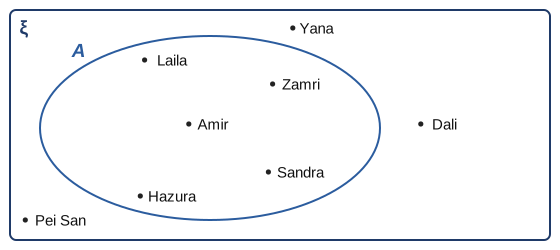
Eight students took part in a Mathematics quiz: Amir, Hazura, Laila, Sandra, Zamri, Dali, Pei San and Yana. These are all the students under discussion. Five of them, Amir, Hazura, Laila, Sandra and Zamri, are members of the Mathematics Society (set A).
ξ = {Amir, Hazura, Laila, Sandra, Zamri, Dali, Pei San, Yana}, A = {Amir, Hazura, Laila, Sandra, Zamri}, so A′ = {Dali, Pei San, Yana}.
Example 5 (textbook p. 254)
Is each set a universal set of {2, 3, 5, 7}? (a) {1, 2, 3, 4, 5, 6, 7, 8, 9, 10} (b) {odd numbers which are less than 10}
- (a) It contains 2, 3, 5 and 7, so it is a universal set.
- (b) {1, 3, 5, 7, 9} does not contain 2, so it is not a universal set.
Example 6 (textbook pp. 254–255)
ξ = {x : x is an integer and 1 ≤ x ≤ 10}. Find the complement of (a) P = {perfect squares which are less than 10} (b) Q = {factors of 10}.
- ξ = {1, 2, 3, 4, 5, 6, 7, 8, 9, 10}
- (a) P = {1, 4, 9}, so P′ = {2, 3, 5, 6, 7, 8, 10}
- (b) Q = {1, 2, 5, 10}, so Q′ = {3, 4, 6, 7, 8, 9}
Show answerHide answer
a) P = {3, 6, 9}, P′ = {0, 1, 2, 4, 5, 7, 8} (like the textbook, the multiples of 3 here are 3, 6, 9, so 0 goes into P′)
b) Q = {2, 3, 5, 7}, Q′ = {0, 1, 4, 6, 8, 9}
Venn diagrams
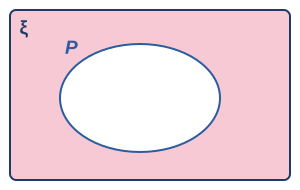
A Venn diagram shows sets as closed shapes. The universal set is drawn as a rectangle. Each set inside it is usually a circle or an oval (a triangle or rectangle is fine too). Each element is a dot with its name.
Example 7 (textbook p. 256)
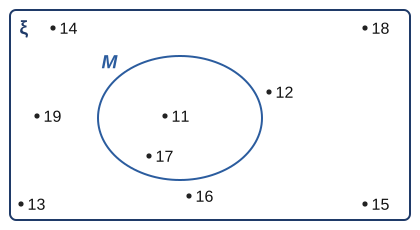
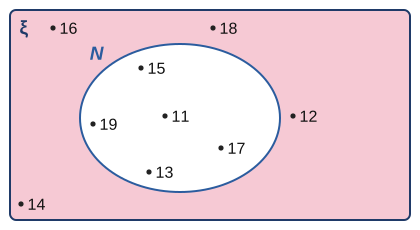
ξ = {x : 10 < x < 20, x is an integer}, M = {11, 17} and N = {odd numbers}. Draw a Venn diagram to show (a) ξ and M (b) N′.
- ξ = {11, 12, 13, 14, 15, 16, 17, 18, 19}; N = {11, 13, 15, 17, 19}
- Write 11 and 17 inside M, and the other 7 elements outside M.
- For (b), write the odd numbers inside N and shade the region outside N: that region is N′ = {12, 14, 16, 18}.
Subsets
Let A = {multiples of 2} and B = {multiples of 4}. Every multiple of 4 is also a multiple of 2, so every element of B is also in A.
Example 8 (textbook p. 257)
Is A a subset of B? (a) A = {2, 4, 6}, B = {1, 2, 3, 4, 5, 6} (b) A = {prime numbers which are less than 20}, B = {odd numbers which are less than 20}
- (a) 2, 4 and 6 are all in B, so A ⊂ B.
- (b) A = {2, 3, 5, 7, 11, 13, 17, 19}. The element 2 is not odd, so 2 ∉ B and A ⊄ B.
Example 9 (textbook p. 258)
List all the possible subsets of (a) {3, 4} (b) {a, b, c}.
- (a) φ, {3}, {4}, {3, 4}: that is 22 = 4 subsets.
- (b) Start with φ, then one element, two elements, three elements:
φ, {a}, {b}, {c}, {a, b}, {a, c}, {b, c}, {a, b, c}: 23 = 8 subsets.
| Number of elements, n | 0 | 1 | 2 | 3 | 4 | 5 |
|---|---|---|---|---|---|---|
| Number of subsets, 2n | 1 | 2 | 4 | 8 | 16 | 32 |
Show answerHide answer
b) N ⊄ M (for example 10 ∈ N but 10 is even, so 10 ∉ M)
c) φ, {p}, {q}, {p, q}
d) {2, 3, 5, 7} has 4 elements, so 24 = 16 subsets
Subsets in Venn diagrams
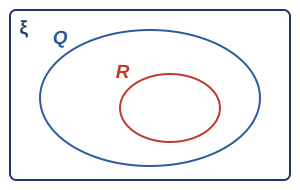
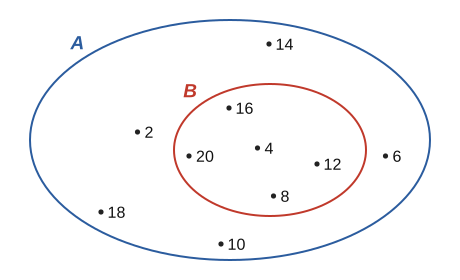
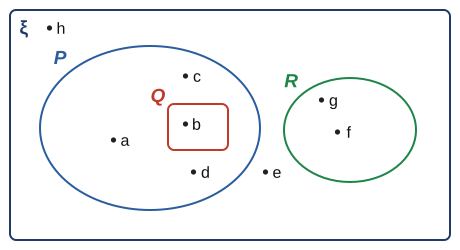
If B ⊂ A, the shape for B is drawn completely inside the shape for A. Here A = {2, 4, 6, …, 20} and B = {4, 8, 12, 16, 20}.
Example 10 (textbook p. 259)
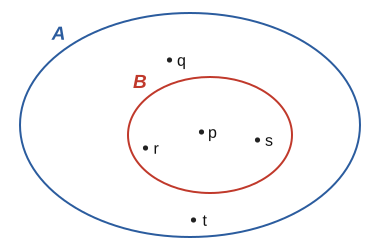
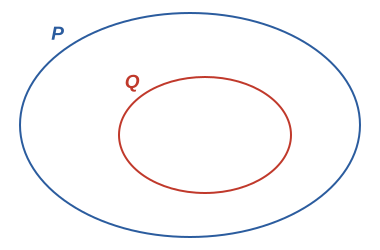
Draw Venn diagrams for (a) A = {p, q, r, s, t} and B = {p, r, s} (b) P = {whole numbers} and Q = {prime numbers}.
- (a) Every element of B is in A, so B ⊂ A. Put p, r, s inside B, and q, t in A but outside B.
- (b) Every prime number is a whole number, so Q ⊂ P. These sets are infinite, so the elements are not written.
Relationships between sets
One Venn diagram can show the universal set, subsets and complements together.
Example 11 (textbook p. 259)
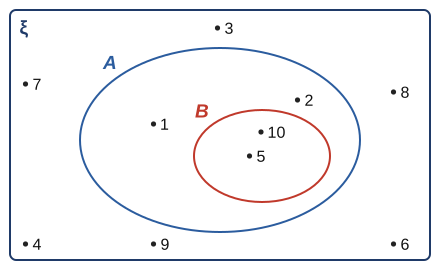
ξ = {x : x ≤ 10, x is a positive integer}, A = {factors of 10}, B = {numbers which are divisible by 5}. Draw a Venn diagram.
- List the sets: ξ = {1, 2, …, 10}, A = {1, 2, 5, 10}, B = {5, 10}
- B ⊂ A, so draw B inside A, and A inside the rectangle ξ.
- Write 5 and 10 in B; 1 and 2 in A outside B; 3, 4, 6, 7, 8, 9 outside A.
Show answerHide answer
Summary
| Idea | Key fact | Example |
|---|---|---|
| Set | A group of objects with a common characteristic | A = {red, white, blue, yellow} |
| Describing a set | Description, listing, set builder notation | Q = {x : x is an odd number and x < 20} |
| Empty set | No elements: φ or { } | {months with 32 days} = φ |
| Element | ∈ is an element of, ∉ is not | 5 ∈ {primes}, 1 ∉ {primes} |
| Number of elements | n(A); count repeated letters once | n({W, A, S, N}) = 4 |
| Equal sets | Exactly the same elements, any order | {S, A, M} = {M, A, S} |
| Universal set ξ | All the elements under discussion; a rectangle | ξ = {1, 2, …, 10} |
| Complement A′ | Elements of ξ not in A; n(A) + n(A′) = n(ξ) | A = {1, 4, 9}, A′ = {2, 3, 5, 6, 7, 8, 10} |
| Subset | B ⊂ A if every element of B is in A; 2n subsets | {a, b, c} has 23 = 8 subsets |