Mathematics questions, chapter 13
Nama / NameKelas / ClassTarikh / Date
The Pythagoras' Theorem
40 marks. Use Practice to check each answer as you go, or Exam to answer everything first. You may use a calculator for square roots. Show your working for Section B.
Section A: objective questions
12 marksChoose the correct answer.
1
Question 1
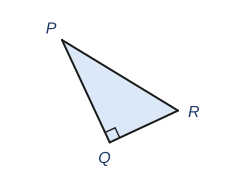
Diagram 1 shows a right-angled triangle PQR. Which side is the hypotenuse?
Show answerHide answer
C
The hypotenuse is the side opposite the right angle. The right angle is at Q, and the side that does not touch Q is PR. PQ and QR both meet at the right angle.
2
Question 2
Which statement about the hypotenuse is correct?
Show answerHide answer
B
The hypotenuse is the longest side and lies opposite the right angle. The two sides that form the right angle are the shorter sides, and only right-angled triangles have a hypotenuse.
3
Question 3
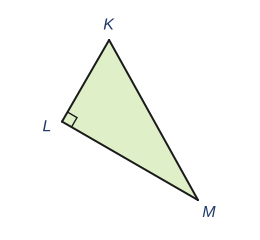
Diagram 2 shows a right-angled triangle KLM. Which relationship is correct?
Show answerHide answer
A
The right angle is at L, so KM is the hypotenuse and must be alone: KM² = KL² + LM². B and C put a shorter side alone, and D forgets to square the sides.
4
Question 4
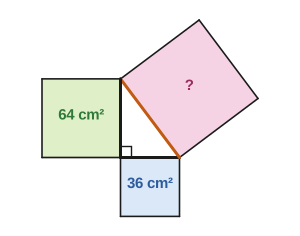
Diagram 3 shows squares drawn on the sides of a right-angled triangle. The areas of the two smaller squares are 36 cm² and 64 cm². What is the area of the largest square?
Show answerHide answer
D
The square on the hypotenuse equals the sum of the other two squares: 36 + 64 = 100 cm². 28 subtracts the areas, 14 adds the side lengths (6 + 8), and 10 is the length of the hypotenuse, not the area of its square.
5
Question 5
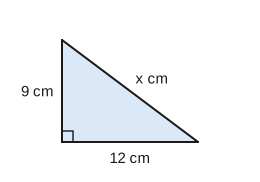
Diagram 4 shows a right-angled triangle. Find the value of x.
Show answerHide answer
B
x is the hypotenuse: x² = 9² + 12² = 81 + 144 = 225, so x = √225 = 15. 21 adds the sides without squaring, 225 forgets the square root, and 7.94 subtracts instead of adding.
6
Question 6
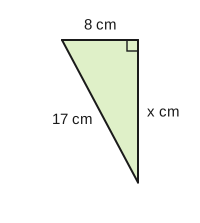
Diagram 5 shows a right-angled triangle. Find the value of x.
Show answerHide answer
C
17 cm is the hypotenuse, so subtract: x² = 17² − 8² = 289 − 64 = 225, x = 15. 18.79 adds the squares (but x cannot be longer than the hypotenuse), 9 is 17 − 8, and 225 forgets the square root.
7
Question 7
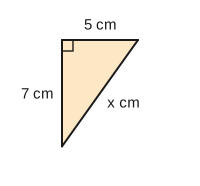
Diagram 6 shows a right-angled triangle. Find the value of x, correct to two decimal places.
Show answerHide answer
A
x² = 5² + 7² = 25 + 49 = 74, x = √74 = 8.60. 4.90 is √(49 − 25) (subtracting), 12 adds the sides, and 74 forgets the square root.
8
Question 8
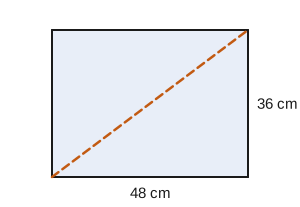
The size of a television screen is the length of its diagonal. Diagram 7 shows a screen 48 cm long and 36 cm high. What is the size of the screen?
Show answerHide answer
D
The corner of the screen is a right angle, so the diagonal is the hypotenuse: d² = 48² + 36² = 2 304 + 1 296 = 3 600, d = 60 cm. 84 adds the sides, 31.75 subtracts the squares, and 3 600 forgets the square root.
9
Question 9
Which set of side lengths forms a right-angled triangle?
Show answerHide answer
C
25² = 625 and 7² + 24² = 49 + 576 = 625, so they are equal. For 5, 12, 14: 14² = 196 but 25 + 144 = 169 (close to the triple 5, 12, 13, but not equal). For 6, 7, 8: 64 ≠ 85, and for 4, 5, 6: 36 ≠ 41.
10
Question 10
A triangle has sides 8 cm, 11 cm and 14 cm. What type of angle is opposite the 14 cm side?
Show answerHide answer
D
14² = 196 and 8² + 11² = 64 + 121 = 185. Since 196 > 185 (c² > a² + b²), the angle opposite the longest side is obtuse. A triangle can never have a reflex angle.
11
Question 11
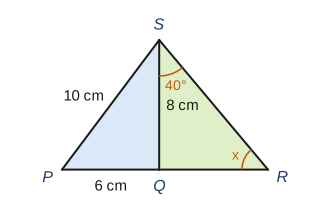
In Diagram 8, PQR is a straight line. SP = 10 cm, PQ = 6 cm, SQ = 8 cm and ∠QSR = 40°. Find the value of x.
Show answerHide answer
A
6² + 8² = 36 + 64 = 100 = 10², so ∠SQP = 90° by the converse. PQR is a straight line, so ∠SQR = 180° − 90° = 90°. Then x = 180° − 90° − 40° = 50°. 140° forgets the right angle (180° − 40°).
12
Question 12
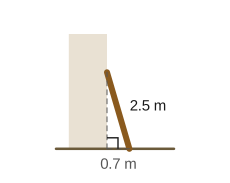
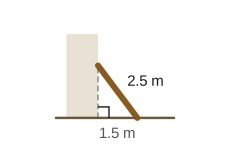
A 2.5 m ladder leans against a vertical wall with its base 0.7 m from the wall (Diagram 9). The top slides down h m until the base is 1.5 m from the wall (Diagram 10). Find h.
Show answerHide answer
B
Before: height = √(2.5² − 0.7²) = √(6.25 − 0.49) = √5.76 = 2.4 m. After: height = √(2.5² − 1.5²) = √(6.25 − 2.25) = √4 = 2.0 m. h = 2.4 − 2.0 = 0.4. 0.8 is how far the base moved (1.5 − 0.7), which is not the same as how far the top moved.
Section B: structured questions
28 marksAnswer all questions. Show your working.
13
Question 13
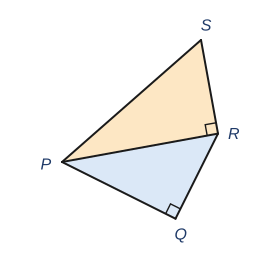
Diagram 11 shows quadrilateral PQRS. The diagonal PR divides it into two right-angled triangles.
[1 mark]
(a)Name the hypotenuse of triangle PQR.
Show answerHide answer
Tick each point you got.
[1 mark]
(b)Name the hypotenuse of triangle PRS.
Show answerHide answer
Tick each point you got.
[1 mark]
(c)Write the Pythagoras' theorem for triangle PRS.
Show answerHide answer
Tick each point you got.
14
Question 14
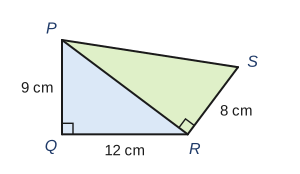
In Diagram 12, PQ = 9 cm, QR = 12 cm and RS = 8 cm. ∠PQR = ∠PRS = 90°.
[2 marks]
(a)Calculate the length of PR.
Show answerHide answer
Tick each point you got.
[2 marks]
(b)Calculate the length of PS.
Show answerHide answer
Tick each point you got.
15
Question 15
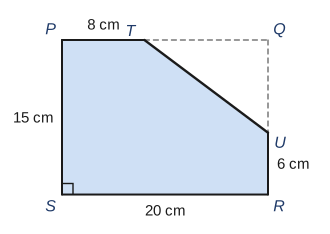
Diagram 13 shows a rectangle PQRS, 20 cm by 15 cm. The corner triangle TQU is cut off. PT = 8 cm and UR = 6 cm.
[2 marks]
(a)Calculate the length of TU.
Show answerHide answer
Tick each point you got.
[2 marks]
(b)Calculate the perimeter of the shaded region PTURS.
Show answerHide answer
Tick each point you got.
16
Question 16
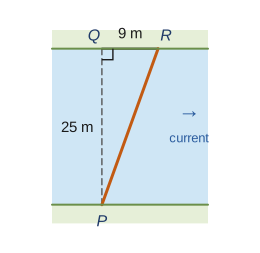
Mei Ling swims across a river 25 m wide, aiming from P straight to Q. The current carries her downstream, so she lands at R, 9 m from Q (Diagram 14).
[1 mark]
(a)Which side of triangle PQR is the distance she actually swam? Give a reason.
Show answerHide answer
Tick each point you got.
[2 marks]
(b)Calculate the distance she actually swam, correct to two decimal places.
Show answerHide answer
Tick each point you got.
17
Question 17
Use the converse of Pythagoras' theorem for each triangle. Show your working.
[2 marks]
(a)Determine whether a triangle with sides 10 cm, 24 cm and 26 cm is a right-angled triangle.
Show answerHide answer
Tick each point you got.
[1 mark]
(b)Determine whether a triangle with sides 9 cm, 12 cm and 16 cm is a right-angled triangle.
Show answerHide answer
Tick each point you got.
[1 mark]
(c)For the triangle in (b), what type of angle is opposite the 16 cm side? Give a reason.
Show answerHide answer
Tick each point you got.
18
Question 18
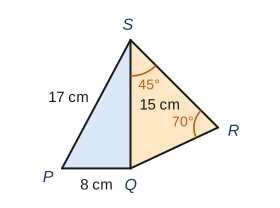
In Diagram 15, PQ = 8 cm, QS = 15 cm, PS = 17 cm, ∠QRS = 70° and ∠QSR = 45°.
[2 marks]
(a)Show that ∠PQS = 90°.
Show answerHide answer
Tick each point you got.
[2 marks]
(b)Find ∠PQR.
Show answerHide answer
Tick each point you got.
19
Question 19
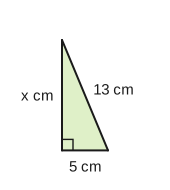
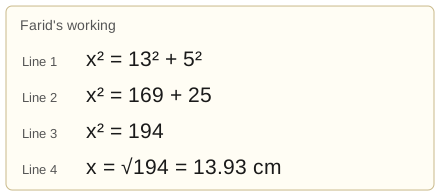
Farid was asked to find x in Diagram 16. Diagram 17 shows his working.
[1 mark]
(a)Farid's answer cannot be correct. Without calculating, explain how you know.
Show answerHide answer
Tick each point you got.
[2 marks]
(b)State his mistake and find the correct value of x.
Show answerHide answer
Tick each point you got.
20
Question 20
Aina has a 60 cm piece of wire. She wants to bend all of it into a right-angled triangle frame whose sides are whole numbers of centimetres.
[2 marks]
(a)Suggest three side lengths she could use. Show that they add up to 60 cm and that they form a right-angled triangle.
Show answerHide answer
The only whole-number answers are 15, 20, 25 and 10, 24, 26.
Tick each point you got.
[1 mark]
(b)Her friend suggests 20 cm, 20 cm and 20 cm. Explain why this does not meet Aina's plan.
Show answerHide answer
Tick each point you got.