The Pythagoras' Theorem
What this chapter covers
- Identify and define the hypotenuse of a right-angled triangle (13.1)
- Determine the relationship between the sides of a right-angled triangle and explain the Pythagoras' theorem using the areas of squares (13.1)
- Determine the length of an unknown side of a right-angled triangle and of combined geometric shapes (13.1)
- Solve problems involving the Pythagoras' theorem (13.1)
- Determine whether a triangle is a right-angled triangle and justify it with the converse of the Pythagoras' theorem (13.2)
- Solve problems involving the converse of the Pythagoras' theorem (13.2)
Right angles are everywhere: the corners of a room, a door frame, a ladder against a wall. Builders and civil engineers use the Pythagoras' theorem to make sure the corners of a building are true right angles (textbook p. 292). This chapter has two parts: the theorem itself, and its converse.
13.1The Pythagoras' theorem
The hypotenuse
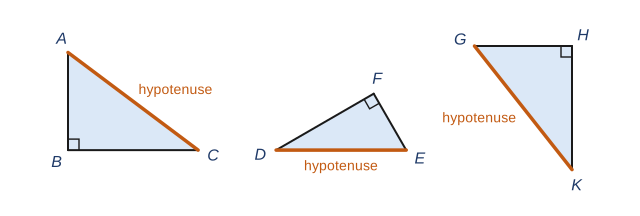
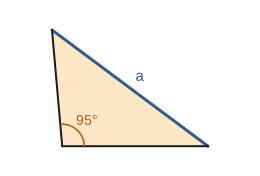
Example 1 (textbook p. 295)
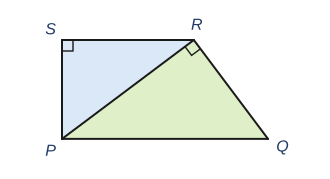
In triangle PSR the right angle is at S. The side opposite S is PR.
In triangle PRQ the right angle is at R. The side opposite R is PQ.
Show answerHide answer
(b) ∠XYZ, the right angle
The relationship between the sides
Draw a square on each side of a right-angled triangle with sides 3, 4 and 5 units. Count the unit squares.
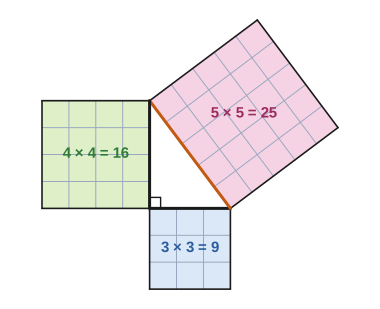
If c is the hypotenuse and a and b are the other two sides: c² = a² + b²
Example 2 (textbook p. 296): state the relationship
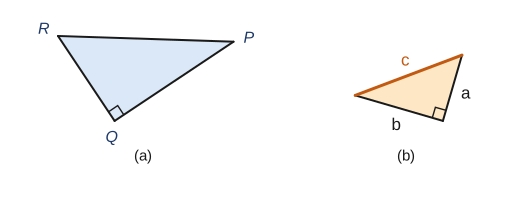
(b) The hypotenuse is c: c² = a² + b²
Three whole numbers that fit c² = a² + b² are called a Pythagorean triple. Knowing a few saves time (textbook p. 297).
| a | b | c | a² + b² | c² |
|---|---|---|---|---|
| 3 | 4 | 5 | 9 + 16 = 25 | 25 |
| 5 | 12 | 13 | 25 + 144 = 169 | 169 |
| 6 | 8 | 10 | 36 + 64 = 100 | 100 |
| 7 | 24 | 25 | 49 + 576 = 625 | 625 |
| 8 | 15 | 17 | 64 + 225 = 289 | 289 |
| 9 | 12 | 15 | 81 + 144 = 225 | 225 |
Finding an unknown side
If you know two sides of a right-angled triangle, the theorem gives the third side. First decide: is the unknown side the hypotenuse or not?
| Finding | Do this | Formula |
|---|---|---|
| the hypotenuse (longest side) | square, add, square root | c = √(a² + b²) |
| a shorter side | square, subtract, square root | a = √(c² − b²) |
Example 3 (textbook p. 297): find x
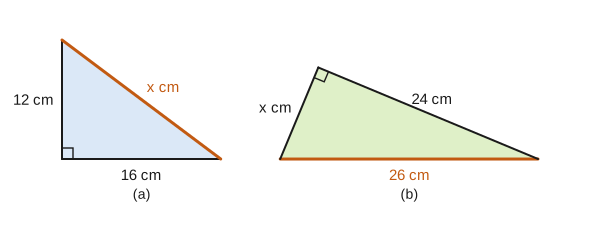
x² = 12² + 16²
= 144 + 256
= 400
x = √400 = 20
(b) 26 cm is the hypotenuse, so subtract.
26² = x² + 24²
x² = 26² − 24²
= 676 − 576
= 100
x = √100 = 10
Combined shapes
Some diagrams have two right-angled triangles joined together. Find the shared side first, then use it in the second triangle.
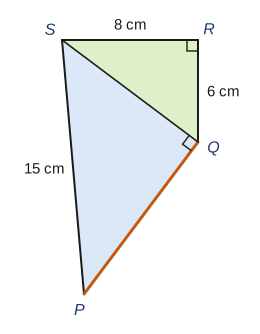
Example 4 (textbook p. 297): calculate the length of PQ
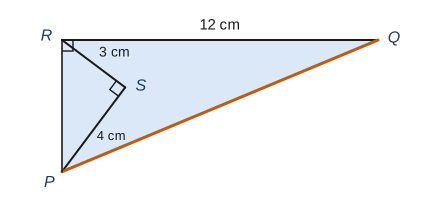
Triangle PRQ: PQ² = PR² + RQ² = 25 + 12² = 25 + 144 = 169
PQ = √169 = 13 cm
(b) Triangle SRQ: QS² = 6² + 8² = 36 + 64 = 100
Triangle SQP: SP is the hypotenuse, so PQ² = SP² − QS² = 15² − 100 = 225 − 100 = 125
PQ = √125 = 11.18 cm (2 decimal places)
(a) The two shorter sides are 10 cm and 24 cm; the hypotenuse is x cm.
(b) The hypotenuse is 15 cm and one side is 9 cm; the other side is x cm.
(c) The two shorter sides are 4 cm and 7 cm; the hypotenuse is x cm.
Show answerHide answer
(b) x² = 15² − 9² = 225 − 81 = 144, x = 12
(c) x² = 4² + 7² = 16 + 49 = 65, x = √65 = 8.06
Solving problems
Draw (or find) the right-angled triangle in the story, mark the right angle, label the sides you know, and decide whether the unknown is the hypotenuse.
Example 5 (textbook p. 298): the fireman's ladder
A child is trapped on the third floor, 6 m above the ground. The base of the ladder is 4.5 m from the wall. How long is the ladder?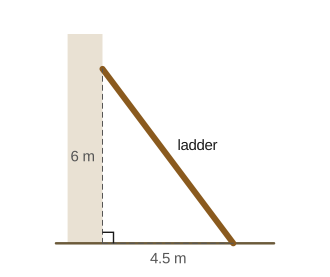
Plan: the wall and the ground meet at a right angle, so the ladder is the hypotenuse.
Solve: ladder² = 4.5² + 6² = 20.25 + 36 = 56.25, ladder = √56.25 = 7.5 m
Check: 7.5² = 56.25 ✓, and 7.5 m is longer than 6 m and 4.5 m ✓
Example 6 (textbook p. 299): perimeter of a combined shape
PVRQ and RUTS are squares with sides 12 cm and 16 cm. Calculate the perimeter of the whole diagram.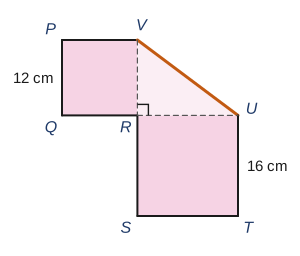
VU² = 12² + 16² = 144 + 256 = 400, VU = 20 cm
Perimeter = VU + UT + TS + SR + RQ + QP + PV = 20 + 16 + 16 + 16 + 12 + 12 + 12 = 104 cm
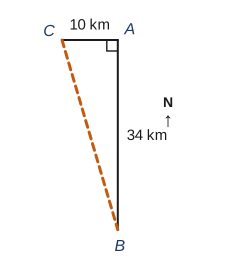
Show answerHide answer
BC² = 34² + 10² = 1 156 + 100 = 1 256
BC = √1 256 = 35.44 km
Show answerHide answer
height² = 7.2² − 4.5² = 51.84 − 20.25 = 31.59
height = √31.59 = 5.62 m
13.2The converse of Pythagoras' theorem
The theorem says: right angle → c² = a² + b². The converse works the other way round: if the sides fit c² = a² + b², the triangle must have a right angle. So we can test a triangle using only its side lengths (textbook p. 300).
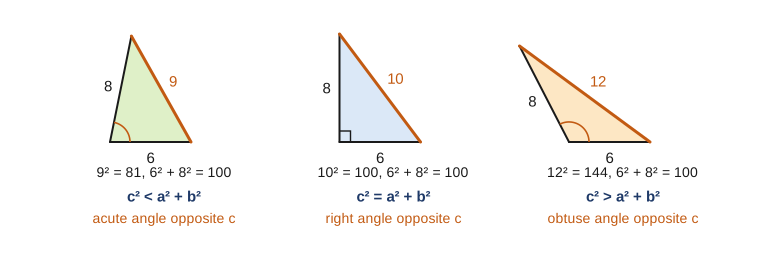
| Compare (c = longest side) | Angle opposite c |
|---|---|
| c² < a² + b² | acute (less than 90°) |
| c² = a² + b² | right angle (90°) |
| c² > a² + b² | obtuse (between 90° and 180°) |
Example 7 (textbook p. 301): is it a right-angled triangle?
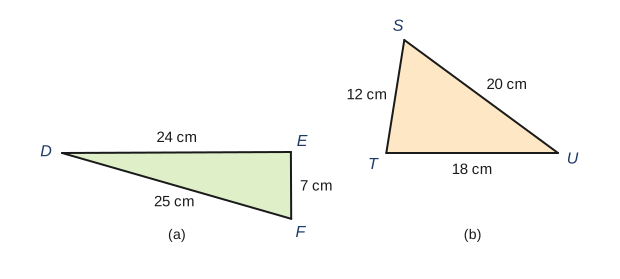
625 = 625, so DEF is a right-angled triangle (the right angle is at E, opposite DF).
(b) The longest side is 20 cm. 20² = 400 and 18² + 12² = 324 + 144 = 468
400 ≠ 468, so STU is not a right-angled triangle.
Example 8 (textbook p. 301): find x
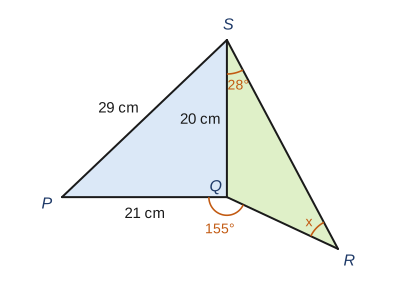
Angles at a point add up to 360°: ∠SQR = 360° − 90° − 155° = 115°
Angles in triangle SQR: x = 180° − 115° − 28° = 37°
Example 9 (textbook p. 302): Sheila's straws
Sheila has straws 15 cm, 20 cm and 25 cm long. Can she make a right-angled triangle frame?15² + 20² = 225 + 400 = 625 and 25² = 625. They are equal, so yes: the angle opposite the 25 cm straw is a right angle.
(a) 9 cm, 40 cm, 41 cm (b) 27 m, 45 m, 35 m (c) 2.5 cm, 6 cm, 6.5 cm
(d) A 2.5 m ladder leans against a wall. Its base is 1.5 m from the wall and its top is 2 m up the wall. Is the wall vertical?
Show answerHide answer
(b) 45² = 2 025; 27² + 35² = 729 + 1 225 = 1 954. Not equal, so no (the angle opposite 45 m is obtuse).
(c) 6.5² = 42.25; 2.5² + 6² = 6.25 + 36 = 42.25. Equal, so yes.
(d) 2.5² = 6.25; 1.5² + 2² = 2.25 + 4 = 6.25. Equal, so the wall makes a right angle with the ground: it is vertical.
Summary
| Pythagoras' theorem | Converse of Pythagoras' theorem | |
|---|---|---|
| You know | The triangle has a right angle | The three side lengths |
| You find | The length of a missing side | Whether there is a right angle |
| Rule | c² = a² + b² (c = hypotenuse) | If c² = a² + b², the angle opposite c is 90° |
| Example | Sides 6 and 8: c = √100 = 10 | 15, 20, 25: 225 + 400 = 625 = 25², right angle |
| Remember | Key fact |
|---|---|
| Hypotenuse | Longest side, opposite the right angle |
| Finding the hypotenuse | Square, add, square root |
| Finding a shorter side | Square, subtract, square root |
| Combined shapes | Find the shared side first |
| Converse test | Square the longest side alone; compare with the sum of the other two squares |
| Check | The hypotenuse must be longer than each of the other sides |