Reproduction
By the end of this chapter you can
- Compare sexual and asexual reproduction in animals and plants, and explain why reproduction is important (4.1)
- Identify the parts and functions of the male and female reproductive systems, the changes at puberty, and compare sperm with ovum (4.2)
- Describe the phases of the menstrual cycle, link the fertile phase to fertilisation, and explain hygiene during menstruation (4.3)
- Describe fertilisation, implantation and the growth of a zygote into a foetus, and the roles of the placenta and umbilical cord (4.4)
- Explain how nutrition, harmful substances and breastfeeding affect the foetus and baby (4.5)
- Explain infertility and how to overcome it, and differentiate methods of contraception (4.6)
- Describe the parts of a flower, pollination, fertilisation, seed structure and germination in plants (4.7)
4.1Sexual and Asexual Reproduction
There are two kinds of reproduction. The big difference is whether reproductive cells (gametes) are involved.
| Sexual reproduction | Asexual reproduction | |
|---|---|---|
| Reproductive cells | Involved (sperm and ovum) | Not involved |
| Number of parents | Two (male and female) | One |
| Fertilisation | Occurs | Does not occur |
| Offspring | Different from the parents; show genetic variation | Genetically identical to the parent; no variation |
| Examples | Humans, mammals, birds, fish, reptiles, amphibians, flowering plants | Amoeba, Paramecium, Hydra, onion, ginger, potato |
Sexual reproduction and fertilisation
The male parent has testes that produce the male gamete, the sperm. The female parent has ovaries that produce the female gamete, the ovum. Fertilisation is the fusion of the nucleus of a sperm with the nucleus of an ovum. The fertilised cell is called a zygote.
| Internal fertilisation | External fertilisation | |
|---|---|---|
| Where the gametes fuse | Inside the body of the female | Outside the body of the female, usually in water |
| How | The male releases sperm into the female's body | The male releases sperm and the female releases ova into the water; the sperm swim to the ova |
| Examples | Humans, mammals, birds, reptiles, insects (e.g. dragonflies) | Fish, frogs |
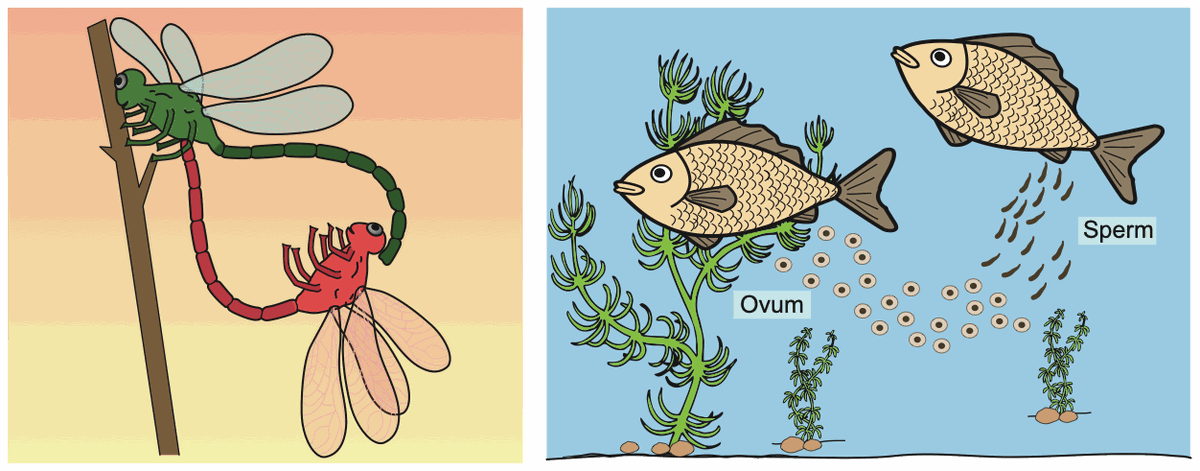
Figures 4.2 and 4.3: Science Form 1 (DLP) textbook, p. 93.
Types of asexual reproduction
| Type | What happens | Examples |
|---|---|---|
| Binary fission | One parent cell divides into two daughter cells (the nucleus divides, then the cytoplasm). | Amoeba, Paramecium, bacteria |
| Budding | A swelling (bud) grows on the body, develops and breaks off as a new individual. | Hydra, yeast |
| Regeneration | A fragment (piece) of the organism grows into a complete new individual. | Flatworm, starfish, Planaria |
| Spore formation | Spores are made in a sporangium. Light spores are scattered by wind and grow into new plants in a moist place. | Fern, fungus (mould), algae, bacteria |
| Vegetative reproduction | A new plant grows from a vegetative part (root, stem or leaf, but not the flower). | Carrot, potato, ginger, onion, grass, Bryophyllum |
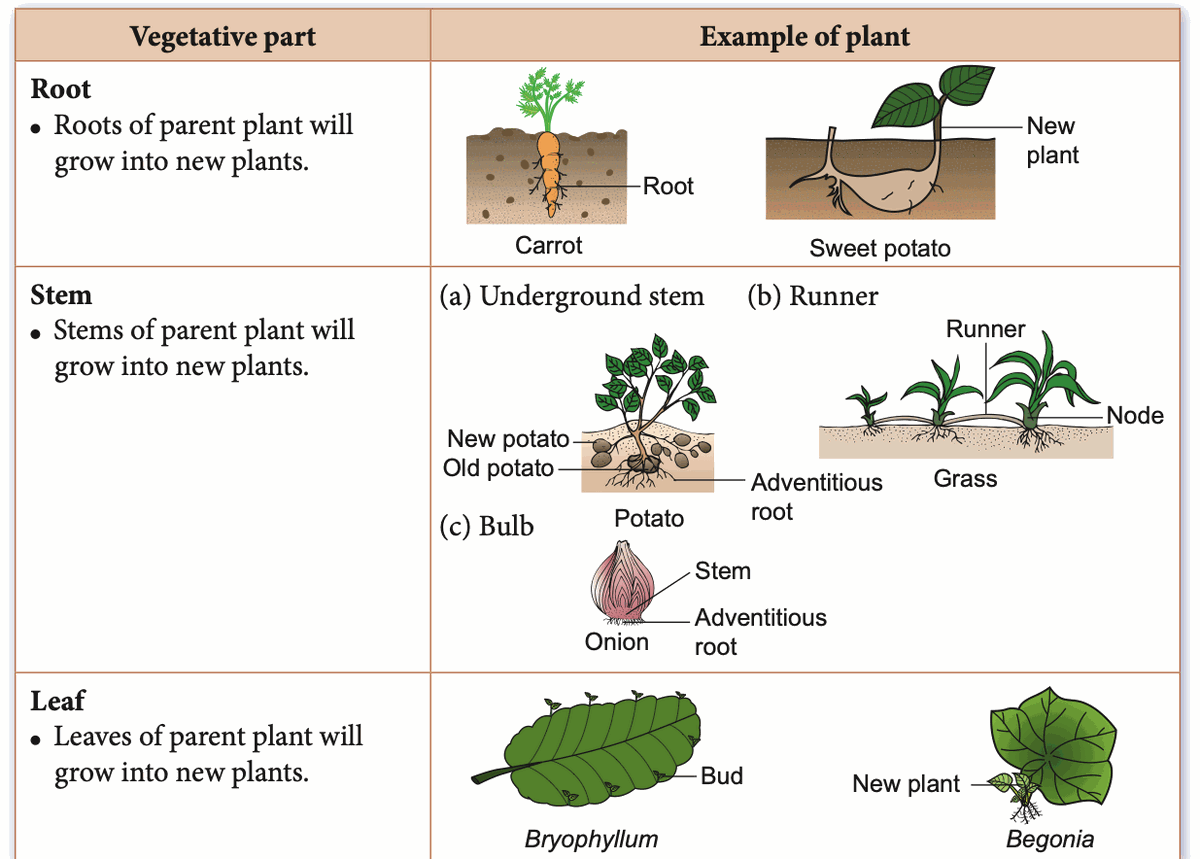
Vegetative reproduction table: textbook p. 96.
Why reproduction is important
- It increases the number of individuals of a species, so the species does not become extinct.
- It passes genetic information (characteristics) from parents to the new generation.
- It keeps life going: old organisms die and are replaced by new ones.
The ability to reproduce is a gift from God that we should be grateful for. Every baby has the right to be loved and cared for; baby dumping is cruel and wrong.
Show answerHide answer
4.2Human Reproductive System
Male reproductive system
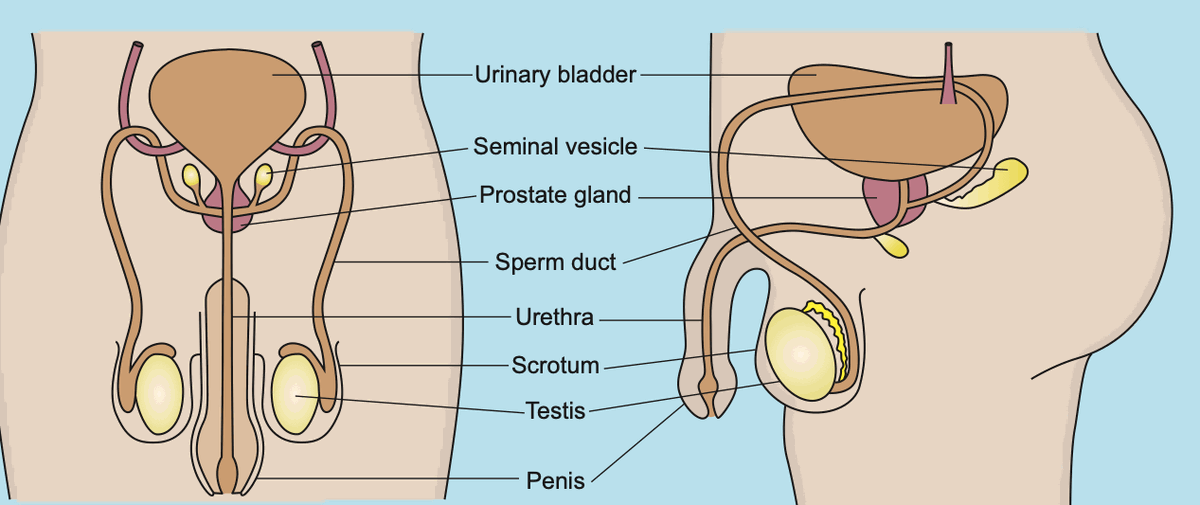
Figures 4.6 and 4.7: textbook p. 98.
| Part | Function |
|---|---|
| Testis (plural: testes) | Produces sperm (male gametes) and male sex hormones |
| Scrotum | Holds and protects the testes |
| Sperm duct | Carries sperm from the testis to the urethra |
| Seminal vesicle | Secretes a nutritious fluid for the sperm |
| Prostate gland | Secretes a fluid that contains nutrients and protects the sperm |
| Urethra | Channel that carries sperm and urine out of the body |
| Penis | Transfers sperm into the vagina during copulation |
Female reproductive system
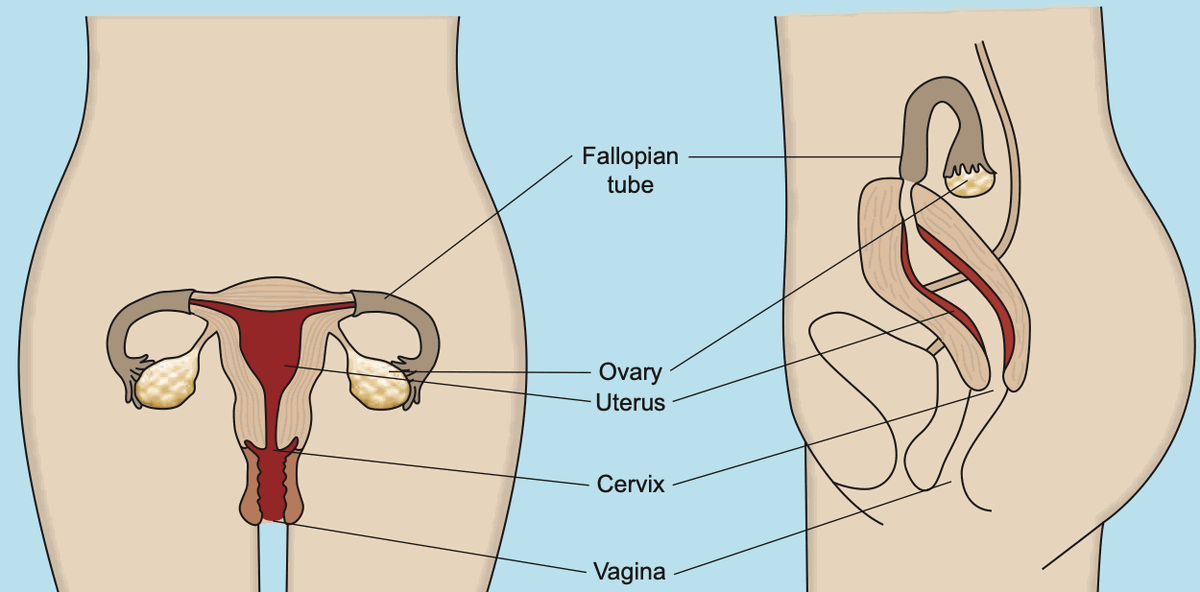
Figures 4.8 and 4.9: textbook p. 99.
| Part | Function |
|---|---|
| Ovary | Produces the ovum (female gamete) and female sex hormones |
| Fallopian tube | Place where fertilisation happens |
| Uterus (womb) | Place where the embryo grows and develops |
| Cervix | Produces mucus that helps sperm swim into the uterus |
| Vagina | Receives sperm; the birth canal through which a baby is born |
Puberty
| Boys | Girls | |
|---|---|---|
| Voice and body | Larynx (voice box) grows and the voice becomes deeper; moustache and beard grow; hair on the face, armpits and chest | Breasts grow; hips become broader; hair grows in the armpits |
| Reproductive organs | Testes produce sperm and sex hormones; penis and scrotum enlarge; pubic hair grows | Ovaries produce ova and sex hormones; menstrual cycle begins; pubic hair grows |
Teenagers also change emotionally. Sweat glands become more active, so bathing every day helps to prevent body odour and acne.
Sperm and ovum
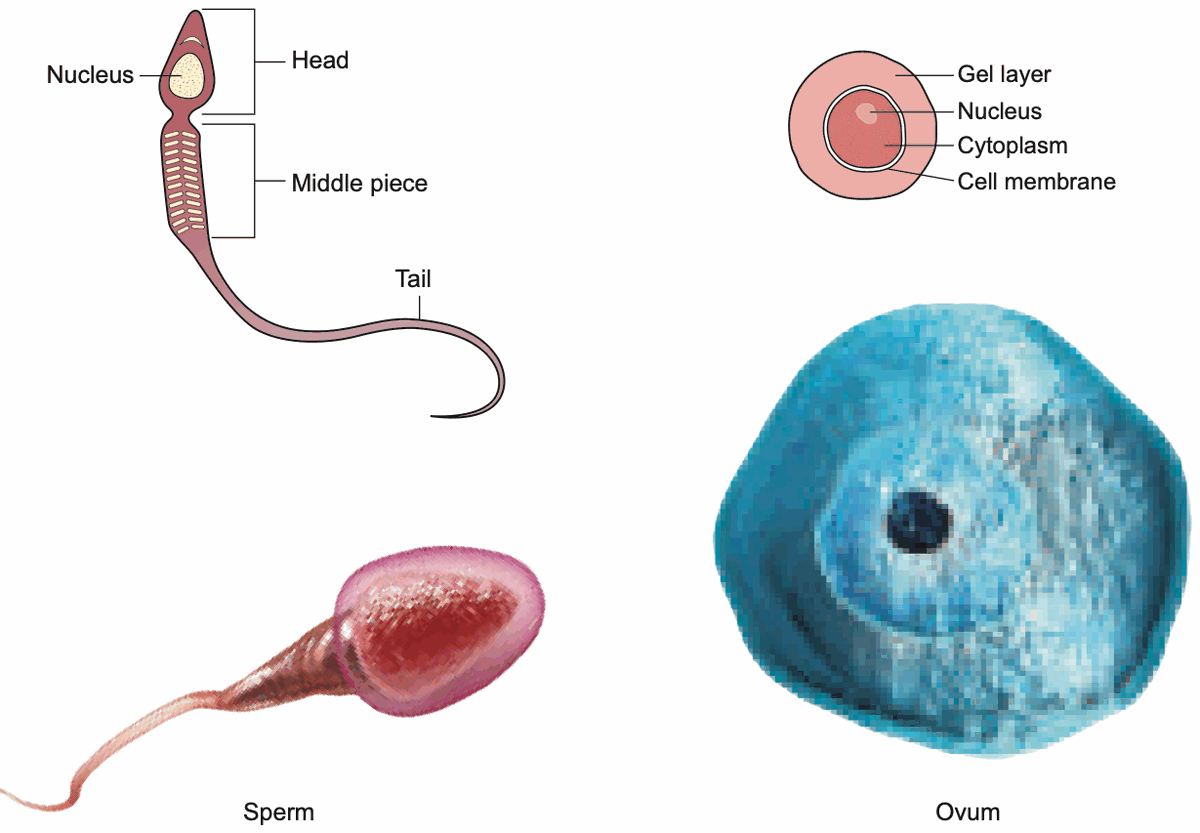
Figure 4.12: textbook p. 102.
| Sperm (male gamete) | Ovum (female gamete) |
|---|---|
| Produced by the testis | Produced by the ovary |
| Smallest cell in the male body; shaped like a tadpole | Largest cell in the female body; round, about 0.1 mm across |
| Can move — the tail lets it swim | Cannot move by itself |
| Millions released (about 60 million per cm³ of semen) | Usually one released each month |
| Lives up to 3–4 days in the female body | Lives up to 2 days after release |
Same: both are reproductive cells, and both have a nucleus that carries genetic information to the offspring.
Show answerHide answer
4.3The Menstrual Cycle
The menstrual cycle is the series of changes in the uterine wall and ovaries, including the release of a mature ovum. It usually lasts about 28 days, but varies between women.
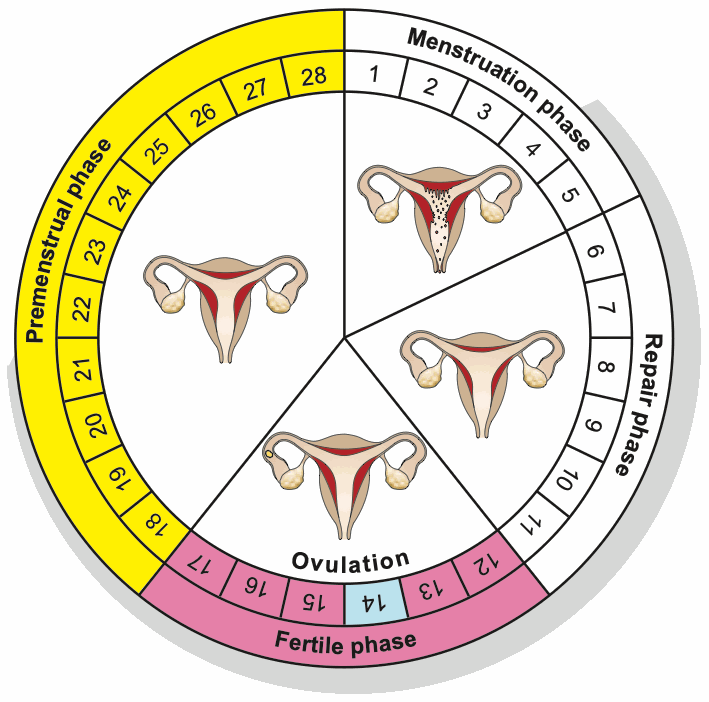
| Days | Phase | What happens |
|---|---|---|
| 1–5 | Menstruation | The uterine lining breaks down and flows out with blood, the unfertilised ovum and mucus. |
| 6–11 | Repair | The lining rebuilds and thickens; new blood vessels form. |
| 12–17 | Fertile | Ovulation (release of an ovum from the ovary) happens on about day 14. Fertilisation is likely if sperm are present. |
| 18–28 | Premenstrual | The lining keeps thickening and is full of blood vessels, ready for implantation. If there is no fertilisation, the cycle starts again. |
Figure 4.14: textbook p. 104.
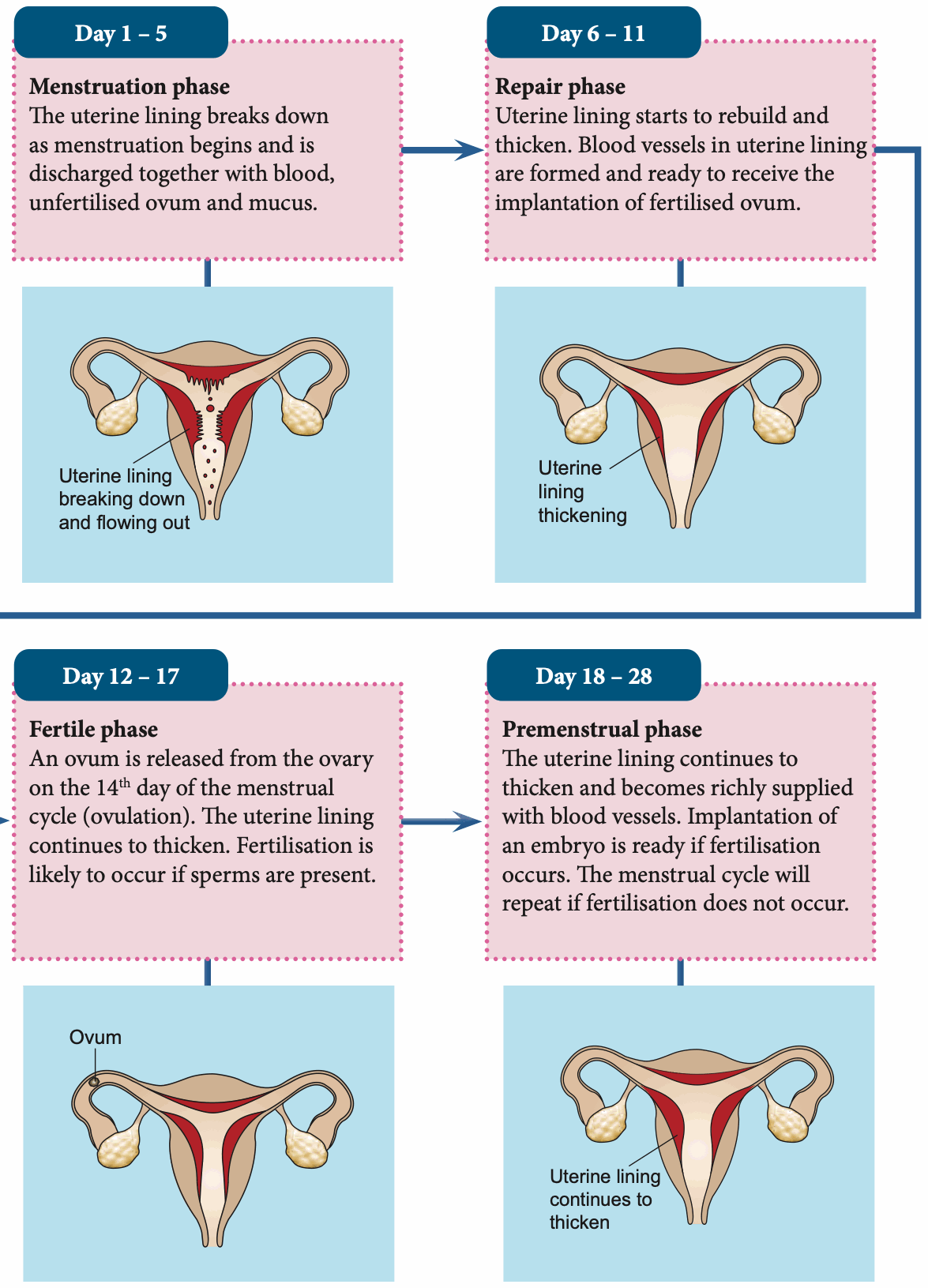
Figure 4.15: textbook p. 105.
Day 1 = 3 March, so ovulation (day 14) = 3 + 13 = 16 March.
Fertile phase (day 12–17) = 14 March to 19 March. Her next menstruation should start on day 29 = 31 March.
Hygiene during menstruation
- Change the sanitary pad 3–4 times a day to stop bacteria and viruses that can cause a urinary tract infection (UTI).
- Bathe often to keep the body clean.
Irregular menstruation (missing periods, or cycles that are too long or too short) can be caused by weight gain, hormone imbalance, emotional stress, too much exercise or a tumour in the cervix. It can lead to infertility, difficulty in planning a family, and anaemia (from losing too much blood). A doctor should check it early.
Show answerHide answer
4.4Fertilisation and Pregnancy
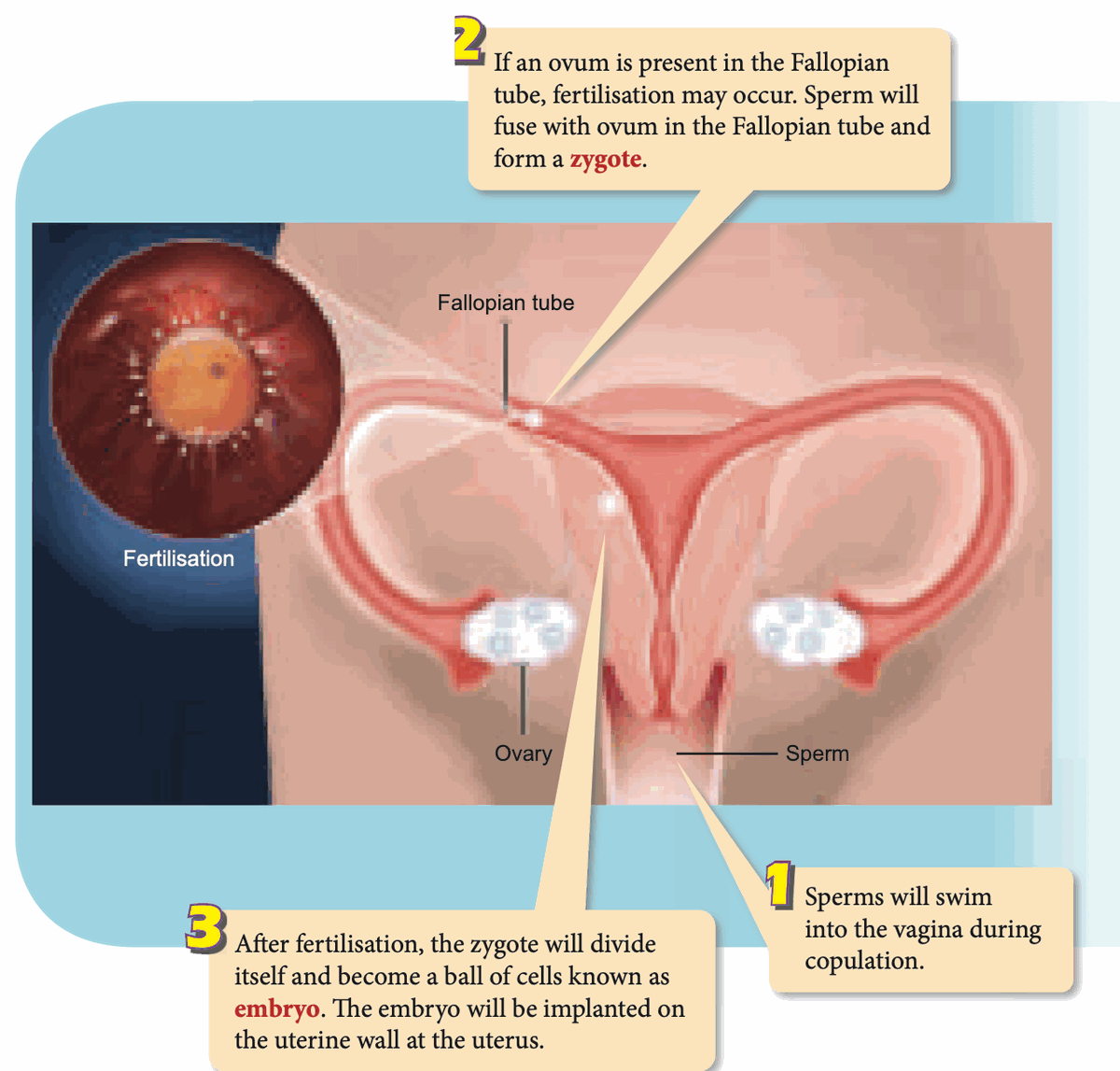
Figure 4.17: textbook p. 108.
- During copulation, sperm swim into the vagina, through the uterus and into the Fallopian tube.
- If an ovum is in the Fallopian tube, a sperm fuses with it (fertilisation) to form a zygote.
- The zygote divides many times to become a ball of cells called an embryo.
- The embryo attaches to the uterine wall. This is implantation, and the woman is now pregnant.
| Week | Development |
|---|---|
| 1–4 | Hands and feet start to form; the embryo has a tiny tail |
| 7–9 | Nose, ears and fingers can be seen |
| 10–19 | Looks like a baby; now called a foetus |
| 20–37 | Foetus grows and resembles a baby |
| 38–40 | Fully formed. The head turns down towards the cervix; the uterine muscles contract strongly; the amnion bursts and amniotic fluid flows out; the baby is pushed out through the vagina |
Placenta, umbilical cord and amnion
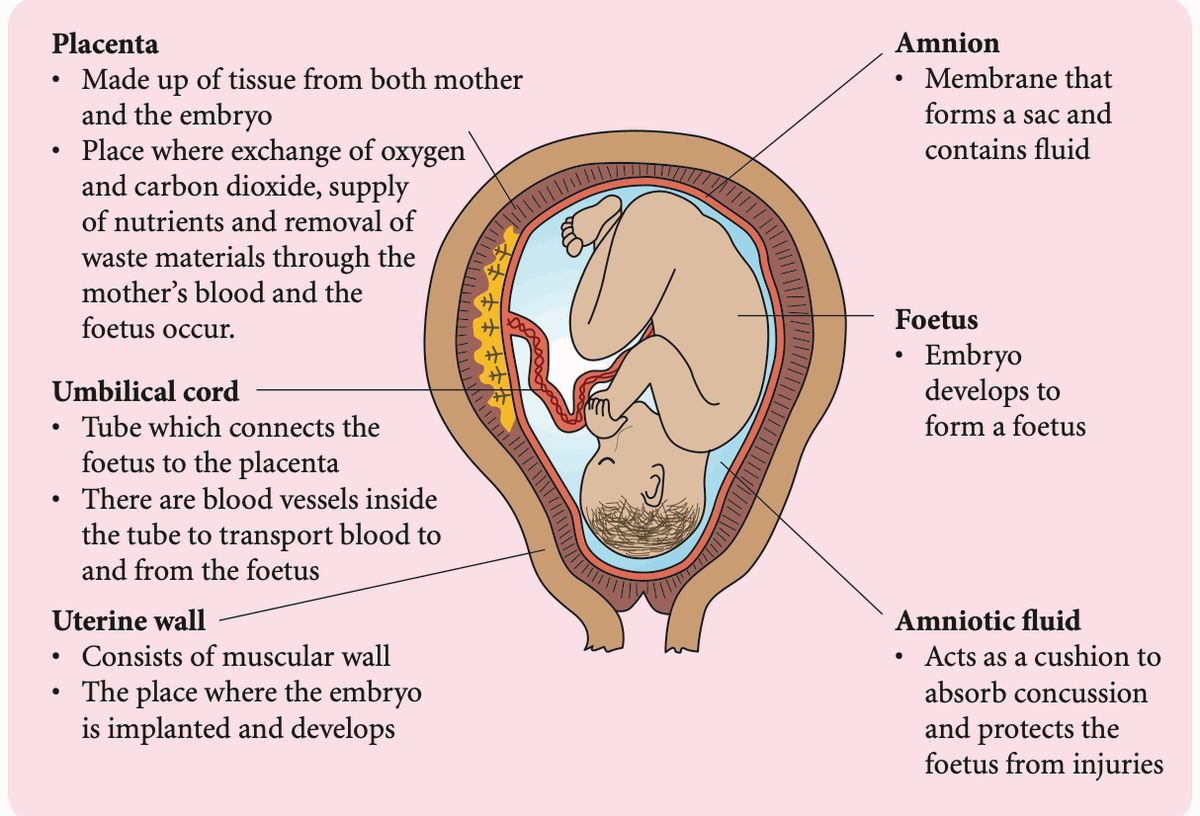
Figure 4.19: textbook p. 110.
| Structure | Function |
|---|---|
| Placenta | Made of tissue from both mother and embryo. Oxygen and nutrients pass from the mother's blood to the foetus; carbon dioxide and waste pass from the foetus to the mother's blood. |
| Umbilical cord | Connects the foetus to the placenta. Its blood vessels carry blood to and from the foetus. |
| Amnion | Membrane that forms a sac filled with fluid |
| Amniotic fluid | Acts as a cushion that absorbs shocks and protects the foetus from injury |
| Uterine wall | Muscular wall where the embryo is implanted and grows |
Show answerHide answer
4.5Factors Affecting the Development of a Foetus and Baby
The foetus gets all its food and oxygen from the mother, so a pregnant woman needs more of most nutrients than a woman who is not pregnant (for example protein 85 g instead of 39 g a day, and iron 15 mg instead of 10 mg).
| Nutrient | Food examples | Why it is needed |
|---|---|---|
| Carbohydrate and fat | Rice, bread, butter, cheese | Energy for daily activities |
| Protein | Chicken, red meat, fish, milk | Growth of new cells of the foetus |
| Calcium and phosphorus | Anchovies, cheese, milk | Healthy bones of the foetus; protects the mother's bones and teeth |
| Iron | Liver, red meat, fish | Makes haemoglobin; prevents anaemia |
| Folic acid | Broccoli, spinach, groundnuts | Development of the foetus's nervous system |
| Vitamin C | Citrus fruits, guava, tomatoes | Healthy skin; prevents bleeding gums |
| Fibre | Cereal, vegetables, fruits | Prevents constipation |
Harmful substances
| Substance | Possible effects on the baby |
|---|---|
| Cigarettes | Low birth weight, premature birth, miscarriage, higher death rate, physical and mental disabilities |
| Alcohol | Foetal Alcohol Syndrome (small head, facial abnormalities, low birth weight); slow development; damage to the brain, nerves and heart |
| Drugs | Defects in the foetus |
Frequent X-rays are also avoided during pregnancy because radiation can harm the developing cells of the foetus.
Breast milk or formula milk?
- Breast milk contains all the essential nutrients a baby needs.
- It contains antibodies that protect the baby from some diseases.
- It is easier to digest than formula milk.
- Breastfeeding builds a close bond between mother and baby, which helps the baby's emotional development.
Every living creature has the right to live, even in the womb. A mother protects that right by eating well and avoiding harmful substances.
Show answerHide answer
4.6Infertility and Contraception
| Causes in males | Causes in both | Causes in females |
|---|---|---|
| Testes cannot produce sperm; low sperm count; low-quality sperm; impotence | Hormone imbalance; defective or diseased reproductive organs; health problems such as diabetes | Ovaries cannot produce ova; blocked Fallopian tubes; abnormal uterus; tumour in the uterus |
Ways to overcome infertility
| Method | Used when |
|---|---|
| Hormone treatment | The person has a hormone imbalance |
| Surgery | There is a blockage in the woman's Fallopian tube or the man's sperm duct |
| In vitro fertilisation (IVF) | The Fallopian tubes are blocked. Ova are taken out and fertilised with sperm in a glass dish; the embryo is placed in the uterus. The baby is called a "test tube baby". |
The first test tube baby, Louise Brown, was born in 1978. Robert Edwards, who developed IVF, won the 2010 Nobel Prize for Medicine.
Methods of contraception
Contraception lets married couples plan their family.
| Method | How it works | Type |
|---|---|---|
| Contraceptive pills | Prevent ovulation | Temporary |
| Implant | Placed under the skin of the arm; releases a hormone that stops the ovary producing ova | Temporary |
| Condom | Worn over the penis; stops sperm entering the vagina | Temporary |
| Intrauterine contraceptive device (IUCD) | Placed in the uterus; prevents implantation | Temporary |
| Vasectomy (male) | Sperm ducts are cut and tied, so sperm cannot reach the urethra | Permanent (surgery) |
| Ligation (female) | Fallopian tubes are cut and tied, so the ovum cannot meet sperm | Permanent (surgery) |
Health screening
Regular health screening (at least once a year from age 40) detects early signs of disease. Cancers of the reproductive system, such as cervical, uterine and prostate cancer, can be treated if found early, and early treatment costs less. A doctor can also advise on correct and safe contraception. Misusing knowledge of contraception, for example to have sex outside marriage, causes social problems.
Show answerHide answer
4.7Plant Reproduction
Parts of a flower
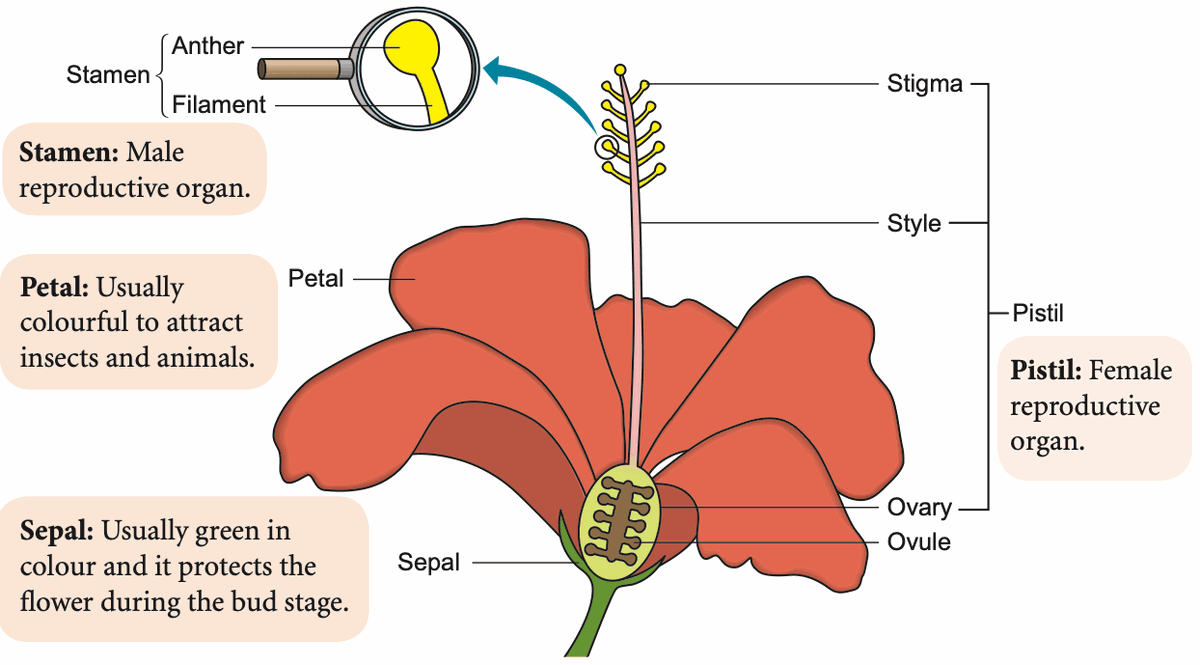
Figure 4.26: textbook p. 120.
| Part | Function |
|---|---|
| Stamen (male organ) = anther + filament | Anther produces pollen grains (which carry the male gametes); filament holds up the anther |
| Pistil (female organ) = stigma + style + ovary | Stigma receives pollen (sticky); style holds up the stigma and connects it to the ovary; the ovary contains ovules (which contain the female gametes) |
| Petal | Usually colourful, to attract insects and animals |
| Sepal | Usually green; protects the flower in the bud stage |
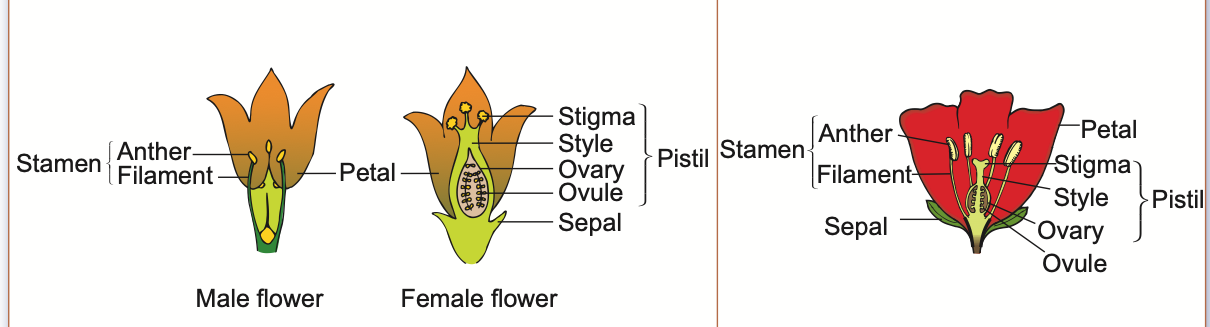
Table 4.5: textbook p. 121.
Pollination
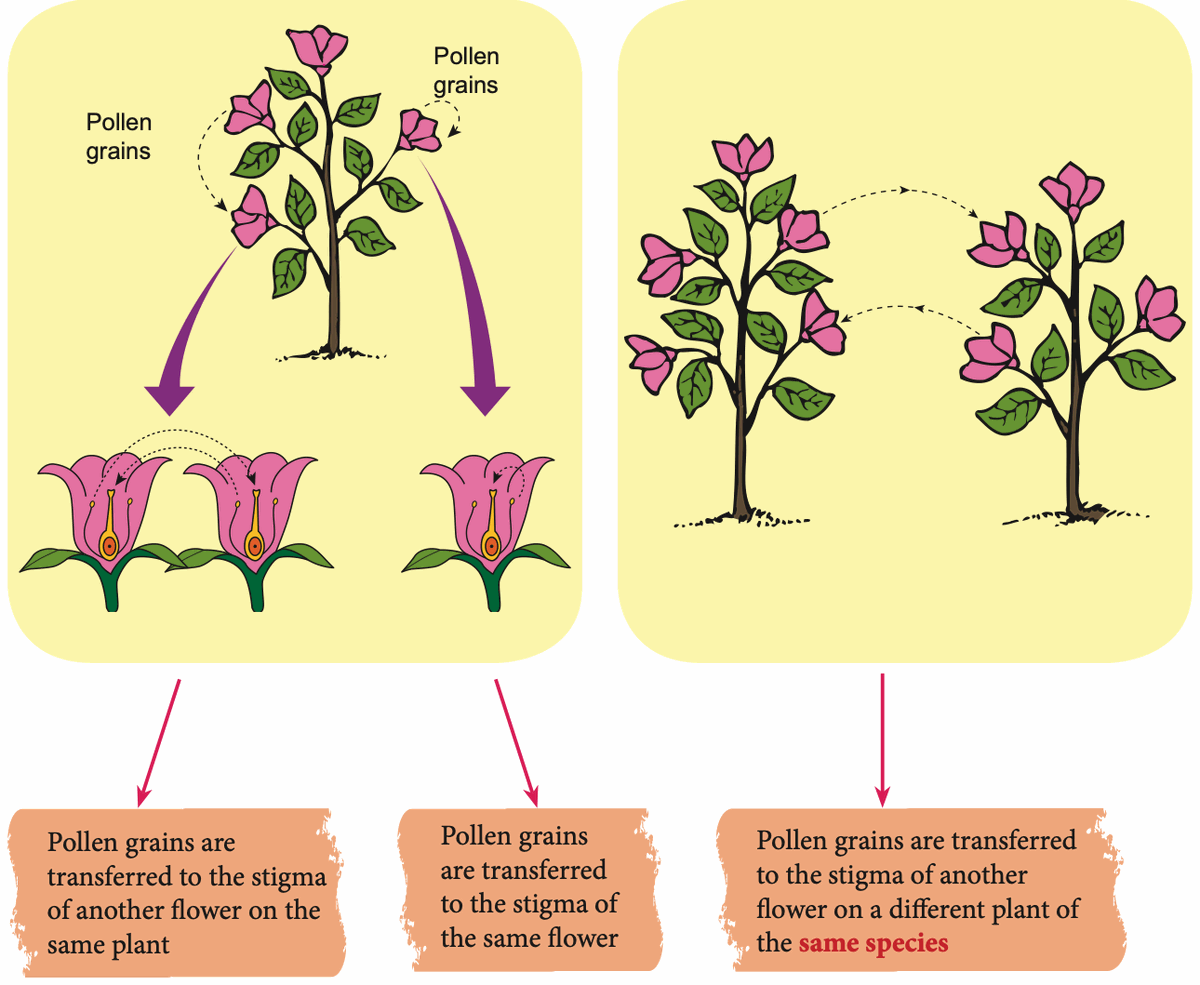
Figure 4.27: textbook p. 122.
| Insect- or animal-pollinated flowers | Wind-pollinated flowers | |
|---|---|---|
| Petals | Big and colourful | Small, white or pale |
| Nectar and smell | Have nectar and smell nice | No nectar, no smell |
| Pollen grains | Rough and sticky (stick to the insect's body) | Plenty, small, smooth and light (carried by wind) |
| Stigma, filament and style | Inside the flower | Long, furry stigma; long filament and style that hang outside |
| Examples | Durian, rambutan, papaya, hibiscus, sunflower, rose | Corn, grass, paddy |
Advantages of cross-pollination: offspring inherit good characteristics from both parents; new varieties; plants that resist pests and diseases and adapt better to the environment; good-quality seeds. Malaysian agencies such as MARDI and MPOB use it to produce hybrids.
| Plant | Parent plants | Hybrid | Better because |
|---|---|---|---|
| Oil palm | Pisifera × Dura | Tenera | More fruits and flesh, thinner shell |
| Papaya | Subang 6 × Sunrise Solo | Eksotika | Sweeter, more flesh |
| Corn | Sweet corns from Taiwan × Mexico | Masmadu | Sweeter, bigger; resists disease and drought |
| Paddy | Siam-29 × Pebifun | Malinja | More harvest, ripens faster |
Fertilisation, seeds and fruits
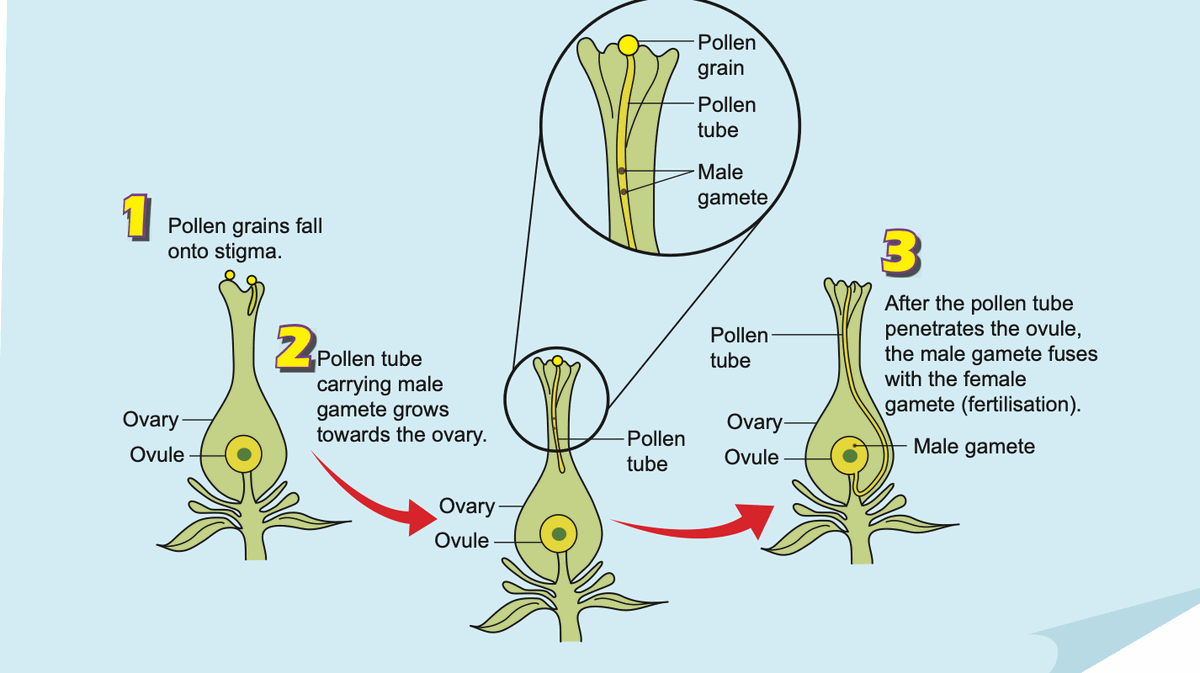
Figure 4.31: textbook p. 126.
- A pollen grain lands on the stigma.
- A pollen tube grows down the style towards the ovary, carrying the male gamete.
- The tube enters the ovule and the male gamete fuses with the female gamete (fertilisation).
- The ovule becomes the seed and the ovary becomes the fruit. The other parts of the flower wither and fall.
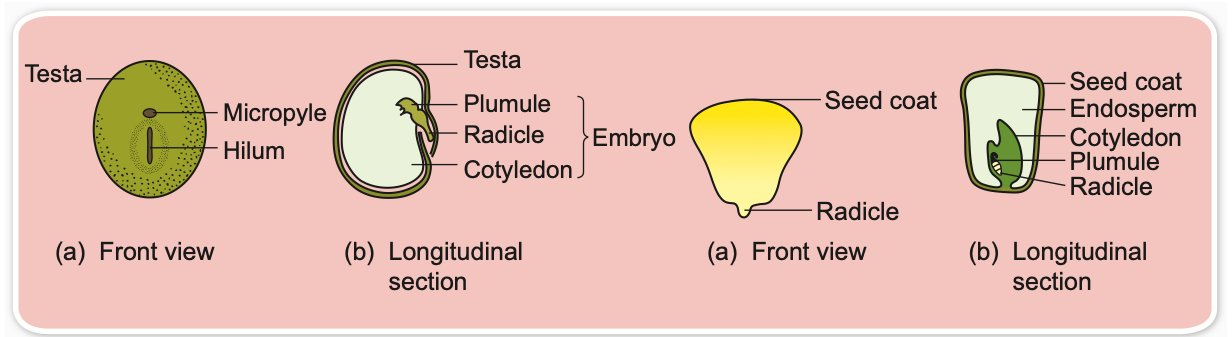
Figures 4.32 and 4.33: textbook p. 127.
| Part | Function |
|---|---|
| Testa (seed coat) | Protects the seed |
| Hilum | Scar where the seed was attached to the fruit |
| Micropyle | Small hole that lets air and water into the seed |
| Plumule | Grows into the new shoot |
| Radicle | Grows into the root |
| Cotyledon / endosperm | Stores food for the growing embryo |
Germination
During germination the testa bursts. The radicle comes out first and grows down to form the root; the plumule grows up to form the shoot.
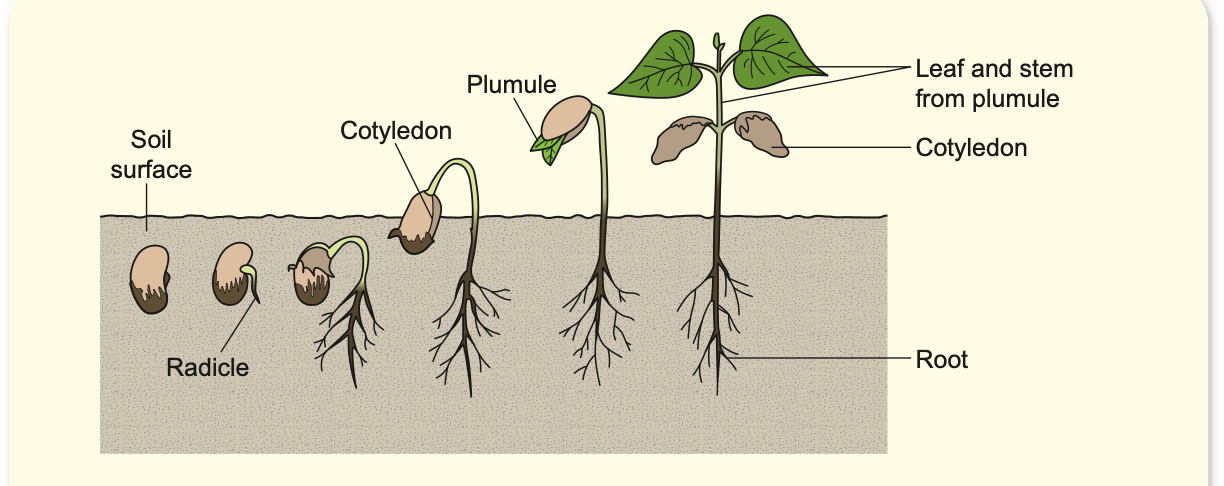
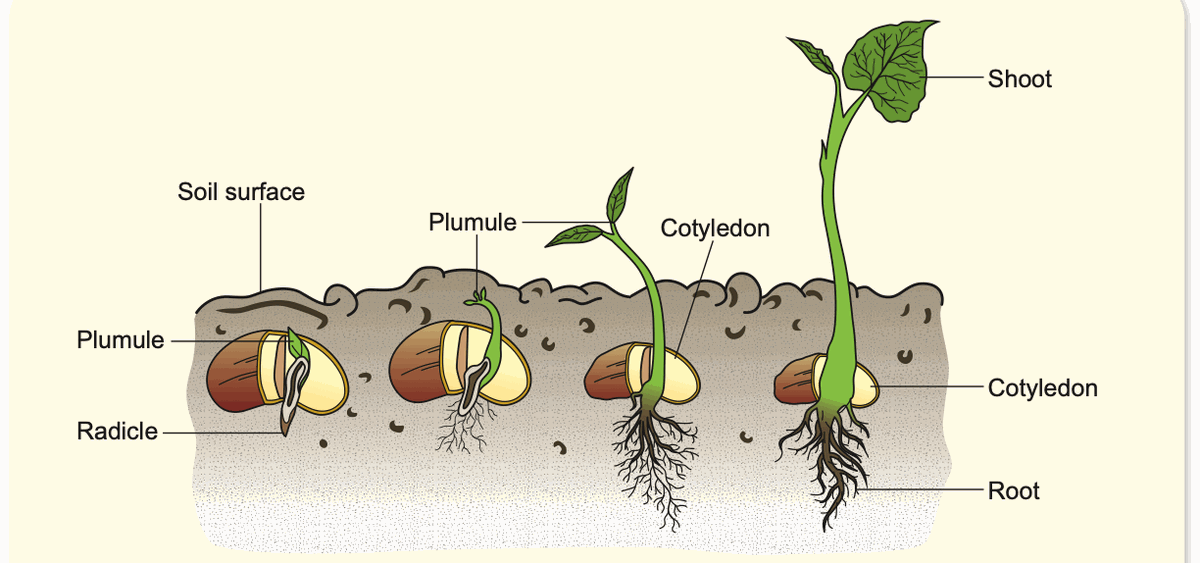
Figures 4.34 and 4.35: textbook p. 128.
Conditions needed for germination
Seeds need water, air (oxygen) and a suitable temperature. Light is not needed. Experiment 4.1 tests this:
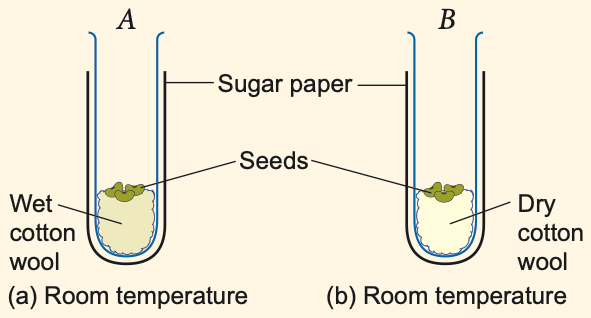
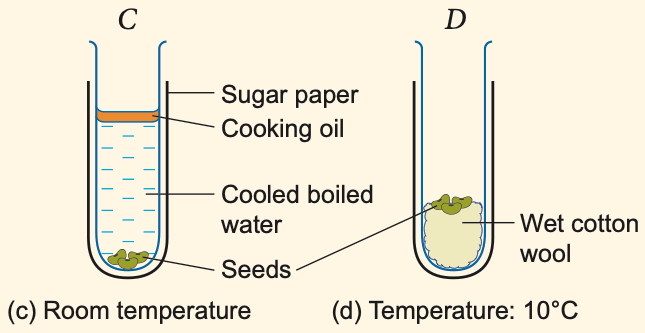
Figure 4.37: textbook pp. 129–130.
| Tube | Water | Air | Suitable temperature | Result |
|---|---|---|---|---|
| A (wet cotton wool, room temperature) | ✓ | ✓ | ✓ | Germinates (control) |
| B (dry cotton wool) | ✗ | ✓ | ✓ | Does not germinate |
| C (under cooled boiled water + oil) | ✓ | ✗ | ✓ | Does not germinate |
| D (wet cotton wool, 10 °C in refrigerator) | ✓ | ✓ | ✗ | Does not germinate |
Show answerHide answer
Summary
| Remember | Key fact |
|---|---|
| Sexual vs asexual | Sexual: two parents, gametes, fertilisation, variation. Asexual: one parent, no gametes, identical offspring |
| Asexual types | Binary fission, budding, regeneration, spore formation, vegetative reproduction |
| Gametes | Sperm (testis): smallest, moves. Ovum (ovary): largest, cannot move |
| Where things happen | Fertilisation: Fallopian tube. Implantation and growth: uterus |
| Menstrual cycle (28 days) | Menstruation 1–5, repair 6–11, fertile 12–17 (ovulation day 14), premenstrual 18–28 |
| Development | Zygote → embryo → foetus (week 10) → birth (38–40 weeks) |
| Placenta / umbilical cord / amniotic fluid | Exchange of substances / link to placenta / cushion against shocks |
| Contraception | Pill (no ovulation), implant, condom, IUCD (no implantation), vasectomy (male), ligation (female) |
| Flower | Stamen = anther + filament (male). Pistil = stigma + style + ovary (female) |
| After fertilisation | Ovule → seed; ovary → fruit |
| Germination needs | Water, air and a suitable temperature |